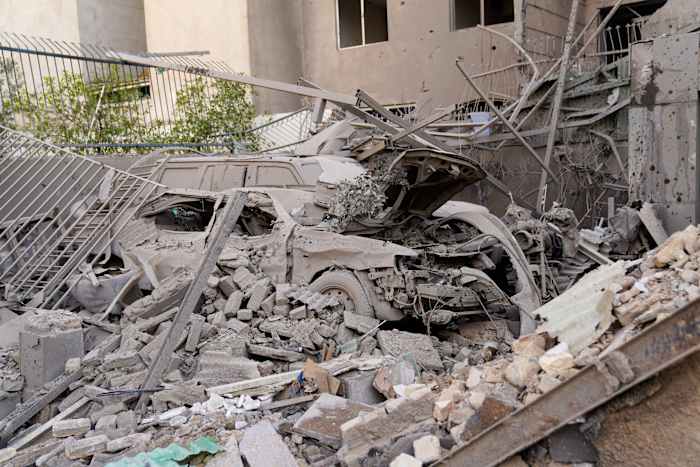
Israelis are professionals at living through high-tension alerts. They know the drill. You hear the siren, you find the stairwell or the reinforced room, you wait ten minutes, and you check the news. It’s a rhythmic, albeit violent, part of life that has shaped the national psyche for decades. But recently, that rhythm broke. The familiar sirens and the predictable cycles of escalation have been replaced by an emergency that feels fundamentally new, leaving even the most battle-hardened citizens questioning if the old rules still apply.
The current atmosphere in Tel Aviv and Jerusalem isn't just about the physical threat of rockets. It's about a collapse of the "normal" emergency. Usually, there's a clear beginning and an end to these flare-ups. You deal with the immediate danger, the Iron Dome intercepts the threat, and you go back to your coffee. Not this time. This isn't just another round of fighting. It's a systemic shift that has stripped away the sense of security that usually buffers daily life in Israel.
The end of the predictable war
For years, the Israeli public operated under a quiet realization. They believed that while their neighbors might be hostile, the "walls"—both physical and technological—would hold. This belief allowed people to build a high-tech economy and a vibrant nightlife just miles from active conflict zones. That wall didn't just crumble physically; it vanished mentally.
When you talk to people on the ground now, they don't mention the sirens first. They mention the silence. It's the silence of empty malls and the eerie quiet of tech hubs that are usually buzzing with energy. The emergency isn't a localized event in the south or the north anymore. It has bled into the very fabric of how the country functions.
The psychological toll is massive. When "emergency" becomes a permanent state rather than a temporary interruption, the human brain stops being able to calibrate risk. You see it in the way people walk down the street—faster, more alert, less likely to linger. The confidence that the state can provide a definitive shield has been replaced by a DIY sense of security.
Why the old playbooks don't work anymore
In previous conflicts, the government and the military had a set script. They communicated clear instructions, set expectations for the duration of the conflict, and managed the economic fallout with standard subsidies. Today, that script looks like it was written for a different country.
The complexity of the current situation involves multiple fronts and a level of internal social friction that didn't exist during previous wars. You're looking at a scenario where the enemy isn't just across a border, but the threat of regional escalation looms so large it paralyzes long-term planning. Businesses can't just "wait it out" because nobody knows what "it" is or when it ends.
- Economic Stagnation: The reserve duty call-ups have pulled a significant portion of the workforce out of the tech sector, the engine of the Israeli economy.
- Social Fragmentation: The political divisions that predated the current emergency haven't disappeared; they've just been pushed under the surface, simmering.
- Global Isolation: Unlike previous eras where international support was a given, the current climate feels lonelier for many Israelis.
This isn't just a military challenge. It’s a test of national endurance. In the past, the collective trauma of war served as a glue. Now, the sheer length and ambiguity of the crisis are acting more like a solvent, slowly wearing down the social contracts that keep the country moving.
The tech sector struggle is a national struggle
If you want to understand why this feels new, look at the offices in Herzliya. Israel's identity is tied to being the "Startup Nation." That brand relies on the idea that no matter what happens, the code gets written and the chips get shipped. "We deliver no matter what" was the unofficial motto.
But when your lead developer is in uniform for six months, and your international investors are getting twitchy about "geopolitical risk," that motto starts to ring hollow. The disruption to the tech ecosystem is a lagging indicator of a much deeper problem. It’s not just about lost revenue. It’s about the loss of the "bubble" that allowed the economy to thrive despite the regional chaos.
The emergency has forced a realization that the economy isn't invincible. The sheer scale of the mobilization has created a labor shortage that hits everything from agriculture to high-end software engineering. This is a structural shock, not a temporary dip.
Living in the gray zone
Most people can handle a crisis if they know there's a light at the end of the tunnel. But what if the tunnel is the new home? That's the question Israelis are grappling with. The current emergency is characterized by its lack of "closure." There are no victory parades on the horizon because the goals are complex and the threats are evolving.
This "gray zone" existence is exhausting. It's the constant checking of Telegram channels for updates that may or may not be true. It's the weight of knowing that the "emergency" might just be the way things are for the foreseeable future.
The traditional resilience of the Israeli public is being stretched to a breaking point. You can only stay "on" for so long before the nervous system starts to fray. We're seeing a rise in demand for mental health services that the country is struggling to meet. It turns out that being "used to war" doesn't actually make you immune to the effects of a prolonged, existential crisis.
What happens when the adrenaline wears off
Adrenaline is a great short-term tool. It gets you through the first few weeks of a crisis. You see incredible acts of volunteerism, people opening their homes, and a massive surge in national unity. But adrenaline is unsustainable.
As the months drag on, the "emergency" becomes mundane. This is the most dangerous phase. When the crisis becomes boring, the cracks start to show. The initial unity begins to give way to old arguments about the draft, the budget, and the direction of the country.
The government's ability to manage this transition is crucial. If the leadership continues to treat this as a standard military event, they'll miss the broader societal shift. This is a moment that requires a new type of domestic policy—one that acknowledges the permanent change in the security landscape while providing a stable framework for daily life.
To navigate this, focus on what you can control. For those living through it, that means building local support networks that don't rely on central government instructions. It means diversifying income streams if possible and being brutally honest about mental health. For those watching from the outside, it means recognizing that the old labels of "conflict" don't capture the reality of a society undergoing a fundamental transformation. This isn't just a war; it's a total recalibration of what it means to live in a state of permanent alert.
Stop waiting for a return to the "normal" of 2022. That version of the country is gone. The path forward requires accepting that the emergency is the environment, and the only way through is to build new structures that can withstand a world where the sirens never truly stop. Keep your go-bag packed, but start planting the garden anyway. Balance the hyper-vigilance with a stubborn insistence on building a future, even if that future looks nothing like what was planned.