Look at your hands. Turn them palms up, then press your palms together. They mirror each other completely. Thumb to thumb, pinky to pinky. Yet, try to slide your left hand directly over your right while facing the same direction. The thumbs refuse to align. One points left, the other points right. They are identical in every physical proportion, yet fundamentally incompatible in orientation.
For decades, chemistry was haunted by this exact geometry.
Nature has a profound, almost obsessive bias. If you look closely at the building blocks of life—the amino acids that construct our proteins and the sugars that form our DNA—you find a strange quirk. They are almost exclusively left-handed. Try to feed a living organism the right-handed twin of these molecules, and the organism will either reject it entirely or find it violently toxic. It is as if the universe decided on a handshake and locked out anyone who tried to offer the wrong hand.
Yet, creating these molecules in a laboratory has always been a bitter struggle. Mix the right ingredients in a flask, and standard chemical reactions spit out a fifty-fifty mixture of both left-handed and right-handed versions. Separating them is agonizingly difficult, expensive, and slow. For generations, chemists felt like blacksmiths trying to forge a watch with a sledgehammer.
Then came Kagan and Soai.
The Mirror Puzzle
Imagine standing in a hall of mirrors. Every movement you make has an instantaneous, flawless counterpart. For the longest time, chemists assumed molecular creation worked the exact same way. If you start with a symmetrical environment, you should end up with a symmetrical result. A racemic mixture—an equal split of left and right—was considered the inevitable tax of creation.
Henri Kagan and Kenso Soai changed that assumption by listening to what molecules were whispering to each other.
In the late twentieth century, Kagan cracked open a door by developing asymmetric catalysis. He used specialized chemical catalysts—tiny molecular matchmakers—to tilt the odds, coaxing a reaction to favor one hand over the other. It was an engineering triumph. But Soai pushed the door off its hinges.
Soai discovered something startlingly close to alchemy. He found a chemical reaction where the product itself acted as a catalyst. Not just any catalyst, but one that amplified tiny, almost imperceptible imbalances. If a reaction started with even a microscopic excess of left-handed molecules, those molecules would encourage the creation of more left-handed molecules. The imbalance snowballed. A whisper became a roar.
This phenomenon, known as asymmetric autocatalysis, wasn't just a clever trick on a lab bench. It offered a tantalizing glimpse into how life itself might have gotten started on a prebiotic Earth. How did a chaotic soup of prebiotic chemicals choose a single handedness? Soai showed that nature didn't need a miracle. It just needed a tiny nudge and a mechanism of amplification.
The Weight of a Single Atom
To understand why this matters, you have to leave the textbook and step into a hospital room.
Medicines are three-dimensional shapes. They are keys meant to turn specific locks inside the human body—receptors, enzymes, cellular gates. If a pharmaceutical drug is a fifty-fifty mix of left-handed and right-handed molecules, one half might cure your illness while the other half binds to a different receptor and causes catastrophic side effects.
History taught us this lesson with brutal clarity. Decades ago, a drug given to pregnant women to combat morning sickness carried both molecular hands. One hand eased the nausea. The other hand inflicted devastating birth defects across an entire generation. The tragedy wasn't caused by a toxic chemical dropped into the mix from the outside; it was caused by the wrong mirror image of a molecule that was otherwise chemically identical.
Ever since, the pharmaceutical industry has treated molecular handedness with absolute reverence. To synthesize pure left-handed or pure right-handed drugs reliably means safer treatments, fewer side effects, and therapies that target diseases with the surgical precision of a laser rather than the blunt force of a hammer.
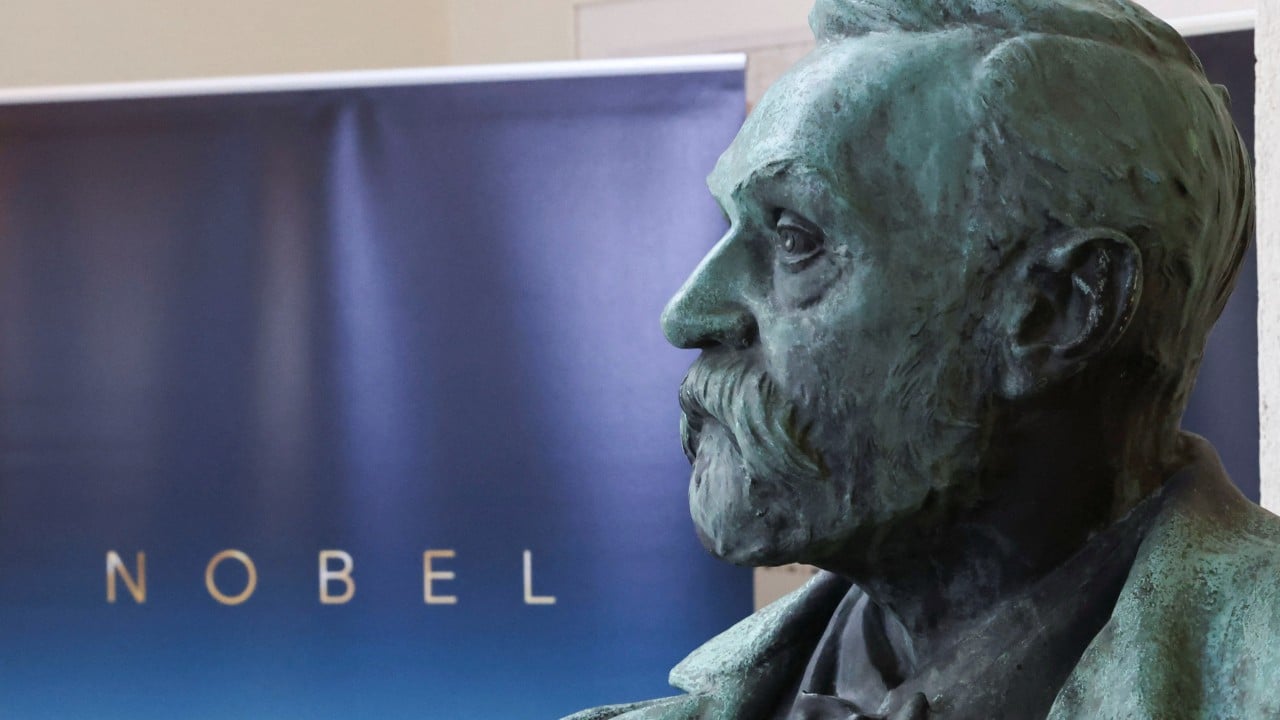
When the Nobel Prize committee turned their gaze toward Kagan and Soai, they were not merely honoring two clever chemists who mixed liquids in glass flasks. They were honoring the architects who mapped the handedness of reality. They gave humanity a way to speak the native language of biology.
The Unfinished Symmetry
We live in a universe that appears balanced on a cosmic scale, yet hides its deepest secrets in asymmetrical corners. Galaxies spin in preferred directions. Subatomic particles violate parity. And within our own veins, proteins fold in precise, left-handed twists that make consciousness possible.
The work of Kagan and Soai reminds us that small differences matter. A tiny imbalance at the beginning of a reaction—or the beginning of time—does not wash away in the noise of chaos. It compounds. It grows. It defines what lives, what thrives, and what heals.
Science often feels cold when read off a slide deck or a press release. It sounds like jargon, acronyms, and committee citations. But strip away the nomenclature, and you find a story of human curiosity chipping away at the walls of the impossible. We looked at the mirror, terrified of the reflection we could not control. Now, we hold the glass.