The air inside the arena hums with a specific kind of electricity, that low, vibrating bass that settles in your chest cavity long before the first note drops. Thousands of flashbulbs strobe against the dark like distant summer lightning. Millions more watch through glowing rectangles across the globe, their thumbs hovering over screens.
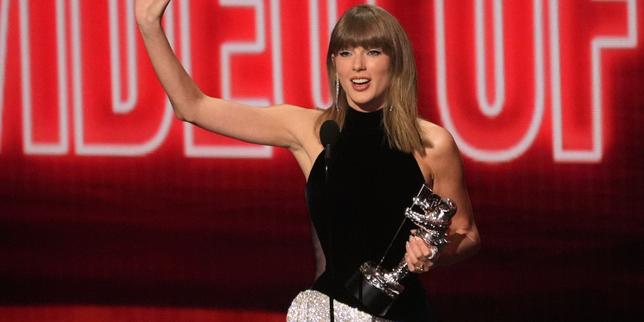
At the center of it all stands Taylor Swift.
She holds the heavy, iconic moon man trophy. It represents the Video of the Year at the MTV Video Music Awards, a pinnacle of modern pop dominance. The cameras zoom in, catching the sheen of sweat on her collarbone, the glint of sequins, the unmistakable flush of adrenaline. The audience expects the usual script. A quick nod to the label, a shoutout to the fans, a hair flip, and an exit into the flashing pandemonium.
Instead, she stops. Her fingers tighten around the silver handle.
"If you want to understand where we are right now," she begins, her voice dropping from its performance pitch into something conversational, almost confessional, "you have to look at the people who built the road we're walking on."
She doesn't talk about chart positions or streaming numbers. She talks about Dolly Parton.
It is a sudden, arresting pivot. In an industry obsessed with the next nanosecond, the fresh face, the reinvention of the wheel, Swift reaches backward. She invokes a woman from Sevier County, Tennessee, who wrote songs on a cardboard guitar and survived Nashville when Nashville was a boys' club built of brick walls and closed doors.
Consider what happens next. The arena noise shifts. For a fraction of a second, the pop-culture machinery pauses.
We live in a culture that treats history like discarded wrapping paper. Every year demands a new icon, a fresh coronation, an immediate dethroning. Youth is currency. Relevance is a ticking clock. Yet here is one of the biggest pop stars on the planet, standing at the absolute summit of contemporary commercial success, using her loudest microphone to shine a light backward.
Why? Because true creators recognize lineage.
Long before stadium tours grossed hundreds of millions, long before social media algorithms dictated who stayed viral, Dolly Parton was sitting on a floor writing "I Will Always Love You" on one side of a yellow legal pad and "Jolene" on the other. She owned her publishing when everyone told her songs were just disposable products. She wore rhinestones like armor and built an empire out of self-deprecation and ironclad business sense. She proved that you could be sweet as mountain clover and sharp as a razor blade at the same time.
When Swift dedicates her trophy to Dolly, she is doing something radical. She is acknowledging that artistic survival isn't a solo sprint. It is a relay race through decades.
Imagine standing backstage at an arena tour, staring down the barrel of a hundred sold-out dates, feeling the crushing weight of a culture that dissects your every word, outfit, and relationship. The isolation is real. The noise is deafening. In those moments, you look for anchors. You look for the women who walked into rooms where they weren't wanted and refused to leave until they owned the furniture.
Dolly Parton is that anchor for generations of songwriters. She took the ridicule—the cheap jokes about her appearance, the dismissive reduction of her intellect—and weaponized it into a multi-decade career of unprecedented longevity. She never apologized for loving glitz, and she never apologized for being a lyrical genius.
When Swift speaks her name on that MTV stage, the gesture bridges a chasm between generations of female artists. It says: We are not separate acts in a fleeting show. We are part of the same continuous line.
The modern music landscape moves at breakneck speed. Artists are pressured to reinvent themselves every eighteen months, to flood TikTok feeds, to treat their art like content. In that environment, looking backward feels like an act of rebellion. It demands slowing down long enough to remember that the song you wrote today exists only because someone fifty years ago took a beating so you could have a voice.
Swift's dedication wasn't just a polite nod to a country music icon. It was a masterclass in perspective. It reminded millions of viewers that greatness isn't born in a vacuum. It is forged in the quiet rooms where someone sits alone with an instrument, wrestling with heartbreak, trying to make sense of the human condition.
The heavy silver trophy eventually went home to a shelf. The cameras turned off. The arena emptied out, leaving behind only discarded paper cups and the faint smell of ozone and spilled soda.
But the echo remained.
Out there tonight, somewhere in a cramped bedroom lit only by the blue glow of a laptop screen, a young girl is strumming a cheap guitar, wrestling with words that don't quite rhyme yet. She heard those words on stage. She saw one titan salute another across the vast expanse of time and genre.
She picks up her pen again. And the song goes on.