Everyone thought the Black Sea was the absolute limit of Ukraine's unmanned naval reach. They were wrong.
When footage surfaced showing Ukrainian sea drones operating off the coast of Libya, targeting Russian naval assets thousands of miles away from Odesa, naval strategists had to throw out their old range maps. You don't just accidentally pilot an uncrewed surface vessel across the Bosphorus, through the Aegean, and straight into the central Mediterranean. That kind of operation takes serious planning, satellite relays, and a complete rethinking of where a fleet is actually safe.
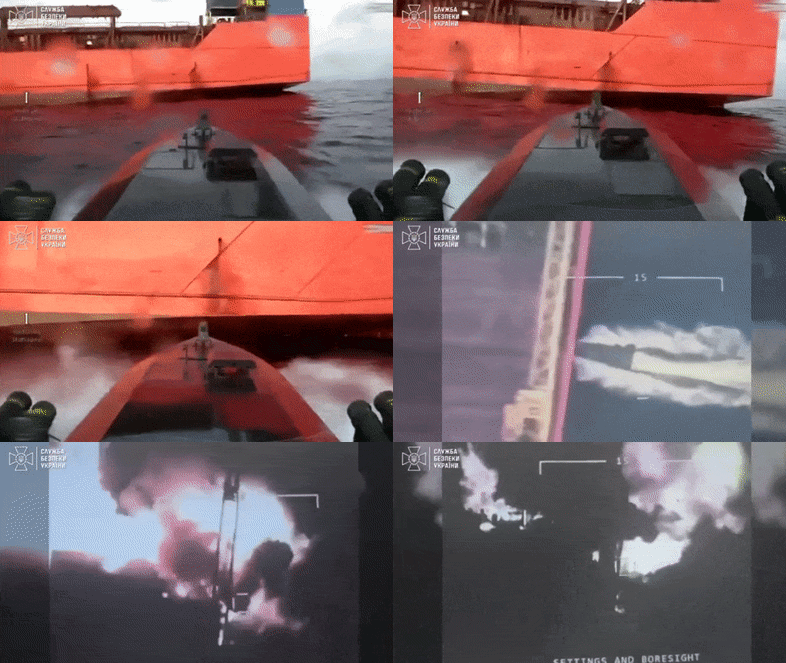
Let's be honest about what happened here. A multi-million-dollar Russian warship—built for blue-water projection and loaded with defensive sensors—got hunted down by low-profile fiberglass hulls packed with explosives. And the whole thing was caught on high-definition video.
How Ukraine Took Sea Drones Out of the Black Sea
For over two years, the world watched Ukraine's Main Directorate of Intelligence (HUR) and the Security Service of Ukraine (SBU) systematically dismantle Russia's Black Sea Fleet using Magura V5 and Sea Baby drones. Analysts kept saying the same thing. They argued these boats only worked because the Black Sea is a closed, relatively small body of water where Starlink coverage was reliable and launch points were close.
The Libya strike shattered that assumption completely.
Operating near the Libyan coast—specifically around areas like Tobruk, where Russia has been trying to establish a permanent Mediterranean logistics hub—changes the math entirely. You can't rely on coastal radio links at that distance. To pull this off, the operators needed either a forward-deployed mothership, covert launch teams operating from friendly or porous coastlines, or multi-hop satellite communications capable of bypassing localized electronic warfare.
Think about the logistics for a second.
A standard Magura V5 has an operational range of roughly 800 kilometers (about 500 miles). The straight-line distance from Ukrainian-controlled ports to the Libyan coast is well over 2,000 kilometers, not counting the winding path through the Turkish Straits and Greek islands. Even if you strip out warhead weight for extra fuel bladders, a solo transit from Ukraine to North Africa pushes the physics of a 5.5-meter hull to the absolute breaking point.
That leaves two very uncomfortable possibilities for Moscow. Either Ukraine has developed a much larger, long-endurance autonomous surface vessel capable of multi-day open-ocean transits, or Ukrainian special operations teams are launching these drones from commercial vessels or staging areas right inside the Mediterranean basin. Honestly, both scenarios are a nightmare for Russian naval planners.
Why Russian Air Defenses Keep Missing Low-Profile Targets
You might wonder how a modern warship with radar, thermal cameras, and deck guns fails to stop a boat skimming the surface at 40 knots. It comes down to basic physics and terrible sensor geometry.
Naval radars are designed to look up and out. They're built to spot supersonic anti-ship missiles skimming 15 feet above the waves or fighter jets dropping in from high altitude. A sea drone sits almost flush with the waterline. On a standard marine radar screen, a 5-meter composite hull looks identical to a whitecap wave or a piece of floating debris.
When the sea state gets even slightly choppy, radar clutter drowns out the target completely. By the time a lookout spots the wake visually or picks up the engine heat on an infrared camera, the drone is already inside the ship's minimum engagement envelope.
The video from the Libya operation shows this exact failure mode playing out in real time. You see the frantic tracer fire hitting the water behind and beside the incoming drone. Heavy machine guns mounted on ship rails aren't stabilized for tracking small, erratic targets weaving at high speed just meters from the hull. Crew members end up firing manually with assault rifles and heavy deck guns, which almost never works under pressure at night.
The Strategic Mess in the Mediterranean
Russia doesn't have the luxury of replacing ships in the Mediterranean right now. Under the Montreux Convention, Turkey closed the Bosphorus and Dardanelles straits to belligerent warships back in February 2022. That means every Russian vessel currently sitting in the Mediterranean is trapped there until the war ends.
They can't sail back to Sevastopol or Novorossiysk for major dry-dock repairs. And Moscow can't send fresh destroyers or frigates down from the Baltic or Northern fleets without telegraphing every move to NATO surveillance aircraft weeks in advance.
When a Russian warship gets hit or sunk off Libya, that hull is gone from the theater permanently.
It also blows a massive hole in Russia's broader geopolitical push in Africa. Moscow has spent years cultivating ties with Khalifa Haftar's Libyan National Army, angling for warm-water port access in Tobruk to replace or supplement its aging facility in Tartus, Syria. Those ports are the logistical lifeline for Russia's Africa Corps operations across Mali, Burkina Faso, and the Central African Republic.
If Ukrainian drones can turn the Libyan coastline into a shooting gallery, Russia's entire Mediterranean supply chain becomes indefensible. Commercial cargo ships hauling weapons and mercenaries suddenly need armed escorts—escorts that are now prime targets themselves.
What Most Military Analysts Get Wrong About Drone Swarms
Whenever a video like this goes viral, commentators immediately jump to the idea that traditional navies are obsolete. That's a lazy take. Aircraft carriers and destroyers aren't going away tomorrow, and pretending a $250,000 remote-controlled boat makes a $2 billion frigate useless misses the real lesson.
Sea drones don't hold territory. They don't project air superiority, they can't blockade a coastline against determined air power, and they struggle badly in heavy winter storms. What they do is create a devastating asymmetric denial zone.
The real shift isn't that big ships are dead—it's that big ships can no longer operate casually near contested or unmonitored coastlines without layered, automated close-in defenses.
If you look at how Western navies are responding to the Red Sea crisis and the Black Sea drone campaign, they aren't scrapping their destroyers. They're bolting on high-energy lasers, upgrading electro-optical tracking systems, and integrating AI-assisted autocannons that can calculate lead angles on surface skimmers faster than a human gunner ever could. Russia's problem isn't just the drones; it's that their older Soviet-era hulls and even newer corvettes lack modern automated close-in weapon systems capable of engaging multiple surface targets simultaneously.
The New Playbook for Asymmetric Maritime Strikes
Watching the footage from Libya, a clear operational doctrine emerges—one that any coastal nation or non-state actor is currently studying closely.
1. Multi-Axis Saturation Over Single Strikes
Notice how these videos rarely show just one boat. Operators send in a lead drone to draw fire and force the ship's crew to panic and burn ammunition on one side of the hull. Seconds later, two or three more drones come in from the blind quarter, targeting the rudder, propellers, or waterline amidships where a hull breach causes uncontrollable flooding.
2. Weaponizing the Footage Immediately
The camera feed isn't just for steering. Publishing high-definition impact footage within hours of a strike serves a direct military purpose. It forces the enemy to divert resources into port security, slows down naval deployments, and creates psychological exhaustion among sailors who know they can be hit even thousands of miles from the active front line.
3. Exploiting Commercial Maritime Traffic
Busy shipping lanes are the ultimate camouflage for uncrewed vessels. The central Mediterranean is packed with tankers, container ships, and fishing trawlers. A low-profile drone shadowing a commercial freighter's radar signature can close dozens of miles undetected before breaking off for its final sprint.
What Happens Next for Naval Security
You don't need to be an admiral to see where this is heading. The boundary between a "safe rear area" and an "active combat zone" has completely evaporated at sea.
For naval commanders, port authorities, and maritime security firms, the takeaways from the Libya strike are immediate and non-negotiable:
- Stop relying on traditional air-search radar for surface threats. Any vessel operating within 500 miles of a potential launch corridor needs dedicated, high-frequency surface-search radar paired with 360-degree thermal imaging.
- Automate close-range kinetic defenses. Human gunners with pintle-mounted machine guns cannot reliably hit a 40-knot target bouncing across three-foot swells. Remote weapon stations with optical auto-tracking are now mandatory baseline gear.
- Audit port perimeters and commercial anchorages. If Ukrainian operators proved anything in the Mediterranean, it's that threats don't have to come from an enemy's home port. Unmonitored stretches of coastline and civilian marinas are now viable launch points for strategic strikes.
- Deploy physical barriers early. Boom nets, floating barges, and acoustic sensors at harbor entrances remain the cheapest, most effective way to stop surface drones before they reach high-value hulls at anchor.
Russia's navy learned the hard way in the Black Sea that ignoring small, cheap threats costs flagship vessels. Getting hit off Libya proves they still haven't figured out how to adapt—and that nowhere within reach of open water is truly out of bounds anymore.