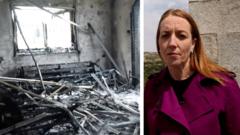
Imagine sitting in your living room when a stone shatters the window. You don't call the police because, in the West Bank, the police often stand by and watch. This isn't a scene from a movie. It’s the daily reality for Palestinian families living in "Area C," the 60% of the West Bank under full Israeli military control. When we talk about the Israeli-Palestinian conflict, we often focus on grand political gestures or large-scale military operations. We miss the quiet, terrifying erosion of safety inside a family's kitchen or bedroom.
The footage coming out of places like Burin, Huwara, and the South Hebron Hills isn't just about property damage. It's about the psychological warfare of displacement. You see charred sofas, smashed television sets, and children who sleep in their clothes so they can run faster if a firebomb hits the roof. These attacks by Israeli settlers have spiked to record levels since late 2023. According to data from the United Nations Office for the Coordination of Humanitarian Affairs (OCHA), settler-related violence now occurs at an average of four incidents per day.
This isn't just "friction" between neighbors. It’s a systemic push to make life so unbearable that Palestinians simply leave.
The Architecture of Fear in the West Bank
Walking into a home that has been targeted by settlers feels different than visiting a standard war zone. There is a specific kind of intimacy to the destruction. You might see a child's notebook soaked in water from a sliced tank or a grandmother’s olive grove hacked to stumps. These aren't random acts of rage. They are surgical strikes against the means of survival.
In many Palestinian villages, the homes are literally surrounded. Illegal outposts—often just a few mobile homes on a hilltop—eventually grow into sprawling suburbs. As they grow, the "buffer zones" expand. Suddenly, a Palestinian farmer needs a military permit to enter his own backyard. If he goes without one, he risks being beaten. If he stays inside, he’s a sitting duck for "price tag" attacks.
These attacks often involve graffiti sprayed on bedroom walls. You’ll see "Death to Arabs" or "Revenge" scrawled in Hebrew right next to a family photo. It’s meant to tell the inhabitants that they aren't even safe in their sleep.
Why the Domestic Front Matters More Than the Front Line
Most international news focuses on Gaza, and for obvious reasons. But the West Bank is where the long-term map of a future state is being erased house by house. When a settler group enters a home, they aren't always looking to kill. Often, they want to occupy. We’ve seen viral videos of settlers sitting on a family’s couch, claiming the house belongs to them by divine right.
The legal gymnastics used to justify this are mind-boggling. Under a mix of Ottoman-era land laws and modern Israeli military orders, land can be declared "State Land" if it hasn't been cultivated for a few years. So, settlers prevent farmers from reaching their fields. The land goes fallow. The state seizes it. The settlers move in. It’s a slow-motion heist.
If you’re living in one of these homes, your existence becomes an act of "sumud"—steadfastness. You don't move. You fix the window for the tenth time. You buy a heavier door. You teach your kids which corner of the house is the safest from Molotov cocktails.
The Myth of Equal Protection
The biggest misconception people have about these attacks is that there’s a functional justice system to stop them. There isn't. Not for Palestinians.
Israeli human rights organization Yesh Din has tracked these cases for years. Their data is depressing. Only about 3% of police investigations into settler violence lead to a conviction. If a Palestinian throws a stone, they face a military court with a 99% conviction rate. If a settler opens fire on a Palestinian home, the case is almost always closed for "lack of evidence," even when there is video.
This creates a culture of total impunity. Settlers often mask their faces, but sometimes they don't even bother. They know the soldiers standing twenty yards away won't intervene. In fact, many soldiers are also settlers themselves, or they've been ordered only to protect Israeli citizens, not the "protected persons" under occupation as required by international law.
Living in a Cage of Cameras and Bars
To survive, Palestinian homes in high-friction areas have transformed. They look like mini-fortresses. You’ll see heavy steel mesh over every window to catch stones and firebombs before they hit the glass. You’ll see sophisticated CCTV setups paid for by NGOs because the footage is the only thing that might—might—get an international diplomat to pay attention.
But cameras don't stop the nightly raids. They don't stop the sound of boots on the roof. I've talked to parents who describe the "silent scream" of their kids—children who have stopped speaking entirely because the trauma of seeing their father humiliated in his own hallway is too much to process.
The economic toll is just as heavy. When a family’s water tanks are shot out—a common tactic—they have to buy expensive trucked water. When their solar panels are smashed, they sit in the dark. It’s a war of attrition designed to drain a family's bank account and their spirit at the same time.
What You Can Actually Do
Watching a video of a home invasion is gut-wrenching, but it usually ends with a "share" button and a sense of helplessness. If you actually want to impact the situation, you have to look at the mechanics of the occupation.
First, support organizations that provide legal aid to these families. Groups like B'Tselem and HaMoked do the thankless work of documenting every single smashed window and filing every hopeless lawsuit. They create the paper trail that prevents the world from saying "we didn't know."
Second, pay attention to where the money goes. Many settler organizations receive tax-exempt donations from the United States and Europe. If you're a taxpayer in a country that funds these outposts through charitable loopholes, that’s your leverage. Pressure representatives to enforce existing laws that prohibit funding activities that violate international law.
Finally, don't look away when the news cycle shifts. The "quiet" periods in the West Bank are often the loudest for the families living in the crosshairs. A house is supposed to be a sanctuary. For thousands of Palestinians, it’s just the front line of a battle they never asked to fight.
Check the reports from the OCHA Protection of Civilians database. It's updated weekly. Read the names of the villages. Know that behind every statistic about "property damage" is a family wondering if tonight is the night the roof catches fire.