The soccer world is obsessed with an ending that hasn't happened yet. Every time Lionel Messi speaks to an interviewer, headline writers scramble. They hunt for clues about his final whistle. They parse every word for signs of despair, fatigue, or closure.
Stop falling for it.
Messi isn't winding down because he's lost his magic. He's simply navigating the rare luxury of a sunset he built with his own two feet. We've spent two decades watching a master bend physics on a pitch. Now, we're projecting our own anxiety about sports without him onto a man who just wants to kick a ball in peace. Let's look at what is actually happening as the greatest career of our era approaches its final chapter.
The Weight of the Final Countdown
You can't talk about Messi and retirement without looking at the psychological shift. For twenty years, his life was governed by a brutal calendar. Barcelona, Paris Saint-Germain, the Argentine national team, Champions League matches every Tuesday, domestic fixtures every weekend. There was no room to breathe.
Now, the rhythm is different. Miami brought a slower tempo, sure, but it brought a new kind of spotlight. Every stadium fills to capacity just to catch a glimpse of him stretching. Opposing players still treat his jersey like holy relics at the final whistle.
He told Argentine media recently that he knows the end is close simply because of his age. That's not a revelation. That's basic biology. But acknowledging time isn't the same as surrendering to it. When you watch him orchestrate an attack for Inter Miami or pick out a ridiculous blind pass for Argentina, you see a player who has traded raw explosive speed for absolute spatial awareness. He doesn't need to run past three defenders anymore. He just lets the ball do the heavy lifting.
What the Numbers Actually Tell Us
People love to claim that modern superstars stay too long at the party. They point to fading legends who limped through their final seasons, a shadow of their former glory.
Messi's data tells a completely different story.
Look at his production since moving to Major League Soccer and his continued dominance in South American World Cup qualifiers. The output hasn't plummeted into irrelevance. He isn't putting up pedestrian numbers. He's still deciding matches on a whim.
- Goal contributions remain absurdly high relative to minutes played.
- His tactical positioning has shifted deeper, effectively turning him into a quarterback for the attack.
- Injury management has become his primary full-time job.
This isn't a player hanging on by a thread. This is an artist carefully curating his remaining exhibitions. He misses matches now because he's smart. He skips turf fields and minor friendlies because his body demands maintenance. That isn't weakness. That's elite self-awareness earned through thousands of bruised shins and tactical fouls.
The Argentina Factor
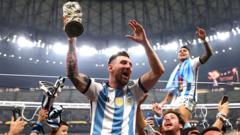
The 2022 World Cup in Qatar was supposed to be the grand finale. The script was written. He lifted the trophy, wiped away years of national heartbreak, and completed football.
Logic dictated he should have walked away right there on the Lusail turf, confetti sticking to his sweat.
Instead, he kept playing. Why? Because the burden was gone. For most of his career, playing for Argentina meant carrying the collective neurosis of a football-obsessed nation. Every loss was treated as a personal failure. Every Copa América miss was a national tragedy.
Winning that gold changed the emotional math. He plays for the Albiceleste now because he genuinely loves the group dynamics, the coaching staff, and the sheer joy of pulling on the stripes without a guillotine hanging over his neck. When he hints at the 2026 World Cup, fans panic. Can he do it? Should he do it?
The better question is why we refuse to let him make his own timeline. If he wants to play until his legs give out on a Tuesday night in Buenos Aires, let him. He earned that autonomy.
Navigating Life After the Cleats Come Off
Athletes talk about the abyss. The silence that follows the roar of ninety thousand people screaming your name. Most players struggle mightily with the transition because sports are the only identity they've ever known.
Messi has spent his entire life inside a bubble. Training ground, hotel room, stadium, repeat. Yet, early signs suggest his post-playing life might look slightly different from the traditional punditry route. He owns properties in Miami and Barcelona. He has deep investments in lifestyle brands and tech. More importantly, he's a remarkably private family man who values simple routines—drinking mate in the backyard, watching his sons play in academy matches, and staying entirely away from the toxic circus of club administration.
He won't be a screaming head on television. He won't write a bitter autobiography settling scores with former managers. He will likely step away from the cameras for a long, quiet stretch.
Moving Past the Obsession
We need to change how we talk about his final years. Stop treating every missed match as an omen. Stop looking for tragedy where there is only transition.
Greatness doesn't expire overnight. It morphs, it slows down, and eventually, it becomes a memory we argue about in pubs and on internet forums.
Enjoy the touches while they last. Watch how he scans the pitch before the ball even arrives at his feet. Notice the subtle drop of the shoulder that still freezes elite defenders in their tracks. That is the masterclass happening right in front of us, and no amount of retirement speculation can diminish it.
Watch the games. Appreciate the craft. Let the man finish his coffee.