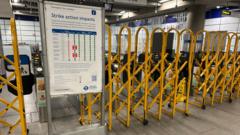
The standard narrative surrounding London Underground strikes is a tired script. On one side, you have the "greedy unions" holding the city to ransom; on the other, the "draconian management" slashing jobs and safety. Commuters are cast as the perpetual victims, caught in a crossfire of press releases and picket lines. This binary view is not just lazy—it is fundamentally wrong.
The strikes are not the problem. They are a symptom of a city desperately clinging to a 20th-century labor model while the rest of the world moves on. We shouldn't be asking when the next strike will end. We should be asking why we still have human beings sitting in driver cabs at all.
The Automation Taboo
Every time a strike hits, the conversation pivots to pay ratios and pension pots. This is a distraction. The real elephant in the tunnel is the Victoria Line. Since the 1960s, the Victoria Line has been "Automatic Train Operation" (ATO). The driver is there primarily to open and close doors and provide a sense of psychological comfort to a public that hasn't quite accepted that a computer is better at maintaining headway than a human.
London is currently lagging behind Paris, Copenhagen, and Singapore. In those cities, Grade of Automation 4 (GoA4) is standard for new builds. No driver. No cab. No strike-induced paralysis.
The "lazy consensus" suggests that automating the legacy lines of the London Underground is "too expensive" or "technically impossible." This is a convenient lie used by both Transport for London (TfL) and the unions to maintain a status quo that suits their respective budgets and membership numbers.
The Cost of Cowardice
Let’s talk about the real numbers. Every strike day costs the London economy roughly £50 million. If you aggregate the losses from the last decade of industrial action, you aren't just looking at a few lost workdays; you are looking at the budget for a significant portion of the signalling upgrades required for full automation.
By refusing to commit to a driverless future, the government is essentially paying a "strike tax" in perpetuity. I have watched city planners waste millions on "mitigation strategies" for strike days—extra buses, signage, temporary staff—money that is effectively burned to keep a failing system on life support.
The Safety Myth
Unions frequently cite "passenger safety" as the primary reason for resisting the removal of staff from trains. It is a powerful emotional hook, but the data does not support it.
The vast majority of operational incidents on the London Underground are the result of human error—fatigue, missed signals, or delayed reaction times. Computer systems don't get tired. They don't have bad days. They don't get distracted by a phone notification.
When we look at GoA4 systems globally, the safety records are impeccable. The Docklands Light Railway (DLR) has been operating without traditional drivers since 1987. Does it feel unsafe? No. It feels efficient. The "safety" argument is a shield for job protectionism, nothing more.
Why the Commuter is Part of the Problem
You are not a victim. If you rely on a single, fragile point of failure for your livelihood, you have failed at risk management.
The "People Also Ask" sections of the internet are filled with questions like "How do I get to work during a Tube strike?" The answer is brutally simple: you don't. Or you walk. Or you cycle. But the fact that the question exists proves that Londoners have developed a toxic dependency on a system they know is unreliable.
The persistent outrage from the public actually fuels the power of the unions. The more you scream on social media about your ruined commute, the more leverage the RMT or ASLEF has at the negotiating table. Your anger is their greatest asset.
The Pension Trap
The current dispute often centers on the TfL pension scheme. It is a gold-plated relic in an era of defined contribution austerity. Critics call it unsustainable; unions call it a right.
Here is the truth: it is unsustainable, but only because the productivity of the workforce hasn't scaled with the cost of the benefits. In any other industry, if you wanted to maintain a 1970s pension plan, you would have to deliver 21st-century efficiency. On the Underground, we are paying 21st-century wages for 20th-century roles.
We are essentially subsidizing a museum of labor relations.
Stop Negotiating, Start Rebuilding
The endless cycle of "talks at ACAS" is a performance. It's theater designed to make it look like progress is being made when, in reality, both sides are just waiting for the other to blink.
A truly contrarian approach would be to stop the negotiations entirely. Divert the proposed pay increases into a dedicated "Automation Transition Fund." This fund would do two things:
- Pay for the immediate retrofitting of the Jubilee and Northern lines for GoA4.
- Provide massive, 10-year severance packages or retraining grants for any driver displaced by the technology.
This is the nuance the "greedy union" vs. "mean management" debate misses. You can be pro-worker and pro-automation at the same time. Giving a driver a £60,000 salary to sit in a dark tunnel is not "supporting the working class." It is a waste of human potential.
The Real Risks
If London follows this path, there will be pain. The transition period would see the mother of all strikes. The city might grind to a halt for a month. That is the downside no one wants to admit.
But a month of pain is better than a century of stagnation.
We are currently choosing a slow death by a thousand cuts. Every few months, a new strike, a new round of "urgent talks," a new 4.5% pay rise that solves nothing. It is a loop of mediocrity that keeps London from being a truly global city.
The Myth of the "Essential" Staff
We are told that station staff are essential for "crowd control" and "customer assistance." Yet, during strike days, many stations remain open with skeleton crews or automated barriers, and the world doesn't end.
The reality is that most "assistance" required by passengers today is handled by the supercomputer in their pocket. We don't need a person in a booth to tell us which platform the Piccadilly Line is on. We need a system that works so well that we don't have to ask questions in the first place.
Stop Asking for Peace
Peace in our time on the London Underground is a pipe dream. As long as there is a human hand on the throttle, there is a hand on the throat of the city's economy.
The goal shouldn't be to "end the strikes." The goal should be to make the strikes irrelevant. When the trains move regardless of who is standing on a picket line at Euston, the power dynamic shifts from the few to the many.
Londoners like to think of themselves as resilient and forward-thinking. It’s time to prove it. Stop complaining about the delays and start demanding the removal of the human element that causes them.
The next time you see a "Tube Strike: What You Need To Know" headline, remember that you already know the answer. The system is broken because it is built on the fallacy that we still need 19th-century labor structures to move people through 21st-century tunnels.
Stop fixing the strike. Fix the technology.