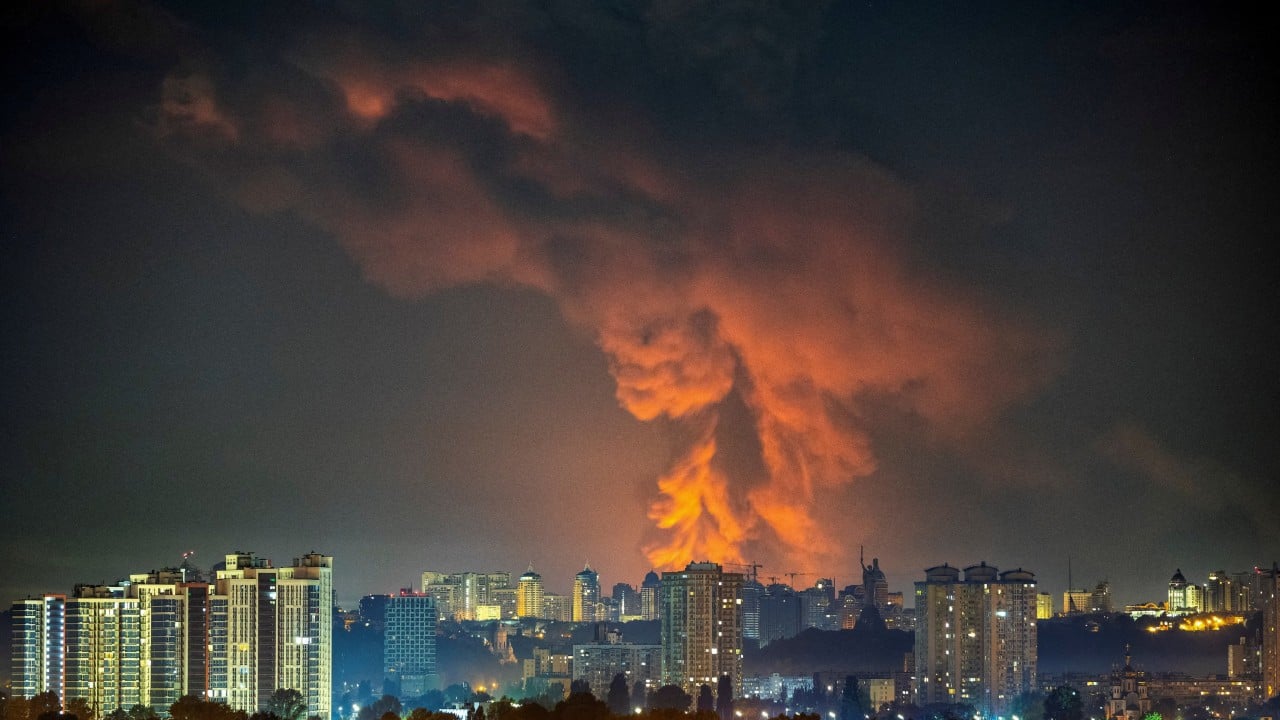
The headlines from the Kyiv region read like a broken record of panic. Fifteen dead. Strikes expanding. A long-range war accelerating into a new, terrifying phase. The mainstream media treats every drone swarm and missile barrage as an escalation, a sudden pivot into uncharted brutality.
They are wrong.
Dead wrong.
What we are witnessing is not an escalation. It is a contraction. It is the logical, mathematically predictable noise of a strategy hitting diminishing returns. When a combatant relies on escalating theater at the periphery, it means their core thesis has already failed.
I have watched strategists misread attrition models for two decades. They look at a smoking crater in a residential district and see unstoppable momentum. I see desperation constrained by geography.
Let us dismantle the lazy consensus piece by piece.
The Myth of the Expanding Battlefield
The conventional narrative insists that long-range strikes represent an ever-widening circle of destruction. Every time a missile hits a substation or an apartment complex outside the immediate theater of contact, analysts scream about a spreading fire.
The mechanics of modern aerospace economics tell a very different story.
High-precision, long-range munitions are finite. They are luxury items in a war of mass. When an inventory shrinks, usage patterns do not expand; they concentrate. They target fixed infrastructure not because it opens up new strategic horizons, but because the kinetic options have narrowed down to static targets.
Imagine a scenario where a retail chain is bleeding cash at its flagships and starts aggressively slashing local delivery radiuses just to keep the warehouses lit. You would not call that an expansion of their market. You would call it triage.
Yet, when military forces do the exact same thing with ballistic assets, the press calls it an expanding war.
It is not expanding. It is contracting into a war of attrition where both sides are simply waiting for the other's economic oxygen to run out. The strikes on the Kyiv region are loud, lethal, and tragic, but strategically, they are the equivalent of a fighter throwing wild, exhausted haymakers in the twelfth round because his legs are gone.
The Precision Fallacy
We need to talk about accuracy, or more specifically, the fetishization of it.
Every time civilian casualties spike, social media fills with shock over how a precision weapon missed its mark or why a civilian zone was targeted. The public operates under a comforting delusion that modern missiles possess a conscience, that they can thread needles in a hurricane.
Military history teaches a harsher lesson. Precision guidance systems degrade under electronic countermeasures. Guidance packages drift. When air defense networks intercept a projectile, the resulting debris field does not care about residential zoning laws. It falls where physics dictates.
To call a strike on a civilian neighborhood an intentional expansion of terror ignores the chaotic reality of terminal ballistics. It makes for good television, but terrible analysis.
The authorities want you to believe that every coordinate is chosen with cold, sadistic intent. The reality is far more mundane and cynical. It is a calculus of acceptable collateral damage filtered through degrading technology and panicked operators. When accuracy degrades, the blast radius becomes the strategy.
The Attrition Trap
People ask: How long can this long-range war continue to escalate?
That is the wrong question.
The right question is: Who absorbs the systemic shock of economic exhaustion first?
A long-range strike campaign is a giant furnace. It burns currency, rare earth metals, and political goodwill at an astronomical rate. Every time a salvo is launched, the nation launching it is trading tomorrow's industrial capacity for today's headlines.
The consensus view treats the aggressor's stockpiles as bottomless and their resolve as absolute. This ignores every historical precedent of industrial-scale conflict. No state can indefinitely out-produce the economic drag of isolation and hyper-inflation fueled by military over-extension.
Look at the data from past campaigns involving sustained missile warfare. The inflection point never arrives with a dramatic collapse on the front lines. It arrives quietly, in ledger books, when the cost per successful strike outweighs the strategic value of the target by a factor of ten.
The Uncomfortable Truth About Defense Economics
Air defense systems are bankrupting the defenders faster than offensive strikes are breaking them.
This is the dirty secret defense analysts whisper behind closed doors. When you fire a multi-million-dollar interceptor at an incoming asset that cost a fraction of that to manufacture, you are losing the financial war even when you win the tactical engagement.
The expanding long-range war is, at its core, a financial exhaustion scam.
The strategy relies on forcing the defender to spend disproportionate capital on defense architecture until their treasury or their patron's patience runs out. Kyiv and its surrounding regions bear the physical scars, but the balance sheet war is being fought in central banks and legislative budget committees thousands of miles away.
Ignoring this financial reality is why mainstream predictions about timelines and outcomes are consistently off by orders of magnitude.
What Actually Happens Next
Stop looking at the smoke in the skyline for answers. Look at the supply chains. Look at the manufacturing output of specialized microchips. Look at the debt-to-GDP ratios of the nations footing the bill.
The kinetic phase of these strikes will continue precisely as long as the logistics hold out—not a day more, not a day less. When the inventory curves cross the financial sustainability thresholds, the long-range war will not fade out through a diplomatic breakthrough. It will simply collapse under its own crushing weight, starved of the very resources that brought it to our screens in the first place.
The next time a headline screams about an expanding war, remember what is actually shrinking.
Options. Time. Money.
The noise is getting louder because the room is getting smaller.