The humidity in São Paulo hangs thick enough to taste, clinging to the skin like an unwanted memory. On the avenue, the sea of red collides with the wall of yellow and green. It is October, and Brazil is holding its breath.
To understand what happened when the first-round ballots were counted, you have to look past the cold arithmetic of the Superior Electoral Court. You have to look at Nuno, a 63-year-old architect and writer who walked into his polling station with a heavy heart, convinced that the choice before him was not merely political, but existential. On the other side of the boulevard stands Aparecida, a lawyer who looks at the same country, the same rising crime rates, and sees only one remedy: an iron fist, a restoration of order. Two Brazilians. Two irreconcilable futures.
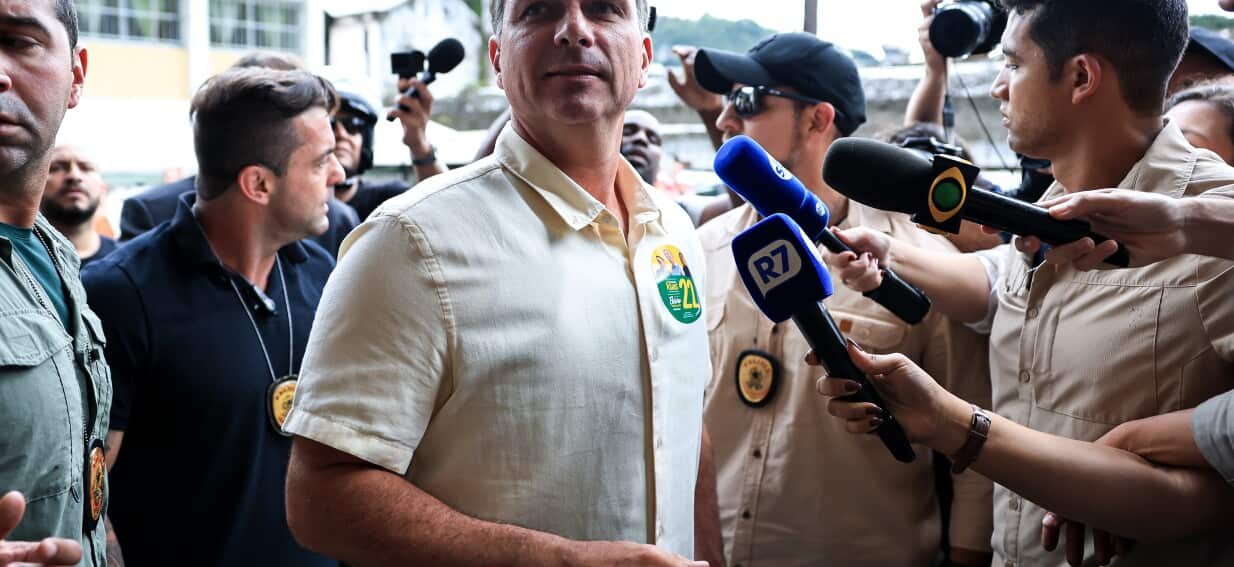
When the initial numbers flashed across screens, the establishment shuddered. Senator Flávio Bolsonaro, bearing a name that commands absolute devotion and blistering revulsion in equal measure, outperformed expectations to secure the lead. It was a moment that sent shockwaves through Latin America's largest democracy. The son had stepped forward to reclaim the banner dropped four years prior, capturing the raw exhaustion of a populace battered by economic friction and institutional fatigue. Millions saw in him a vehicle for disruption, a chance to rewrite the script written by an entrenched political class.
Yet elections are living things. They breathe. They panic.
As the runoff campaign commenced, a strange transformation gripped the streets. The air grew charged not with party anthems, but with a sudden, sharp clarity of what was at stake. Young people—students like 17-year-old Ester, who had never known a world untouched by the polarization of the modern era—poured outward. They did not wait for party bosses to mobilize them. They organized organically, driven by a visceral dread that the democratic machinery under which they grew up might stutter and halt.
The polls began to tighten like a tourniquet. The gap shrank to fractions of a percentage point. On one side, the political machinery of the right leaned heavily on promises of security, traditional values, and foreign alignment. On the other, the incumbent, Luiz Inácio Lula da Silva, summoned the ghosts of his long career, fighting to turn a defensive retreat into a historic comeback.
When Sunday arrived, the tension did not break; it fractured. Voting extensions stretched the hours as lines snaked around concrete schools under heavy skies. Rumors flew across
The Smoke of October And The Ghost of Brazil
news, politics
The coffee at the corner stand in Copacabana was cooling long before the sun cleared the concrete spine of the favelas. Across the street, a television mounted beneath a plastic awning buzzed with numbers that defied the quiet wisdom of the morning papers. Flavio Bolsonaro had done it. Or rather, the machinery behind his family name had done it, defying the pollsters who swore the tide had turned, dragging a divided nation right back to the edge of an abyss everyone claimed they were tired of staring into.
Silence fell over the small cluster of men watching the screen. Not the silence of shock, but the heavier silence of recognition. They had seen this film before.
To understand Brazil on this morning in October is to understand a country that lives with its foot on two different pedals, accelerating toward a futuristic metropolis while slamming the emergency brake to stay anchored in a nostalgic, fierce tribalism. The headlines from the foreign bureaus will call it a resurgence of the right. They will use words like polarization and runoff. But out here, where the salt air mixes with the exhaust of diesel buses, it feels less like a political science seminar and more like an old grudge that refuses to die.
Consider what actually happened at the ballot boxes. For months, the conventional wisdom dictated a swift, decisive victory for the left, a return to the comfortable familiarity of Luiz Inacio Lula da Silva’s broad coalition. The polls were confident. The experts nodding on evening broadcasts were certain. Yet, millions of Brazilians walked quietly into voting booths and pulled a different lever. They were not just casting a vote for Flavio; they were casting a vote against the certainty of the establishment.
We forget how deeply exhaustion dictates human behavior.
Imagine standing in a line that stretches down a red-dirt hill in Sao Goncalo, the tropical heat pressing down like a wet wool blanket. You have worked twelve hours. Your grocery bill has doubled over the past three years. You turn on the phone at night, and the politicians in Brasilia look like aristocrats arguing over the menu while the house burns. Into that frustration steps a movement that says your anger is sacred. It is a powerful drug. It does not matter that the economic formulas are shaky or that the political rhetoric burns bridges to ash. It offers a mirror to the forgotten, and the forgotten will always look into it.
Now, the math shifts. The noise of a crowded field has cleared, leaving a binary choice. It is Lula versus the Bolsonaro machine. Old guard against the new insurgency.
The runoff is no longer about convincing the undecided. There are no undecideds left in Brazil. Every soul with a voter registration card has already drawn their line in the sand. This next phase is an exercise in mobilization, a raw contest of organizational muscle and psychological warfare. Lula represents the institutional memory of the state, the promise of social safety nets, the international prestige of a statesman who once pulled millions from extreme poverty. But he also carries the heavy baggage of past scandals and an economic reality that feels increasingly fragile to a generation born into the digital age.
Flavio, inheriting the mantle and the fierce, loyal base of his father, represents something darker and sharper. He embodies the grievance of the traditionalist, the rural landowner, the evangelical Christian who feels the cultural ground shifting beneath their feet, and the everyday citizen who equates order with strength, regardless of the cost to democratic norms.
The stakes are invisible only to those who do not live here.
When a country splits down the middle like this, the fracture line runs through families, through dinner tables, through the silence between old friends who refuse to talk about politics anymore because they know they are looking at two entirely different versions of reality. One side sees a defender of liberty and family values standing against a corrupt socialist elite. The other sees a direct threat to the fragile architecture of human rights and environmental survival that keeps the Amazon breathing.
Both narratives cannot be true. Yet both are felt with absolute, terrifying conviction.
The sun climbs higher over Rio. The television at the corner stand switches to a soccer highlight, a welcome distraction from the impending storm. But the men do not disperse. They linger over their tiny plastic cups of bitter, sweet coffee, looking out at the Atlantic, waiting for the wind to change. The runoff looms, three weeks away, stretching out like a long, dark bridge over troubled water.
Brazil holds its breath. The ghost of its past wrestles with the phantom of its future, and somewhere in the smoke of the burning Amazon, the rest of the world watches, wondering which fire will finally warm the house, and which one will burn it to the ground.