Rain on the pavement outside Manchester Town Hall has a particular kind of weight. It does not fall so much as it settles, a grey film that coats the red brick and turns the stone into a mirror for leaden skies. Inside, the air smells of old wool, damp coats, and the peculiar, breathless tension of a room waiting for a door to open.
Power in Britain is usually pictured as a mahogany desk in Whitehall, surrounded by papers and guarded by men in identical navy suits. But power has a different address now. It sits in the north, behind a glass desk, watching the hands of a clock move with deliberate slowness.
Andy Burnham knows the weight of that room. He also knows the weight of an expectation.
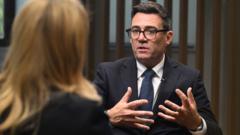
When the BBC microphone was placed before him, the question was simple. Almost painfully simple. Everyone wanted to know the date. Everyone wanted to know when the curtain would rise on a new electoral drama, when the ballots would be printed, when the citizens would be asked to march to the polling stations and cast their judgment. The rumor mill had been spinning for weeks, fed by anonymous sources and late-night briefings in Westminster wine bars. The narrative demanded a rush. The pundits demanded a deadline.
Burnham shook his head.
There would be no early election. Not now. Not on a timeline dictated by panic or political convenience.
To understand why that answer matters, you have to step away from the television studios and walk down a residential street in Bolton or Wigan. You have to look past the abstract percentages on election night broadcasts and see the kitchen tables where household budgets are being stretched until the paper tears.
People are tired. That is the truth that rarely makes it into the glossy policy papers. They are tired of the perpetual motion machine of British politics, where every six months brings a new crisis, a new leader, a new promise whispered over a podium, and very little that changes the dampness in the walls of a poorly insulated terrace house. An early election would have been a spectacle. It would have filled the airwaves with shouting heads and staged factory visits. It would have offered the illusion of motion.
Motion is not progress.
Burnham’s refusal was a quiet act of defiance against the frantic rhythm of modern media. It was an acknowledgment of a deeper fatigue. When you govern a city region that has lived through decades of industrial erosion, you learn to distrust anything that promises salvation in thirty days. Real change moves at the speed of concrete mixing, not the speed of a breaking news alert.
Consider what happens when a community is treated as a permanent campaign stop. The bunting goes up. The politicians arrive in pressed shirts, shake three hands, point at a regeneration site, and vanish before the dust settles. The local council is left holding a half-finished blueprint and a budget that doesn't quite cover the basics of keeping the buses running on time. The cynicism settles in thicker than the Manchester rain.
By taking early elections off the table, Burnham is trying to buy something far more valuable than a headline: time. Time to build a transport network that actually connects the towns to the cities. Time to integrate social care with the health service so that elderly residents do not fall through the cracks between municipal departments. Time to prove that local government can do more than just manage decline.
Of course, this approach carries its own risk. Patience is a hard sell when the heating bill is due tomorrow. Critics will say he is playing a long game while the pieces are shifting on the national board. They will argue that hesitation looks like reluctance, that caution is just another word for fear.
Politics is a game of shadows. Every move is measured against what the opponent might do in the dark.
Yet there is a distinct kind of courage in refusing to dance to someone else's tune. Westminster operates on adrenaline. The capital lives from crisis to crisis, addicted to the sudden spike of a poll result or the rapid-fire exchange of Prime Minister's Questions. The regions, the places where the factories used to be and the new logistics hubs are rising, operate on a different frequency. They measure time in generations, not parliamentary terms.
When you sit across from someone who has spent twenty years watching promises made and broken by successive governments in London, you realize that eloquence is cheap. Statistics are malleable. The only currency that retains any value is consistency.
Burnham’s rejection of the early poll isn't just a tactical maneuver. It is a boundary line drawn in the mud. It says that the administration of millions of lives is not a card game to be rushed when the dealer thinks he has a winning hand. It says that the work of rebuilding a region's infrastructure, of fixing its buses, of housing its families, has to come before the frantic theater of the ballot box.
The rain outside Manchester Town Hall continues to fall. The buses rumble past the Gothic arches, splashing water over the curbs. Inside, the desks are cleared, the microphones are packed away, and the grand architecture stands silent against the evening chill.
The date has not been set. The drama has been postponed.
Out in the streets, away from the cameras and the strategists, people keep walking with their heads down against the wind, waiting for something that lasts longer than a headline.