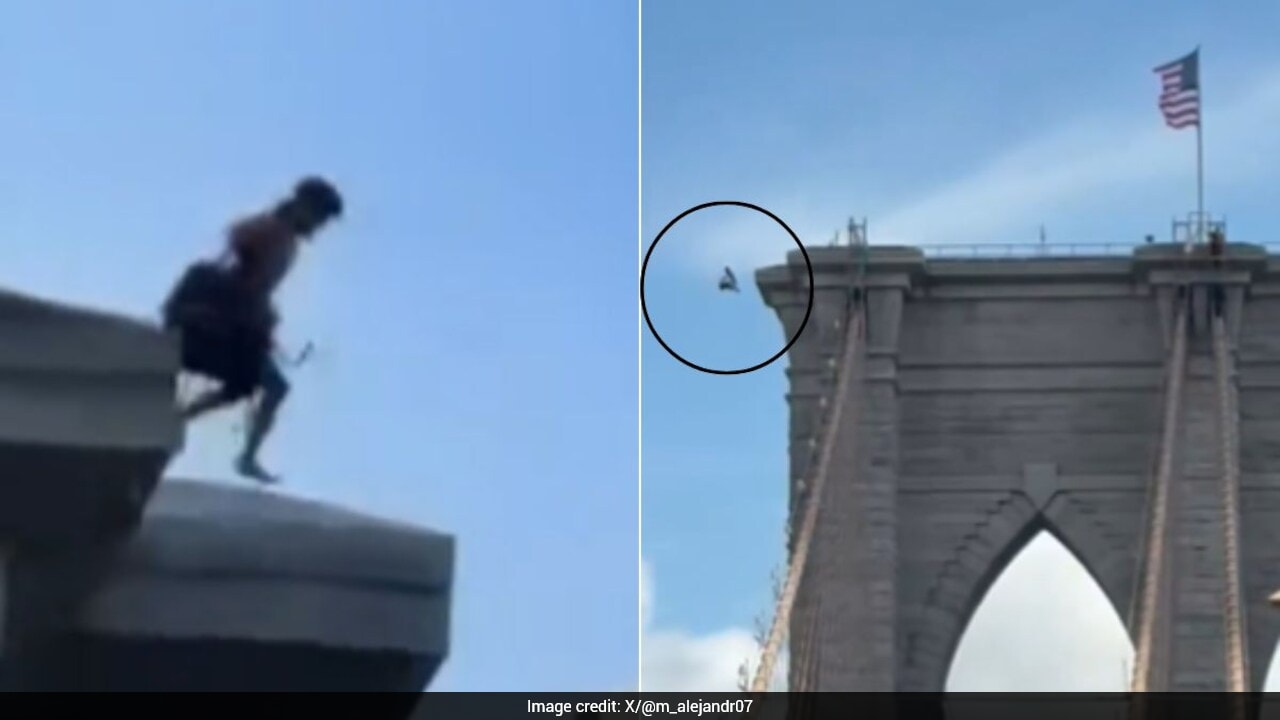
Water is supposed to be soft. At least, that is the comforting lie we tell ourselves when we stand too high above it. We look down at the harbor, watching the chop of the East River churn against the gray granite pilings, and our brains play a cruel trick. We mistake distance for mercy.
I know what the concrete looks like from up there. I know how the wind behaves when you clear the stone parapet, how it catches your shirt, how it suddenly stops feeling like air and starts feeling like something solid trying to push you back.
On a Tuesday afternoon, a man stood where the suspension cables hum like a harp played by a gale. He did not climb up to look at the view. He did not pull out a phone to capture the Manhattan skyline for an audience that demands constant motion. He stripped off his clothes, every last stitch of fabric, leaving his identity on the pedestrian boardwalk like a discarded shell. And then he jumped.
The Geography of Freefall
To understand what happened next, you have to understand the geometry of the Brooklyn Bridge. It rises one hundred and thirty-five feet above the water at its highest point. That is roughly a thirteen-story building.
Gravity does not care about your intentions. It does not care if you are having a psychotic break, if you are seeking a cheap thrill, or if you are trying to rewrite the rules of your own existence. It accelerates a human body at nine point eight meters per second squared. By the time you hit the surface of the water from that height, you are traveling at roughly seventy miles per hour.
At seventy miles per hour, water ceases to be a liquid. It behaves like unyielding asphalt.
Emergency responders arrived with the grim efficiency of people who have seen too many winters and too many desperate summers. They expected a recovery operation. They expected to pull a broken form from the cold, indifferent current. Instead, they pulled out a survivor.
Miracle is a lazy word. We use it when we are too exhausted to do the math.
Consider what actually happens in those two point nine seconds of flight. Your stomach flies into your throat. Your ears pop with the sudden spike in atmospheric pressure. Your eyes water so badly that the bridge, the towers, and the distant skyline smear into a single gray smear.
He survived. How?
Luck is a factor, certainly. A few degrees off-center, landing on your stomach or your back from that height, and your internal organs rupture instantly. The spleen shears. The aorta tears. But physics also has room for anomalies. He entered the water feet first, or close enough to it, slicing through the surface tension like a poorly aimed spear. The deceleration shredded muscle tissue, cracked ribs, and likely compressed his spine, but it did not end him.
The Anatomy of Desperation
We treat these events as spectacles. We pull out our phones. We film the distant figure on the stone arch. We turn human agony into viral currency, scrolling through thirty-second clips while waiting for our morning coffee to brew.
We never ask about the silence that follows the splash.
I have stood on that bridge when the tourists are gone and the commuter traffic has thinned to a steady hum. The iron groans under your feet. The city roars around you, an endless, churning engine of ambition and anxiety. It is very easy to feel invisible in a city of eight million people. In fact, it is harder to feel seen.
When a person strips naked before a crowd of strangers, they are performing a radical, terrifying act of exposure. They are saying: Look at me. Really look at me. I am nothing. I am bare. I am stripped of everything you use to define your worth—the job title, the address, the clothes on my back, the armor we all wear to survive the subway ride.
It is madness, yes. But it is a madness born of a very rational pain.
The medical reports came out in fragments. Stable. Non-life-threatening injuries. Transferred to a hospital for psychiatric evaluation. Standard procedure for an extraordinary event. The system wraps its bureaucratic arms around the broken body, stitches the wounds, pumps out the water, and checks the boxes.
And then what?
The Return to the Pavement
We love stories with neat resolutions. We want the man to emerge from the river, repentant and transformed, ready to embrace a new lease on life with a gentle, cinematic smile.
Life does not work like that.
The water does not wash away the ghosts. When he wakes up in a sterile hospital room smelling of antiseptic and bitter institutional coffee, the bridge will still be there. The city will still be roaring outside the reinforced glass window. The rent will still be due. The quiet, grinding pressure that drove him up those stone steps will still be waiting for him when he is discharged.
Survival is not a reward. Sometimes, it is just an extension of the sentence.
I think about the people on the deck that day who watched him climb over the railing. I think about the split second before he let go, where the air was entirely silent, suspended between the noise of the traffic and the shock of the impact. I think about the choice—if you can call it a choice when the mind has run out of every other exit.
We call it a miracle because it spares us the discomfort of looking at the machinery underneath. We prefer the mystery of the leap to the monotony of the descent.
The sirens have faded. The news cycle has already moved on to the next disaster, the next political scandal, the next shiny distraction designed to keep our eyes safely fixed on the screen. But out over the dark, deep channel of the East River, the bridge still stands. It holds the weight of millions of footsteps every single year, waiting quietly for the next person who forgets how hard the water can be.


