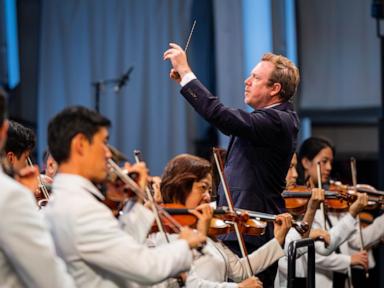
The air inside Walt Disney Concert Hall does not just move; it vibrates. If you have ever sat in those honey-colored wooden tiers while the Los Angeles Philharmonic is at full throttle, you know it is less like watching a concert and more like standing inside the engine room of a magnificent, invisible ship. For over a decade, that ship was steered by Gustavo Dudamel—a man of kinetic, curly-haired energy who turned classical music into a contact sport. When he announced his departure for the New York Philharmonic, a collective panic quieted the LA cultural scene. Who could possibly step into a vacuum that large?
The answer arrived not from the traditional, insular corridors of European high culture, but from thirty thousand feet in the air.
Daniel Harding is the new music director of the Los Angeles Philharmonic. To the casual observer, it is a standard piece of musical musical-chairs. Elite conductor takes over elite orchestra. But to look at this appointment as a mere resume update is to miss the entire human drama of what just happened. Harding is not just a musician. He is a commercial airline pilot. He is a man who regularly balances the fragile, sublime beauty of a Mahler symphony with the cold, calculated mechanics of flying an Airbus A320 for Air France.
This is the story of how the LA Phil found its next leader by looking for someone who understood that control is an illusion, whether you are holding a baton or a joystick.
The Ghost in the Concert Hall
Every major cultural institution has a ghost. In Los Angeles, that ghost is the memory of what Dudamel represented. He was "The Dude"—a symbol of youthful exuberance, Venezuelan passion, and a rare crossover appeal that made classical music feel vital to a city obsessed with the silver screen. Replacing him is an impossible psychological math problem. If you hire a clone, you fail. If you hire the polar opposite, you alienate the audience.
Consider the sheer pressure of walking onto that stage for the first time after a revolution. The musicians of the LA Phil are arguably the finest in the world, accustomed to a specific brand of charismatic heat.
Enter the fifty-year-old native of Oxford, England.
Harding does not look like the stereotypical maestro of the past. He doesn't sport a flowing mane or an artificial, brooding scowl. There is a lean, focused intensity to him. He grew up playing the trumpet before realizing his true instrument was the entire orchestra. By his teenage years, his genius was already making people uncomfortable. At just seventeen, he sent a tape of his conducting to Simon Rattle. Rattle listened, recognized a rare, terrifying talent, and immediately hired him as an assistant. A year later, Harding was conducting the City of Birmingham Symphony Orchestra.
He was a prodigy in a world that eats prodigies alive.
The Midlife Pivot That Changed Everything
But prodigy status is a ticking time bomb. By his thirties, Harding was a fixture on the world’s greatest stages, from the London Symphony Orchestra to the Swedish Radio Symphony. Yet, something inside the machine felt incomplete. The relentless cycle of hotel rooms, rehearsals, and standing ovations can create a strange kind of sensory deprivation. You become insulated from the very world you are trying to interpret through music.
So, he did something unthinkable in the hyper-competitive world of classical music. He took a sabbatical. Not to rest, but to qualify as a commercial airline pilot.
Imagine the cognitive dissonance. One night, you are interpreting the complex, emotional architecture of Brahms for thousands of weeping patrons. The next morning, you are in a simulator, memorizing emergency checklists for hydraulic failure.
This choice was not a hobby; it was a necessity. Harding has spoken openly about how flying saved his relationship with music. In the cockpit, there is no room for interpretation. The physics of flight are absolute. The wind does not care about your artistic vision. If you do not respect the instrument, the plane falls out of the sky.
That grounding—literally and figuratively—is precisely what makes him the most fascinating choice to lead Los Angeles into its next era. Dudamel brought the fire of raw inspiration. Harding brings the profound clarity of a man who knows exactly how to navigate a storm.
The Invisible Chemistry of 100 People on a Stage
To understand why this match matters, we have to look at what conducting actually is. The audience sees a man waving his arms, apparently making music happen through sheer force of will.
It is a lie. The conductor makes no sound at all.
The true job of a music director is psychological. You are standing in front of a hundred highly sensitive, fiercely intelligent artists, each of whom has spent decades mastering an instrument. They do not need someone to count to four for them. They need a unifying principle. They need to know that the person on the podium has a map of the territory and knows where the hidden dangers lie.
The parallels between the podium and the cockpit are striking.
| The Cockpit | The Podium |
|---|---|
| Crew Resource Management | Orchestral Hierarchy |
| Absolute Technical Precision | Score Analysis and Intonation |
| Navigating Atmospheric Turbulence | Managing Artistic Tension and Pacing |
| The Safety of Hundreds of Passengers | The Shared Emotional Experience of the Audience |
When a pilot flies a plane, they practice Crew Resource Management. It is the art of utilizing every person in the cockpit to ensure a safe flight, stripping away ego in favor of collective awareness. When Harding steps onto the podium at the Walt Disney Concert Hall, he brings that exact ethos. He is not a dictator; he is a commander who trusts his crew to fly.
Why Los Angeles Needed a Pilot
Los Angeles is a city built on illusions. It is a place where stories are manufactured, where reality is often secondary to perception. The LA Phil, under the visionary leadership of chief executive Deborah Borda and later Simon Woods, became the richest and most progressive orchestra in America by leaning into that grand scale. They built a brand that was spectacular.
But spectacles can burn out.
The post-Dudamel era requires a different kind of sustainability. The challenge now is not just to dazzle, but to deepen. Harding’s contract, which begins with the 2026-2027 season, signals a shift toward a meticulous, deeply intellectual engagement with the music.
Music critics have often noted that Harding’s performances are stripped of sentimentality. He doesn't wallow in emotional manipulation. Instead, he lays out the architecture of a piece of music with such breathtaking clarity that the emotion emerges naturally from the structure itself. It is the musical equivalent of a perfectly executed approach through heavy cloud cover—suddenly, the runway appears, pristine and exact.
The Long Journey to the First Downbeat
The road ahead is long. A music director’s tenure is not measured in months, but in seasons. There will be doubts. People will look at his European pedigree and wonder if he can truly connect with the vibrant, multicultural fabric of Southern California. They will wonder if a man who spends his free time flying commercial routes across Europe has the bandwidth to fully embrace the demanding civic role that comes with being the cultural figurehead of Los Angeles.
But those doubts misunderstand the nature of a man who chooses to live two lives.
Harding is not dividing his attention; he is doubling his perspective. The loneliness of the conductor’s life is well-documented. You are always the boss, always the outsider, always the one carrying the ultimate responsibility for the performance. In the sky, Harding found a place where he was just part of a system, a worker bound by the laws of aerodynamics. He returns to the podium refreshed by that humility.
The true test will come on an autumn evening when the house lights drop, the audience falls silent, and Daniel Harding raises his baton for his first official concert as music director.
The orchestra will breathe in together. A hundred instruments will poise on the edge of silence. In that fraction of a second before the music begins, the pressure will be immense—the weight of history, the ghost of his predecessor, the expectations of a city.
But looking at the man on the podium, one gets the distinct impression that he is perfectly comfortable with the altitude.