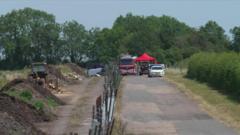
The headlines always follow the exact same script. "Pilot dies after plane crash near airfield." It is a formulaic, low-effort template designed to elicit immediate, unthinking panic from a public that treats private aviation as an inherent death wish. The local news runs a few seconds of blurry drone footage showing crumpled aluminum in a field, quotes a shaken witness who claims the engine "sounded funny," and waits for the National Transportation Safety Board (NTSB) to drop a preliminary report.
This lazy consensus frames general aviation as an inherently reckless gamble, a playground for wealthy daredevils operating under lax rules. It is a completely flawed premise.
When a light aircraft goes down, the media treats the incident as a shocking failure of technology or an act of god. The reality is far more uncomfortable, nuanced, and systematically ignored. The vast majority of fatal general aviation accidents are not mechanical failures. They are human failures, specifically engineered by a culture that prioritizes checking regulatory boxes over actual, adaptive survival skills. If we want to stop reading about dead pilots, we have to stop coddling the broken training systems that produce them.
The Mechanical Scapegoat Myth
Every time a small plane crashes, the immediate public assumption is that the engine quit. We see questions plastered across forums and comment sections: "Why didn't the engine hold up?" or "Are these small planes structurally sound?"
Let us dismantle the mechanical myth with actual data. Year after year, NTSB data demonstrates that powerplant failures account for a fraction of fatal accidents. The overwhelming majority of fatal crashes in general aviation fall under a grim, technical acronym: LOC-I (Loss of Control - Inflight) and CFIT (Controlled Flight Into Terrain).
Think about what those terms actually mean.
- Controlled Flight Into Terrain (CFIT): This means the aircraft was functioning perfectly. The engine was producing full power. The instruments were operational. The pilot, entirely disoriented by weather or poor planning, flew a perfectly good airplane straight into the side of a mountain or a dark field.
- Loss of Control - Inflight (LOC-I): This frequently happens in the traffic pattern, very close to the airfield. The pilot allows the aircraft to get too slow while turning from base to final, exceeds the critical angle of attack, and enters an unrecoverable aerodynamic stall and spin at 400 feet. The engine did not fail. The pilot failed to fly the wing.
Blaming the machine is a coping mechanism. It allows the public to feel safe in their commercial airliner seats, believing that as long as big maintenance crews look at big engines, the sky is safe. It allows the aviation community to avoid the mirror. The brutal truth is that general aviation does not have a machine problem. It has a proficiency crisis.
The Federal Aviation Administration Compliance Trap
I have spent decades watching pilots pour thousands of dollars into maintaining compliance with Federal Aviation Administration (FAA) regulations, mistakenly believing that legal compliance equals safety. It does not.
The regulatory framework is a floor, not a ceiling. The FAA says a private pilot only needs to complete a flight review every 24 calendar months to remain legally allowed to carry passengers. This review requires a bare minimum of one hour of ground training and one hour of flight training.
Imagine applying that logic to any other high-consequence activity. Would you trust a brain surgeon who only practiced for two hours every two years? Would you get into a race car with a driver who hasn't looked at a track since 2024?
Yet, the aviation industry treats the biannual flight review as a golden standard. Pilots become rusty. Their instrument scanning degrades. Their ability to handle crosswinds atrophies. But because a piece of paper says they are compliant, they take off into challenging conditions.
True proficiency is a perishable currency. It burns up every single day an aircraft stays tied down on the ramp. A contrarian approach to safety demands that we trash the concept of minimum legal currency. If you are not flying multiple hours a month, practicing simulated emergencies, and actively seeking out flight instructors to tear your habits apart, you are a passenger in your own cockpit, just waiting for the right sequence of bad weather to prove it.
The Deadly Irony of Cockpit Automation
Technology was supposed to save general aviation. The introduction of glass cockpits, digital moving maps, and synthetic vision systems was heralded as the ultimate safety revolution. Instead, it created a generation of system monitors who cannot hand-fly an airplane when the screens go dark.
Look at how flight training has shifted. Students spend hours learning how to program a GPS navigation unit rather than looking out the window to spot landmarks or identify traffic. They rely on digital autopilots to fly precise approaches.
Automation is an incredible tool right up until it fails. When an alternator dies or an electrical short knocks out the primary flight display, a technologically dependent pilot experiences an immediate, catastrophic spike in cognitive workload. The sudden transition from passive observer to active manipulator of a destabilized aircraft leads directly to panic.
The industry has traded stick-and-rudder muscle memory for software management. When a plane crashes near an airfield during an emergency return, it is often because the pilot was staring at a screen trying to diagnose a failure rather than looking outside to pitch the nose down, maintain glideslope, and find a survivable patch of grass.
Redefining the Urgent Questions
People looking at aviation accidents consistently ask the wrong questions. They ask: "What broke?"
We must force them to ask: "What choices led the pilot to a position where they ran out of options?"
An accident near an airfield is rarely a sudden lightning bolt of bad luck. It is the end result of an error chain that began hours, sometimes days, before takeoff. It began with a pilot ignoring an unfavorable wind forecast. It continued when they skipped a thorough pre-flight inspection because they were in a rush. It grew heavier when they pushed through deteriorating visibility because they suffered from "get-there-itis"—the psychological compulsion to reach a destination despite overwhelming danger.
The actionable, unconventional advice for any pilot or passenger is simple: stop focusing on surviving the emergency. Focus on avoiding the trap entirely. The most powerful safety device in any aircraft is the throttle quadrant, and the most important decision is choosing to leave it pulled back while the plane is still parked on the tarmac.
The Cost of the Truth
The downside to this perspective is that it removes the comfort of victimhood. It is terrifying to admit that when an aircraft goes down, the person at the controls was almost always the author of their own fate. It places the entire burden of safety squarely on the individual. It means you cannot buy safety with a newer avionics panel, a better engine warranty, or a shiny new airframe.
But accepting that harsh reality is the only way to genuinely mitigate risk. The sky is completely unforgiving of apathy, ignorance, and unearned confidence. Until flight training programs stop teaching students how to merely pass a checkride and start forcing them to master aggressive, real-world stick-and-rudder proficiency, the headlines will remain exactly the same.
Stop reading the standard crash reports looking for a mechanical bogeyman. The flaw isn't in the aluminum. It is in the cockpit.

/melissa-ballerinas-mini-melissa-campana-papel-inf-32996-rosa.jpg)