Silence in the Xingu River basin is never actually silent.
If you stand at the edge of the clearing in the Brazilian state of Mato Grosso just before dawn, the air feels heavy, thick enough to chew, smelling of damp earth, woodsmoke, and crushed green leaves. You hear the low, percussive roar of howler monkeys miles away. You hear the dry rattle of palm fronds shifting in the river breeze. You hear the slow, deliberate footsteps of an old man whose bare soles have memorized every root and stone of this forest floor for nearly a century.
His name is Raoni Metuktire.
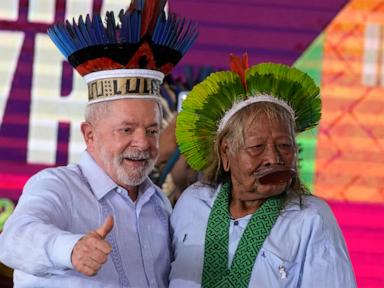
To the rest of the world—from the red carpets of Cannes to the marble halls of the Vatican, from Sting’s stadium tours to presidential palaces in Paris—he is Chief Raoni, the living icon of the Amazon. With his trademark wooden lip plate, the botoque, and his crown of bright yellow macaw feathers, he has spent forty years pleading with strangers in cold, concrete cities not to burn down his house.
Yet for decades, the most sacred square mile of his entire existence sat outside the lines drawn on Brazil’s official maps.
He was born around 1932 in a village called Krajmopyjakare, deep in the heart of what non-Indigenous cartographers later labeled the Kapôt Nhinore region. When Raoni took his first breath there, the outside world did not exist to the Kayapó people. There were no highways. There were no soy plantations stretching to the horizon like a monoculture sea. There were no gold miners poisoning the tributaries with mercury. There was only the forest, the river, and the ancestors buried beneath the roots of the Brazil nut trees.
Then came the roads. Then came the cattle ranchers. Then came the lines on paper.
When Brazil’s government finally began demarcating Indigenous territories in the late twentieth century, bureaucrats drew borders with rulers from thousands of miles away. Through an accident of history, political cowardice, and relentless pressure from agribusiness lobbies, Raoni’s birthplace—the exact patch of earth where his umbilical cord was buried—was left outside the protected boundary of the Xingu Indigenous Park.
For more than thirty years, Chief Raoni fought to bring his cradle home.
In late 2024, standing beneath the canopy he had spent his life defending, Brazilian President Luiz Inácio Lula da Silva signed the decree that finally began the formal demarcation of Kapôt Nhinore. On paper, it was an administrative act—a technical step toward protecting roughly 362,000 hectares of forest across Mato Grosso and Pará. In reality, it was the closing of a ninety-year circle, a rare moment when the machinery of modern statecraft bent toward justice before the last witness died.
A Border Drawn in Ink Against a Wall of Fire
To understand why a line on a government map matters so much to a man who does not use maps, you have to picture what happens to an unprotected forest in central Brazil.
Imagine a hypothetical rancher named Carlos, operating a sprawling cattle spread just south of the Xingu basin. Carlos isn't a cartoon villain; he is a businessman responding to the cold math of global commodity markets. Land inside a demarcated Indigenous territory is legally untouchable—a constitutional fortress where logging, mining, and commercial agriculture are strictly forbidden. Land just outside that line, however, sits in a lethal gray zone of public land waiting to be claimed, cleared, and titled.
In Mato Grosso, that gray zone is known as the Arc of Deforestation.
Without federal demarcation, Kapôt Nhinore was an island of intact rainforest surrounded by a rising tide of pasture and soy fields. Land grabbers—known locally as grileiros—operate with a brutally simple playbook. First come the illegal loggers to strip the mahogany and ipê trees. Next come the chainsaws to clear the underbrush. Then comes the fire, set during the dry season to turn ash into cattle grass, followed by forged property deeds filed in compliant local registries.
Once the trees are gone, the water changes.
I have stood on the banks of rivers in southern Pará where the forest was stripped away twenty years ago, and the transformation feels physical, almost nauseating. Without the dense root systems of the canopy acting like a giant sponge, the seasonal rains wash red clay straight into the water. The river turns the color of brick dust. The fish suffocate. The small streams dry up completely by August.
For the Kayapó people, who call themselves the Mebêngôkre—"the people of the wellspring"—the destruction of Kapôt Nhinore wasn't an abstract environmental statistic. It was the systematic erasure of their origin story.
When a Kayapó elder dies, they are buried in the earth of their ancestral village, becoming part of the physical geography that guides the living. Leaving Kapôt Nhinore outside federal protection meant leaving the bones of Raoni’s parents, grandparents, and teachers exposed to bulldozers and cattle hooves.
Four Decades of Knocking on Closed Doors
Raoni’s journey to save his birthplace did not begin in Brasilia. It began with a refusal to stay invisible.
In 1954, when Raoni was in his early twenties, he made first peaceful contact with the Villas-Bôas brothers, the legendary Brazilian indigenists who were lobbying the government to create the Xingu National Park. At the time, the Brazilian state viewed Indigenous peoples as obstacles to national integration—relics meant to be assimilated, moved, or forgotten as highways sliced through the interior.
Raoni watched the BR-163 highway carve a red scar through the forest. He watched infectious diseases wipe out entire neighboring clans who had no immunity to the common cold. He realized early on that bows and war clubs could not stop diesel engines, and that silence was a death sentence.
So he learned the power of spectacle.
In 1989, alongside British rock star Sting, Raoni embarked on a global tour across seventeen countries, appearing on television screens from London to Tokyo. He stood beside presidents and pop stars, refusing to remove his feather headdress or soften his message. That campaign helped halt the Kararaô dam complex—later revived as Belo Monte—and forced the international community to recognize that the Amazon was not an empty warehouse of timber and minerals.
Yet back home, the wheels of bureaucracy ground at a glacial pace.
The technical studies required to recognize Kapôt Nhinore as traditional Indigenous land dragged on for decades. Under Brazil’s 1988 Constitution, Indigenous peoples have an original right to the lands they traditionally occupy—meaning the government does not grant them the land; it merely recognizes a right that predates the Brazilian state itself.
Still, recognition requires a multi-step gauntlet:
- Anthropological identification: Funai, Brazil’s Indigenous affairs agency, must conduct years of historical and field research to prove continuous cultural connection.
- Declaratory ordinance: The Ministry of Justice must formally declare the boundaries of the territory.
- Presidential homologation: The President of the Republic must sign the final decree, locking the territory into the national registry and authorizing the removal of illegal occupants.
Every single stage became a political battlefield. During the administration of Jair Bolsonaro from 2019 to 2022, the process froze completely. Bolsonaro famously vowed not to demarcate "a single centimeter" of Indigenous land, dismantling environmental enforcement agencies and emboldening illegal miners and land grabbers across the basin.
Raoni, by then approaching ninety, watched his lifelong allies die of old age and COVID-19 while his birthplace remained in limbo. In 2020, his wife of more than sixty years, Bekwyjkà, passed away. Weeks later, Raoni himself was hospitalized with severe gastrointestinal bleeding and COVID-19. Many feared the old chief would never see the forest again.
He survived. And when he walked out of the hospital, frail and leaning on a wooden staff, he went straight back to demanding the signature that would secure Kapôt Nhinore.
The Return to the Beginning
When Luiz Inácio Lula da Silva returned to the presidency in January 2023, Raoni stood beside him on the ramp of the Planalto Palace in Brasília, placing a traditional ceremonial sash over the president’s shoulders in front of millions of viewers. It was an image heavy with unspoken expectation: We helped put you back in power. Now keep your promise.
Even with a sympathetic government, nothing in the Amazon moves without friction.
The agribusiness caucus in Brazil’s Congress—known as the bancada ruralista—wields immense legislative power, representing the soy, corn, and beef exports that anchor Brazil’s trade surplus. For months, lawmakers pushed legislation known as the Marco Temporal (Time Frame) thesis, an effort to restrict Indigenous land claims strictly to territories physically occupied on October 5, 1988, the day Brazil’s current constitution was promulgated.
Think about the perverse logic of that rule. If an Indigenous community had been violently expelled from their land by gunmen or state road-builders in 1975—as happened across Mato Grosso—they would permanently lose their right to return simply because they weren't standing there in 1988.
Although Brazil’s Supreme Court ruled the Marco Temporal unconstitutional in September 2023, Congress overrode presidential vetoes to pass a version of the law anyway, plunging dozens of demarcations into legal uncertainty.
That political storm makes Lula’s movement on Kapôt Nhinore far more than a ceremonial photo opportunity. By advancing the demarcation of Raoni’s birthplace, the Brazilian government directly challenged the narrative that Indigenous lands are negotiable bargaining chips in congressional horse-trading.
When the delegation arrived in the Xingu region to formalize the step, Raoni was in his nineties. His eyesight had dimmed. His voice, once capable of booming across a village plaza without amplification, had softened to a rasp.
Yet when he spoke, the weight in the clearing shifted.
He spoke in Mẽbêngôkre, pausing sentence by sentence for his grandson to translate into Portuguese. He did not talk about carbon credits, biodiversity offsets, or climate finance mechanisms. He talked about the spirits of his ancestors who still walk among the trees of Kapôt Nhinore. He reminded the politicians standing before him in crisp linen shirts that the forest breathes for the whole world, and that when the trees fall, the rain stops falling on the soy fields too.
The Invisible Science Behind an Old Man’s Plea
It is easy for outsiders to romanticize Raoni as a mythic figure fighting a poetic battle against modernity. Doing so misses the hard, empirical reality: his worldview aligns almost perfectly with modern Earth-system science.
Consider what scientists call the "biotic pump" and the flying rivers of the Amazon.
The Amazon rainforest does not merely receive rain; it manufactures it. A single mature Brazil nut tree can pump more than a thousand liters of water from deep underground into the atmosphere every single day through transpiration. Across hundreds of billions of trees, that moisture forms massive airborne rivers of vapor that travel west toward the Andes, hit the mountain wall, and turn south—delivering the rainfall that waters crops across central and southern Brazil, Paraguay, and northern Argentina.
Data from satellite monitoring consistently proves that demarcated Indigenous territories are the most effective barrier against deforestation in the tropics—outperforming even strictly protected national parks. Between 1985 and 2022, Indigenous lands in the Brazilian Amazon lost barely over one percent of their native vegetation, while surrounding private and undesignated lands suffered massive clearing.
Why? Because a fence on a map cannot stop a chainsaw, but a community living on the land can.
The Kayapó do not simply inhabit the forest; they actively patrol it, manage its fire regimes, and monitor its borders using drones, GPS units, and generational knowledge of every creek and game trail. Protecting Kapôt Nhinore plugs a critical geographic gap in the Xingu corridor—a continuous wall of protected forest stretching across millions of hectares that buffers the southern Amazon against savannah conversion.
Scientists warn that if deforestation and climate warming push the Amazon past a tipping point—estimated around 20 to 25 percent forest loss—large sections of the basin could irreversibly dry out into degraded scrubland. The southern edge, right where Raoni was born, is the frontline where that collapse would begin.
What Remains After the Ink Dries
Signing a decree is not the end of a war. In the Amazon, paper has always been fragile against steel and fire.
Even after presidential approval, demarcated territories require physical boundary markers, federal police operations to evict illegal squatters, and constant surveillance funding—resources that shrink whenever commodity prices spike or political winds shift in Brasília. Across Brazil, hundreds of Indigenous land claims remain stalled in bureaucratic purgatory, waiting for signatures that may never arrive before their elders pass away.
Raoni knows this better than anyone alive. He has outlived military dictatorships, boom-and-bust gold rushes, six Brazilian presidents, and countless promises signed in capital cities and forgotten by the next election cycle.
Yet for once, the map matches the memory.
Somewhere deep inside Kapôt Nhinore, beneath a canopy so thick that midday sunlight breaks into pale green shafts, the red earth holds the footprints of a boy who once chased tapirs along unnamed creeks before the highways came. Today, that boy is a ninety-something elder whose face is known on every continent, leaning on his staff while the river moves slowly past the bank—unbroken, unburned, and finally called by its true name.