The asphalt does not forgive a body travelling at fifty miles per hour.
In February 2021, Tony Fahey learned this truth with terrifying suddenness. A car struck him during his daily walk, shattering bone and tearing tissue. Emergency surgeons pieced him back together in a sterile operating theatre, but the true battle began afterward. Eighteen months of grueling, silent rehabilitation followed. Every step was a negotiation with pain. Every breath in the recovery ward felt like a small, stubborn victory against the dark.
Most men at eighty-two look back across their lives from the safety of a comfortable armchair. They count their decades in quiet afternoons and afternoon naps.
Tony Fahey built a machine to walk on water instead.
To understand why an octogenarian pensioner would spend his twilight years engineering an impossible vessel, you have to look further back into his past. Decades ago, in 1977, Tony was a different kind of daredevil. He sought out Leo Villa, the legendary chief mechanic who had built speed record machines for the great Malcolm and Donald Campbell. Villa saw something feral and focused in young Tony, coming out of retirement to mentor him. Within a single year, Tony shattered records. He set the British national water speed record, claimed a world production-engine powerboat title, and hit a blistering peak of 158 miles per hour on Lake Windermere. His R6-category speed world record from that era remains stubbornly unbroken today.
Speed is a jealous master. But endurance is something entirely different. Speed asks how fast you can cheat death; endurance asks how long you can look it in the eye without blinking.
The turning point came during his recovery years. Tony met a young boy living with a critical illness. They talked about boats, about the scream of engines on the water, about the simple magic of moving fast. Tony promised to come back and take him out on the water. He returned a week later, eager and smiling, only to discover he was an hour too late. The boy had passed.
Grief has two choices. It can make a man small, or it can make him monumental.
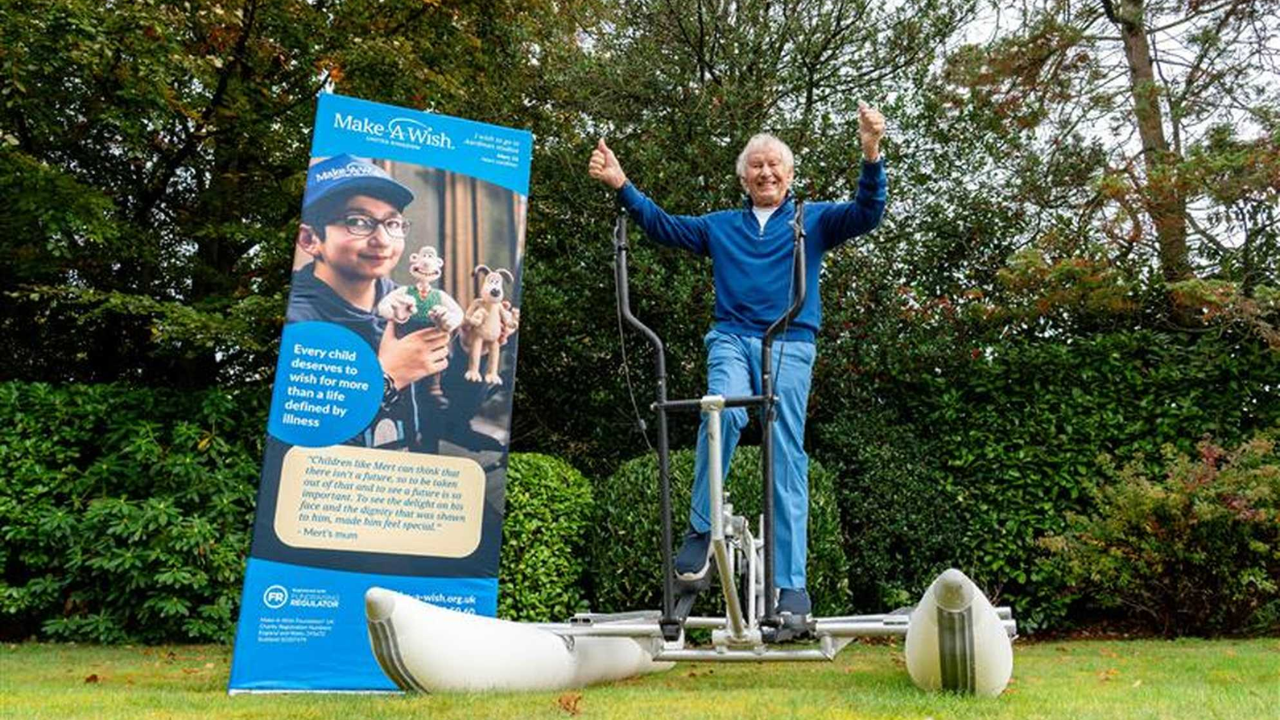
Tony chose the latter. He commissioned a design engineer to build something unprecedented: the aqua elliptica. It is a human-powered watercraft that mimics the rhythmic, gliding motion of a gym cross-trainer, translating a forward walking cadence directly into aquatic propulsion. It is clumsy-looking on paper, a bizarre marriage of bicycle mechanics, catamaran floats, and elliptical pedals. On the water at Sale Water Park in Greater Manchester, however, it is poetry.
Preparation became his obsession. Five days a week, rain or shine, Tony trained. His body, once broken by a fifty-mph impact, was systematically rebuilt into an engine of pure stubbornness.
When May arrived, the waters of Sale Water Park mirrored a grey Manchester sky. Tony did not step onto the lake alone; he led a team of four into the mist to attempt a series of punishing endurance milestones for Make-A-Wish UK.
The rules of the attempt were brutal. Continuous motion. No sitting down for a comfortable break. Day turned into night, and night bled back into the pale grey of dawn. Muscles seized. Blisters tore open. The cold damp of the Greater Manchester air settled deep into joints that had already survived a catastrophic highway collision five years prior.
At moments when exhaustion threatened to drag him under, Tony did not think of the records. He thought of the boy he was an hour too late for.
Hour after hour, the mechanical pedals turned. The floating platform glided forward in a steady, hypnotic rhythm, creating the optical illusion that a man was simply taking a stroll across the surface of a deep lake.
When the twenty-four hours finally ticked away, the team had secured four distinct world records. They had walked on water continuously for two hours, covered five miles in a single unbroken stretch, sustained the grueling effort for a full twenty-four-hour endurance cycle, and pushed a cumulative team distance past one hundred kilometers. More than thirty thousand pounds poured into the charity chest for children who need a miracle of their own.
As the support crews cheered from the banks and the exhaustion finally settled over his shoulders, Tony stood upright on his floating machine. He looked across the ripples of the lake.
The asphalt had tried to claim him. Time had tried to slow him. Grief had tried to silence him.
Instead, he left ripples that will echo long after the water settles.