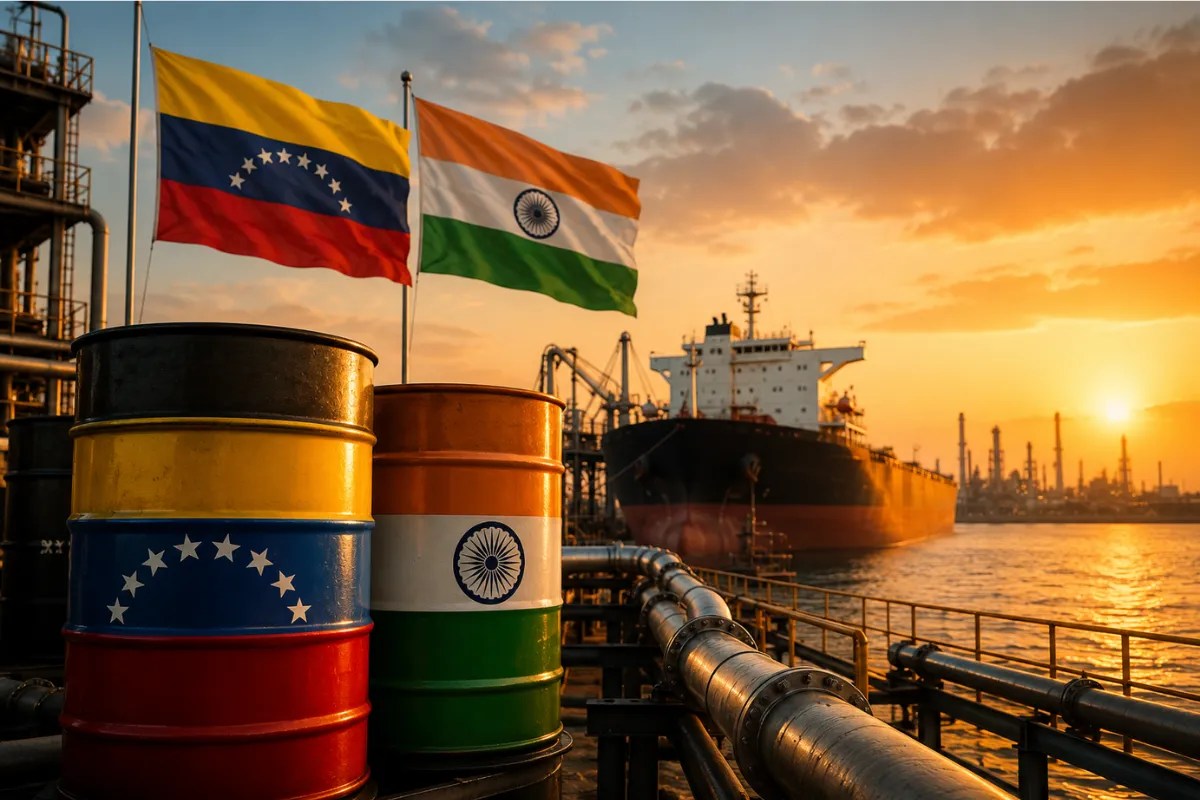
A heavy, metallic scent hangs over the port of Jamnagar. If you stand near the docks of Gujarat when the wind shifts, you can smell it—the thick, sulfurous tang of raw oil. It arrives in the bellies of colossal tankers, ships that have braved thousands of nautical miles across volatile oceans just to empty their black cargo into India’s insatiable refineries.
Most people look at a petrol pump and see a price tag. They see a fluctuating number that dictates their monthly budget, a minor grievance on a Tuesday morning commute. But look closer. That liquid flowing into your car is not just fuel. It is geography. It is a shifting mosaic of global power, secret maritime routes, and desperate economic gambles.
For decades, India’s energy lifeline was predictable. It was a story written in the sands of the Middle East. You bought from Riyadh; you bought from Washington's allies. Then, the world fractured.
Today, a quiet revolution has rewritten the map inside your fuel tank. In a stunning realignment of global trade, Venezuela has aggressively marched past both Saudi Arabia and the United States to claim the position of India’s third-largest oil supplier. Russia, defying a wall of Western sanctions, stubbornly holds the number one spot. The traditional giants are being pushed aside by nations that, just a few years ago, were deemed economic outcasts.
To understand how this happened, you have to leave the air-conditioned boardrooms of New Delhi and look at a single, hypothetical man named Carlos.
Carlos works at the Jose Terminal in Anzoátegui, Venezuela. For years, his reality was decay. He watched the rusted pipelines of PDVSA, Venezuela's state oil company, choke under the weight of crushing American sanctions. The world had turned its back on his country’s oil, which happens to be some of the heaviest, sludge-like crude on the planet. To the untrained eye, Venezuela was done. Its economy was a ghost town, its oil fields silent monuments to political isolation.
But the global energy market possesses a fierce, almost predatory intelligence. It hates a vacuum. And more than anything, it loves a discount.
When the United States temporarily eased sanctions on Venezuelan oil, a race began. Indian refiners, possessed some of the most sophisticated processing technology on earth, realized something crucial. They did not need the light, sweet, expensive crude of the Middle East if they could buy Venezuela’s heavy, difficult oil at a massive bargain and refine it into pristine fuel.
Consider what happens next. The tankers began to move. Millions of barrels of oil, once locked behind geopolitical walls, began charting a course toward the Indian subcontinent. In a matter of months, Venezuela’s supply to India skyrocketed, completely upsetting the established hierarchy. Saudi Arabia, with its disciplined pricing and traditional dominance, suddenly found itself outmaneuvered by a nation reeling from hyperinflation.
This is not a simple story of corporate strategy. It is an act of sheer national survival.
India imports over 85 percent of its crude oil. Think about that number. It is an terrifying vulnerability. If the choke points of the global ocean close, or if a war breaks out in the Persian Gulf, India's economy stalls within weeks. The lights go out. The trains stop. Therefore, the bureaucrats navigating this crisis cannot afford the luxury of geopolitical sentimentality. They must hunt for the cheapest, most secure barrel available, regardless of where it comes from or whose flag flies over the well.
This brings us to the elephant in the global room: Russia.
While Venezuela's rise to the third spot is a dramatic twist, Russia's grip on the number one position remains ironclad. Since the outbreak of the war in Ukraine, Moscow has faced an unprecedented barrage of Western financial penalties. The West expected the Russian economy to collapse. Instead, Moscow looked east.
A shadow economy was born. To bypass Western restrictions, a vast, stateless "ghost fleet" of aging tankers emerged. These ships operate under flags of convenience, switching off their transponders and transferring oil from ship to ship in the dead of night in the middle of the ocean. It sounds like the plot of a geopolitical thriller, but it is happening right now, every single day.
Indian refiners became the primary destination for this discounted Russian Urals crude. The math was simple, brutal, and undeniable. By purchasing Russian oil at a discount below the Western price cap, India saved billions of dollars. Those savings act as a buffer, protecting the average citizen from the catastrophic inflation tearing through Europe.
It is a deeply uncomfortable truth. It forces us to confront the hypocrisy embedded in the global order. Western nations criticize New Delhi for buying Russian oil, yet European countries continue to import refined products that originated from that very same Russian crude, processed elegantly on the shores of Gujarat.
Money, like oil, finds the path of least resistance.
Where does this leave the United States and Saudi Arabia? For a long time, Washington used its energy boom to project power, positioning itself as a reliable partner for India’s growing economy. Saudi Arabia relied on its geographic proximity and historic ties. But the raw pragmatism of the current era has exposed the limits of old alliances. When survival is on the line, loyalty is a poor substitute for a ten-dollar discount per barrel.
The traditional energy architecture is cracking. The lines drawn during the Cold War no longer hold. A country's political alignment no longer dictates its trading partners. Instead, we are witnessing the rise of a fiercely transactional world where India can buy Russian oil, refine it using American-designed technology, and sell the finished product to Europe, all while filling its reserves with Venezuelan sludge.
The next time you watch the numbers spin at a fueling station, remember Carlos in Anzoátegui. Remember the dark, nameless tankers slipping through the Malacca Strait with their tracking systems turned off. The fuel keeping your world moving is carrying the weight of a quiet, desperate global war. A war won not with missiles, but with discounts, whispers, and the endless pursuit of the next cheap barrel.