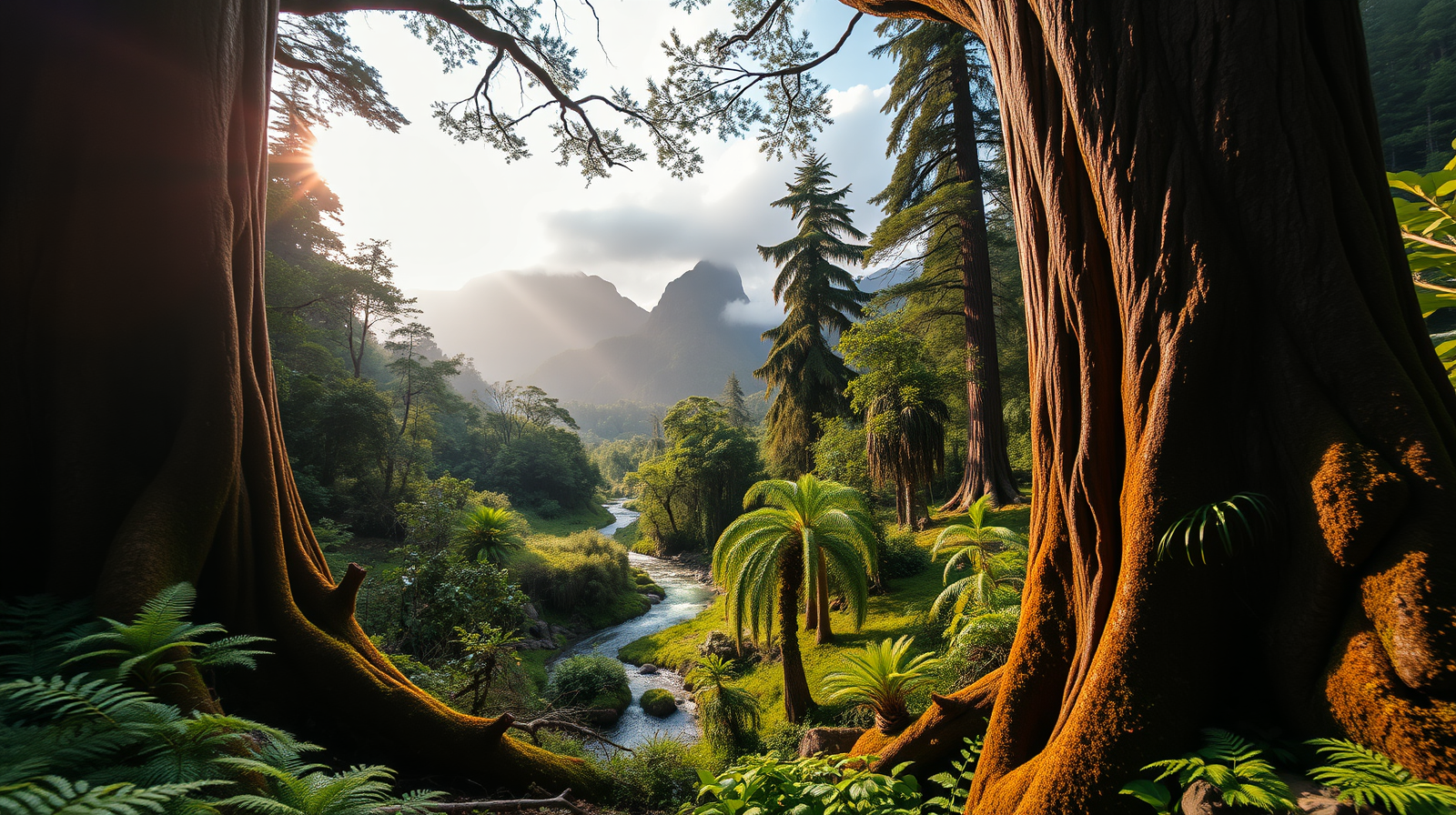
The rain in southern Chile does not fall so much as it occupies the space, a permanent grey mist that smells of wet stone, decaying pine needles, and centuries of undisturbed earth. Stand long enough beneath the canopy of an alerce tree in the Renihue River Valley, and you begin to understand why a man might abandon a empire of synthetic fleece and corporate boardrooms to stand shivering in the mud.
Douglas Tompkins arrived in this liquid wilderness in 1991. He brought with him a fortune built on the bright, noisy zippers and colorful nylon of the outdoor industry—things designed to help people conquer nature. But when he looked out over the ancient temperate rainforests of Chilean Patagonia, he did not see a playground. He saw a patient, dying patient. He saw massive tracts of old-growth timber marked for the chainsaw, ecosystems teetering on the edge of oblivion, and a profound, institutional silence about what was being lost.
Consider what happens when a billionaire decides to buy a valley.
At first, suspicion curdles the local air. In remote outpost towns where cattle ranches and logging operations dictate the rhythm of survival, a wealthy American showing up to snap up hundreds of thousands of acres looks less like a philanthropist and more like a land-grabber with an eccentric hobby. Whispers traveled along the gravel roads of the Carretera Austral. Some called him a water thief. Others whispered of secret nuclear dumps or foreign military bases.
Tompkins said nothing. He just kept writing checks, funneling the wealth of The North Face and Esprit into deeds, titles, and boundaries.
He wasn't collecting trophies. He was performing a kind of terrestrial triage.
Alongside his wife Kristine McDivitt Tompkins, the former CEO of Patagonia, he spent decades quietly acquiring more than two million acres across Chile and Argentina. They did not fence it off to keep humanity out like modern-day robber barons. Instead, they began the agonizing, counter-intuitive work of undoing human intervention. They tore down hundreds of miles of interior fences in places like the Chacabuco Valley. They pulled out thousands of head of cattle and sheep, allowing scarred earth to breathe. They brought back the elusive huemul deer, the puma, and the Andean condor.
Then came the tragedy that could have shattered the entire experiment. In 2015, Douglas Tompkins died in a kayaking accident on the cold waters of Lake General Carrera.
The vision could have dissolved into grief and probate battles. Instead, Kristine Tompkins stepped forward, holding the blueprint of a promise.
In 2017, she walked into a formal meeting with Chilean President Michelle Bachelet to sign what would become the largest private land donation to a government in South American history. Nearly one million acres of privately held wilderness were handed back to the public trust. Combined with existing state lands, this monumental transfer birthed new sanctuaries like Pumalín Douglas Tompkins National Park and Patagonia National Park, anchoring a sprawling 1,700-mile network known as the Route of Parks.
This wasn't just a transfer of real estate. It was a radical redesign of how a nation views its own geography.
Walk through Pumalín today, and you are stepping into a sanctuary protecting roughly a quarter of the world's remaining old-growth alerce trees—cathedrals of wood that were saplings when the Roman Empire fell and can live for over three millennia. These forests are silent vaults, storing an estimated 229 million metric tons of carbon, quietly anchoring the planetary atmosphere while the rest of the world burns through its margins.
Yet the true genius of the Tompkins model lies not in the trees, but in the people outside the park gates.
For generations, conservation has been framed as a war between local livelihoods and ecological preservation. You protect the forest, and you starve the logger. The Tompkins foundation flipped the equation entirely. By weaving these massive protected areas into the Route of Parks, they turned remote, economically forgotten gateway communities into ecotourism hubs. Small towns that once relied on cutting down the last ancient tree now thrive on showing it to travelers from Tokyo, Berlin, and New York.
Conservation, as it turns out, is an act of local economic empowerment, provided you give the community a reason to care about what is breathing in their backyard.
The numbers are staggering. Over eleven million acres are now protected within the broader Patagonian park network. Billions of dollars in private capital were spent, not to extract value, but to permanently lock it away from the balance sheets of corporate extractors.
When you stand at the edge of the Chacabuco Valley, where sheep tracks have faded back into native bunchgrass and the wind sweeps down unobstructed from the high Andes, the ghosts of the old disputes feel very far away. The locals who once eyed the American conservationists with bitter suspicion now run the outfitters, guide the hikes, and manage the park stations.
The map has changed. But more importantly, the imagination of what land is for has shifted on its axis.
A piece of paper signed in an office in Santiago codified it into law, but the real monument is written in the damp, heavy air of the southern rainforest, where the trees are allowed to grow old, fall down, and rot in peace, exactly as they have for ten thousand years.
:max_bytes(150000):strip_icc()/GettyImages-700832601-5bb602c0c9e77c002609fe08.jpg)