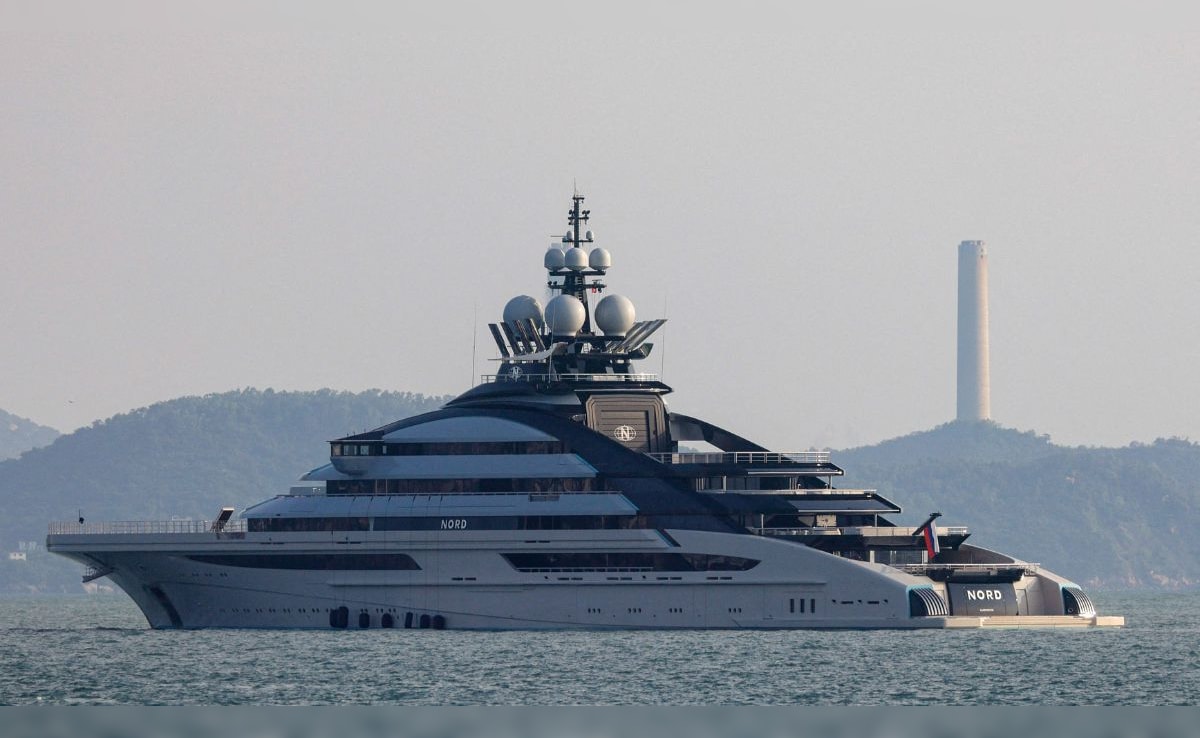
The movement of the 465-foot superyacht Nord through the Strait of Hormuz is not a leisure transit; it is a high-stakes stress test of international maritime law and the physical limits of the global financial sanctions regime. Valued at roughly $500 million, the vessel serves as a mobile sovereign micro-state that challenges the reach of Western jurisdictional enforcement. To understand the significance of this transit, one must look past the luxury aesthetic and analyze the vessel as a distressed asset operating within a fractured geopolitical framework.
The Architecture of Mobility as Defense
A superyacht of this scale operates on three distinct layers of existence: the physical hull, the digital identity (AIS), and the legal shell. For an asset like the Nord, which is linked to Alexei Mordashov—a target of extensive Western sanctions—maintaining mobility is a survival requirement. Once a vessel of this magnitude is seized, the maintenance costs alone (estimated at 10% of the vessel’s value annually) become a liability for the seizing state or a total loss for the owner.
The transit through the Strait of Hormuz represents a strategic exit from "contested" waters into "permissive" environments. The Strait is a chokepoint where 20% of the world’s oil passes, making it a zone of intense surveillance but also a region where local jurisdictions—specifically those in the Middle East—have historically maintained a neutral or non-extradition stance regarding Russian assets.
The Cost Function of Asset Preservation
Maintaining a $500 million asset under sanction involves a complex variable cost structure that traditional maritime analysis often ignores:
- Operational Burn Rate: Even when stationary, a vessel of 142 meters requires a skeleton crew, power for climate control to prevent interior degradation, and port fees. In transit, fuel consumption for twin MTU engines becomes a massive logistical hurdle if traditional bunkering ports are closed to sanctioned entities.
- Jurisdictional Arbitrage: The primary goal is to reach a "Safe Harbor" where the local government does not recognize the specific sanctioning body's authority (e.g., US OFAC or EU mandates). The transit to Vladivostok or Middle Eastern hubs is a flight toward legal safety.
- Depreciation and "Dark" Maintenance: Sanctioned vessels lose access to official manufacturer parts and certified technicians. Every mile traveled toward a non-aligned port increases the reliance on secondary market logistics, which may compromise the long-term resale value of the hull.
The Strait of Hormuz as a Geopolitical Filter
The Strait of Hormuz is governed by the United Nations Convention on the Law of the Sea (UNCLOS), specifically the right of "transit passage" for all vessels. This legal nuance is what allowed the Nord to move through one of the most monitored waterways in the world without immediate interdiction.
Naval forces stationed in the region, including the US Fifth Fleet, operate under specific Rules of Engagement (ROE). Unless a vessel is suspected of piracy, terrorism, or direct violations of international safety standards, the "right of innocent passage" remains a powerful shield. The Nord’s transit highlights a structural flaw in the sanctions regime: economic restrictions are not synonymous with maritime blockade. A sanctioned owner may be barred from the US banking system, but their physical property remains protected by centuries-old maritime passage rights unless a local court issues a seizure warrant.
Strategic Signal Intelligence and AIS Manipulation
The use of the Automatic Identification System (AIS) during this transit reveals a calculated approach to visibility. Large vessels are required to broadcast their position for safety. However, sanctioned assets frequently engage in "spoofing" or "going dark" (turning off the transponder) to obscure their destination.
The Nord’s decision to remain visible or selectively invisible during the Hormuz transit signals its intent to the international community. Appearing on AIS suggests a claim of legitimacy—an assertion that the vessel is operating within the law and has nothing to hide. Conversely, "going dark" is a tactical move used when approaching ports where a quiet entry is preferred to avoid diplomatic pressure on the host nation.
The Three Pillars of Sanction Resistance
The ability of the Nord to remain operational and mobile depends on a triumvirate of support systems that exist outside the Western financial perimeter.
1. Parallel Financial Rails
A vessel cannot operate without liquidity. Crew salaries, fuel, and docking fees must be paid. The Nord’s continued movement implies the existence of a payment pipeline using non-Western currencies or sophisticated barter systems. This bypasses the SWIFT network and utilizes banks in jurisdictions that have not adopted the G7’s sanction package.
2. Flag State Protection
The "Flag of Convenience" system is the Achilles' heel of maritime enforcement. While many sanctioned yachts were flagged in the Cayman Islands or Bermuda (UK Overseas Territories), many have since re-flagged to the Russian registry or other non-compliant nations. If the flag state does not de-register the vessel, other nations have limited legal grounds to board it on the high seas.
3. Logistical Ghost Networks
Modern superyachts require specialized aviation-grade fuel and proprietary software updates for navigation and engine management. The Nord’s transit suggests a shadow supply chain is now active, providing "gray market" parts and services. This mirrors the "shadow fleet" of tankers used to transport sanctioned oil, indicating that the infrastructure for maintaining high-value Russian assets has matured and stabilized.
Structural Vulnerabilities in Enforcement
The Nord’s journey exposes the reality that sanctions are only as strong as their weakest link in the global port network. The "Sailing for Safety" strategy utilized by these vessels relies on the fact that international law is fragmented.
- The Mutual Legal Assistance Treaty (MLAT) Gap: For a seizure to occur in a foreign port, the requesting country (e.g., the US) must have an active MLAT with the host country. If the host country refuses to recognize the underlying "crime" (in this case, being a sanctioned individual), the request is denied.
- The Proportionality Defense: Owners of these vessels often tie up the legal system by arguing that the seizure is a violation of property rights without due process. While the vessel is tied up in a multi-year legal battle, it rots. The Nord’s strategy is to avoid this "death by litigation" by staying in motion toward jurisdictions that offer total legal immunity.
The Economic Implications of Mobile Wealth Hiding
The Nord is a precursor to a larger shift in how ultra-high-net-worth individuals (UHNWIs) in non-aligned nations will structure their assets moving forward. We are seeing the "de-Westernization" of luxury assets.
Future builds will likely prioritize "sovereign-neutral" components—engines, electronics, and stabilization systems that do not rely on US or EU-based intellectual property or cloud-based maintenance locks. If a yacht can be remotely disabled via a software update from a headquarters in Germany or the Netherlands, it is no longer a safe store of value for a sanctioned individual.
The Nord's transit through Hormuz marks the end of the era where the Mediterranean was the only viable theater for superyacht operations. The shift toward the Indian Ocean and the Pacific represents a permanent relocation of mobile capital.
Strategic Vector: The Future of Maritime Asset Protection
The Nord's successful navigation of the Hormuz chokepoint dictates a new playbook for the protection of high-value mobile assets under geopolitical duress.
The primary move for stakeholders in this space is the diversification of "jurisdictional footprints." This involves maintaining multiple crews of differing nationalities, using decentralized autonomous organizations (DAOs) or complex trust structures for ownership that lack a single "point of failure," and ensuring that all critical maintenance can be performed in "neutral" shipyards in the Global South.
As the Nord nears its destination, it leaves behind a blueprint for how the world’s most expensive private assets can effectively vanish from the Western oversight loop while remaining in plain sight. The vessel is no longer just a boat; it is a proof of concept for the limitations of global financial hegemony in the 21st century.
The final strategic play for those monitoring these movements is to shift focus from the vessel itself to the bunkering and provisioning nodes that allow it to bypass traditional ports. Controlling the fuel and the parts is the only way to ground a sovereign asset that refuses to recognize the lines on a map.