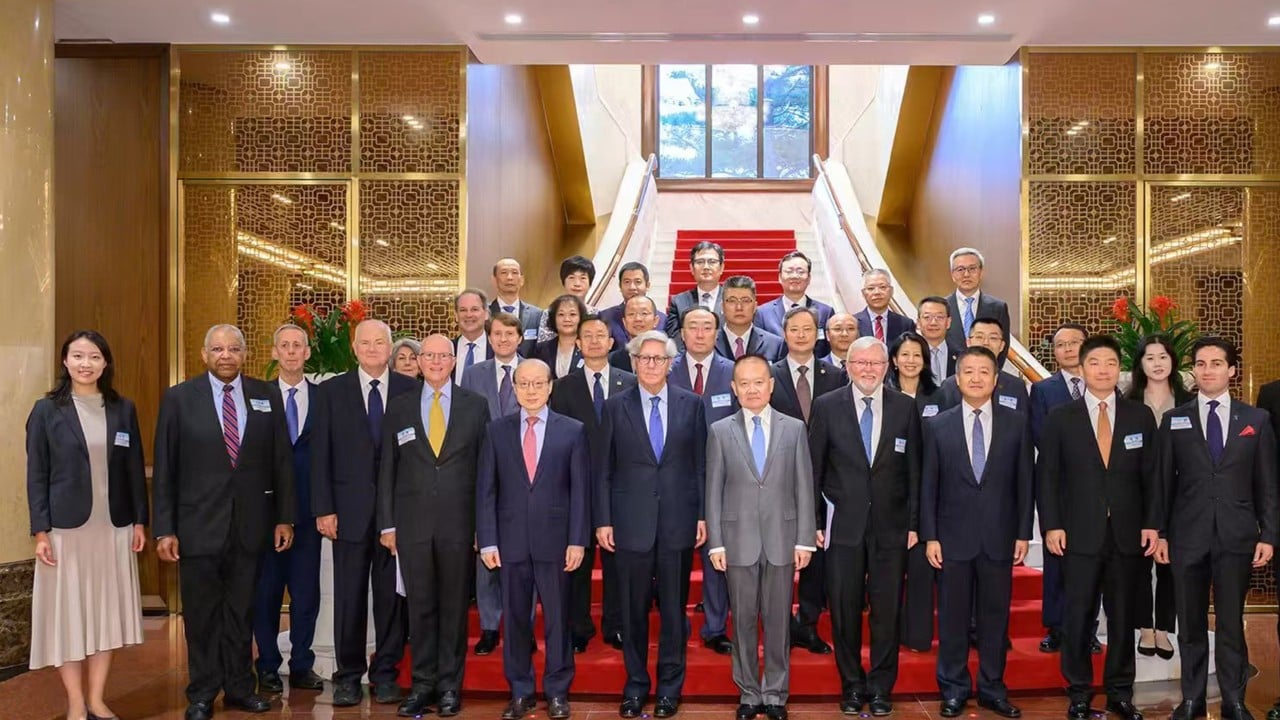
Bilateral stability between superpowers does not emerge from diplomatic goodwill. It is a calculated equilibrium produced by institutionalized channels that bypass the rigidity of formal statecraft. The recent recurrence of Track One Point Five dialogues between Washington and Beijing represents an attempt to construct a predictable operational ceiling for geopolitical conflict. Official state diplomacy, designated as Track One, suffers from public posturing, domestic political exposure, and legalistic inflexibility. Purely academic or non-governmental exchanges, categorized as Track Two, lack executive implementation power. Track One Point Five occupies the structural intersection, combining current government officials acting in unofficial or semi-official capacities with policy experts, think tanks, and business leaders. This hybrid architecture functions as a low-cost, high-bandwidth laboratory for testing policy propositions without incurring formal political liability.
The core utility of these multi-tiered exchanges lies in mitigating the information asymmetry that defines modern great-power competition. When formal channels freeze due to domestic electoral pressures or immediate security crises, operational miscalculations compound rapidly. The mechanics of these dialogues operate through three distinct vectors: signal calibration, constraint mapping, and decoupled technical problem-solving. Each vector addresses a specific failure mode in traditional state-to-state communication.
The Three Operational Vectors of Hybrid Diplomacy
Signal Calibration
In standard diplomatic environments, public pronouncements are designed for domestic consumption, rendering them noisy indicators of actual intent. Track One Point Five forums strip away public rhetorical performance. Participants utilize off-the-record parameters, frequently bound by Chatham House rules, to test the boundaries of red lines.
A state official participating in an unofficial capacity can signal flexibility or communicate the precise domestic threshold of a policy stance without binding their administration to a formal concession. This reduces the risk of strategic surprise. Both capitals require a mechanism to distinguish between tactical posturing and existential intent. Without this calibration, minor maritime or commercial frictions risk escalating through uncorrected misinterpretation.
Constraint Mapping
Superpower competition is bounded by structural limits, including economic interdependence, technological entanglement, and shared global vulnerabilities such as climate degradation or artificial intelligence safety. Hybrid dialogues map these constraints systematically rather than reactively.
When participants from both nations model the friction points in supply chains or military-to-military communication failures, they generate empirical data on the systemic cost of total decoupling. The resulting insights allow strategists to identify non-negotiable security imperatives and separate them from negotiable commercial or regulatory disputes.
Decoupled Technical Problem-Solving
Complex systemic risks, particularly the governance of autonomous military systems and artificial intelligence frameworks, evolve faster than formal treaties can be negotiated. Traditional treaty-making requires years of bureaucratic drafting, legislative ratification, and public scrutiny.
Hybrid channels permit technical experts and mid-level bureaucrats to draft shared taxonomies for emerging risks. By addressing issues like algorithmic escalation in financial markets or automated defense systems away from the glare of legislative bodies, these forums establish baseline safety protocols that can later be adopted by formal state apparatuses.
The Cost Function of Bipolar Friction
The pursuit of normal stability is constrained by an unforgiving economic and political cost function. Every attempt to institutionalize dialogue faces severe internal resistance within both political systems. In Washington and Beijing, hardline factions treat engagement as appeasement, creating a domestic penalty for diplomats perceived as overly accommodating.
Consequently, the utility of these talks must be evaluated against their structural limitations. Hybrid diplomacy cannot resolve foundational ideological disagreements, nor can it reverse deep-seated technological competition in critical infrastructure and semiconductors. What these mechanisms can achieve is the establishment of a lower bound on hostility—a systemic floor preventing competitive friction from descending into kinetic conflict.
The structural failure mode of these dialogues occurs when they are mistaken for substantive policy alignment. They are not peace treaties or alliance renewals. They are risk-management protocols designed to maintain basic operational safety in a permanently adversarial environment. If the participants treat the process as an end in itself rather than a diagnostic tool, the dialogue degenerates into diplomatic theater.
Strategic Allocation of Diplomatic Capital
To maximize the efficacy of semi-formal bilateral engagement, policy architectures must transition from episodic summits to continuous, institutionalized simulation exercises. Officials must stop treating these channels as emergency valves to be opened only during crises.
The primary strategic directive for managing bilateral friction is to institutionalize technical working groups that operate independently of top-level political volatility. By isolating functional discussions on economic rules, algorithmic safety standards, and maritime safety protocols from broader geopolitical grandstanding, both nations can preserve functional operational guardrails. Stability is not a permanent condition gifted by diplomatic optimism. It is a depreciating asset that requires continuous, unglamorous, and rigorously structured maintenance.