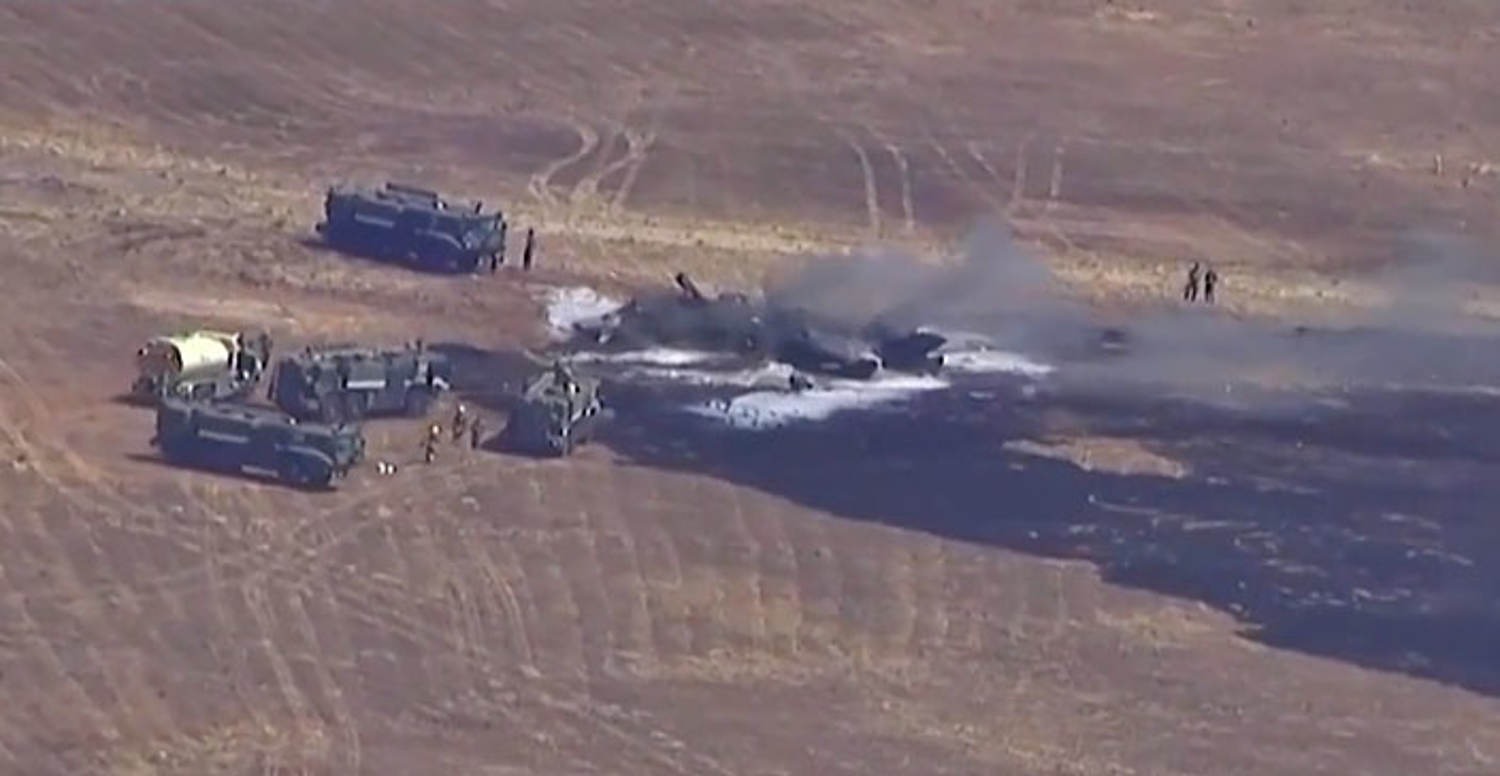
The recent Class A mishap involving an F-35B Lightning II at Marine Corps Air Station Miramar demonstrates the complex vulnerabilities inherent in fifth-generation tactical aviation. Rather than treating such an incident as an isolated operational failure, structural analysis requires deconstructing the compounding variables of high-performance vectoring flight, fiscal lifecycle costs, and systemic maintenance dependencies.
The Miramar incident officially triggered a Class A designation, the military's most severe classification for aviation events involving total aircraft loss, damages exceeding two million dollars, or fatalities. While the pilot successfully executed emergency ejection procedures and sustained non-life-threatening injuries, the destruction of a platform valued at approximately 109 million dollars refocuses strategic scrutiny on the operational mechanics governing short takeoff and vertical landing systems.
The Aerodynamic Complexity Vector
The F-35B variant relies on a complex propulsion architecture comprising a main turbofan engine, a driveshaft-driven lift fan positioned forward of the cockpit, a three-bearing swivel nozzle that redirects thrust downward, and roll-post ducts on the outer wings. This configuration enables unique operational flexibility but introduces multiple failure points absent in conventional fixed-wing platforms.
Managing transition states—specifically the shift between wing-borne aerodynamic lift and thrust-borne vertical lift during low-speed final approaches—demands precise sensor feedback and rapid actuator response times. Witnesses observed the aircraft decelerating sharply near the runway threshold prior to the emergency ejection, a profile indicative of instability within the flight control logic or propulsion vectoring loop.
The Cost Function of Modern Stealth Fleets
Financial tracking of the F-35 program reveals a widening gap between initial acquisition projections and long-term sustainment outlays. Government Accountability Office assessments place the total program cost trajectory near two trillion dollars across its multi-decade lifecycle, driven heavily by depot-level maintenance bottlenecks and software integration delays.
- Acquisition Outlay: Capital expenditure per unit hovers near 109 million dollars depending on the production lot, tying up substantial capital within single tactical wings.
- Sustainment Friction: Mission-capable rates are continually constrained by specialized coating maintenance, supply chain delays for proprietary components, and software block upgrades.
- Attrition Economics: The loss of a single airframe through a Class A mishap carries cascading opportunity costs, permanently reducing the fleet size of an active combat-coded squadron assigned to the 3rd Marine Aircraft Wing.
Systemic Risk Mitigation
Preventing future mishaps of this classification requires shifting diagnostic focus from pilot error to systemic engineering redundancies. Flight control computers must process complex aerodynamic inputs in real time, yet edge-case scenarios during low-speed vertical descent can overwhelm automated recovery parameters.
Re-engineering failure mitigation strategies involves expanding autonomous flight envelope protections, upgrading diagnostic telemetry to detect actuator fatigue before structural failure occurs, and decentralizing maintenance depots to reduce turnaround times for high-wear propulsion components. The long-term viability of the fleet relies on decoupling software complexity from mechanical reliability.