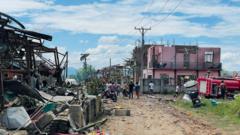
The utilization of high-yield explosive ordnance against localized logistics hubs in rebel-held territories represents a calculable shift from territorial acquisition to cost-imposition strategies. When a major blast decimates a village infrastructure under opposition control, public reporting typically focuses on immediate casualty counts. A structural analysis, however, reveals that these events operate as deliberate disruptors within a broader framework of asymmetric warfare. The primary objective is rarely the immediate capture of geography; instead, it is the systematic destruction of the insurgent governance capacity, the enforcement of civilian displacement, and the degradation of the opposition's economic baseline.
Understanding these dynamics requires breaking down the operational theater into specific variables: kinetic delivery methods, localized supply-chain vulnerabilities, and the strategic calculus of state versus non-state actors. By evaluating these components, we can map the long-term structural consequences of remote kinetic strikes in contested regions. For a deeper dive into similar topics, we suggest: this related article.
The Tri-Border Vulnerability Framework
Rebel-held villages in peripheral regions do not exist in isolation; they function as critical nodes in an informal, transnational network. The vulnerability of these settlements to catastrophic kinetic events can be analyzed through three distinct structural pillars.
- Logistical Convergence: Opposition groups rely heavily on border-adjacent geography to facilitate the inflow of material, ranging from medical supplies to small arms. A village positioned along these routes naturally becomes a warehousing and distribution hub. This concentration of high-value assets creates an optimal target profile for state forces utilizing aerial assets or long-range artillery.
- Administrative Substitution: When a central government loses physical control over a territory, rebel factions attempt to establish alternative governance structures to secure legitimacy. This includes setting up local administrations, taxation systems, and rudimentary judicial bodies. Destroying the physical infrastructure of these institutions undermines the perceived competence of the opposition leadership, signaling to the population that the rebel administration cannot guarantee basic security.
- Demographic Concentrators: Displaced populations internally migrating away from active frontlines frequently cluster in deep-interior rebel villages, assuming these locations offer relative safety. This demographic density artificially inflates the casualty rate of any kinetic strike. The presence of dense civilian concentrations mingled with decentralized military installations ensures that high-yield explosives produce catastrophic collateral damage, which serves to accelerate broader regional depopulation.
The Logistics of Remote Kinetic Delivery
State forces possessing a monopoly on aviation and heavy artillery utilize these assets to offset deficiencies in ground-force availability and morale. When executing strikes on remote opposition enclaves, the choice of ordnance and delivery mechanism dictates both the immediate destructive yield and the subsequent psychological fallout. For further details on this topic, in-depth coverage can be read at The Guardian.
Aerial Ingress versus Artillery Interdiction
The deployment of unguided high-explosive bombs via fixed-wing aircraft or rotorcraft remains the primary mechanism for maximizing localized structural collapse. In mountainous or densely forested terrain, precision-guided munitions are often economically inefficient or unavailable due to supply constraints. Consequently, state forces rely on area-denial tactics, dropping large-tonnage conventional explosives designed to detonate upon impact or via proximity fuzes.
This operational methodology introduces structural instability into the target zone. The shockwave generated by a high-yield blast in a rural settlement causes widespread failure of non-reinforced masonry structures, which are typical in peripheral regions. The primary cause of mortality in these scenarios is rarely the fragmentation itself, but rather the secondary structural collapse of unreinforced dwellings and subsequent asphyxiation or trauma beneath the rubble.
The Problem of Information Asymmetry in Damage Assessment
Accurately quantifying the impact of a blast in rebel-held territory is obstructed by competing information-warfare strategies. State entities typically report the successful neutralization of command-and-control centers or illicit supply depots. Conversely, opposition networks emphasize civilian casualties to mobilize international diplomatic pressure and secure humanitarian funding.
A rigorous analytical approach requires discounting the rhetorical layering from both factions and focusing on verifiable operational indicators:
- Crater Metrics: The physical dimensions of the detonation point indicate the approximate weight and class of the explosive payload, distinguishing between improvised local storage detonations and external state-delivered ordnance.
- Displacement Velocity: The rate at which the surviving population evacuates the target zone post-strike serves as a quantifiable metric of regional stability and faith in local defense capabilities.
- Supply Price Fluctuation: Sharp increases in the cost of basic commodities in neighboring sectors immediately following a strike confirm the destruction of a central distribution node.
Attrition Dynamics and the Cost Function of Insurgency
The strategic logic underpinning these strikes is rooted in classical attrition theory. A state military capable of sustaining a protracted conflict focuses on driving up the operational cost function of the insurgent force until it exceeds their resource generation capacity.
$$\text{Total Insurgent Cost} = C_{\text{material}} + C_{\text{governance}} + C_{\text{legitimacy}}$$
Every strike on a rebel-controlled village forces the opposition to reallocate scarce resources from offensive military operations toward basic survival and reconstruction needs.
The Reconstruction Bottleneck
Non-state actors rarely possess the capital, heavy machinery, or technical expertise required to clear large-scale structural debris or restore damaged utility grids. When a village suffers severe structural damage, the local administrative body faces an immediate operational bottleneck. If they fail to restore water, medical access, and basic shelter, their local legitimacy erodes. If they divert funds to rebuild, their frontline military capabilities suffer from resource starvation.
The Displacement Weaponization Factor
Forcing civilian populations out of rebel territories and into government-controlled zones or international refugee camps alters the demographic balance of the conflict. This migration strips the insurgency of its tax base, its local intelligence-gathering networks, and its recruitment pool. The civilian population transforms from an asset supporting the insurgency into a financial and logistical burden managed by external humanitarian agencies or neighboring states.
Operational Limitations of the Stand-Off Strategy
While high-yield kinetic strikes allow state forces to inflict severe damage without risking ground troops, the strategy possesses inherent limitations that prevent it from achieving absolute military victory.
The reliance on remote bombardment frequently hardens political resolve among the surviving population, driving recruitment toward radical factions within the opposition. Furthermore, absent subsequent ground maneuvers to occupy and secure the targeted zone, the strategic value of the strike decays over time. Insurgent networks are highly adaptable; they routinely decentralize their storage facilities and shift to mobile command posts in response to persistent aerial threats.
The long-term efficacy of this doctrine depends entirely on whether the state can maintain a continuous operational tempo. If the frequency of strikes drops due to economic sanctions, ordnance depletion, or maintenance backlogs, opposition forces inevitably adapt their logistics chains, render their infrastructure resilient to air strikes, and re-establish the status quo ante.
Tactical Realignment for Non-State Defensively Positioned Forces
To mitigate the systemic vulnerabilities exposed by high-yield remote strikes, defensive actors operating in peripheral territories must transition away from concentrated rural hubs. The preservation of administrative and logistical continuity requires implementing a strict protocol of operational decentralization.
- Dispersal of Logistics Assets: High-value material must be divided into micro-depots scattered across wider geographic corridors, ensuring that no single kinetic event can compromise more than five percent of regional reserves.
- Asymmetric Communications Infrastructure: Physical administrative centers must be replaced with mobile, digitally distributed governance teams operating via encrypted, off-grid communication networks to deny state intelligence clear target coordinates.
- Subterranean Fortification: Critical medical and command infrastructure must be systematically relocated to subterranean facilities or deep terrain features capable of withstanding heavy ordnance detonations.
Failing to implement these structural shifts guarantees that centralized rural settlements will remain lucrative target profiles, allowing state forces to achieve maximum disruptive impact with minimal expenditure of tactical assets.