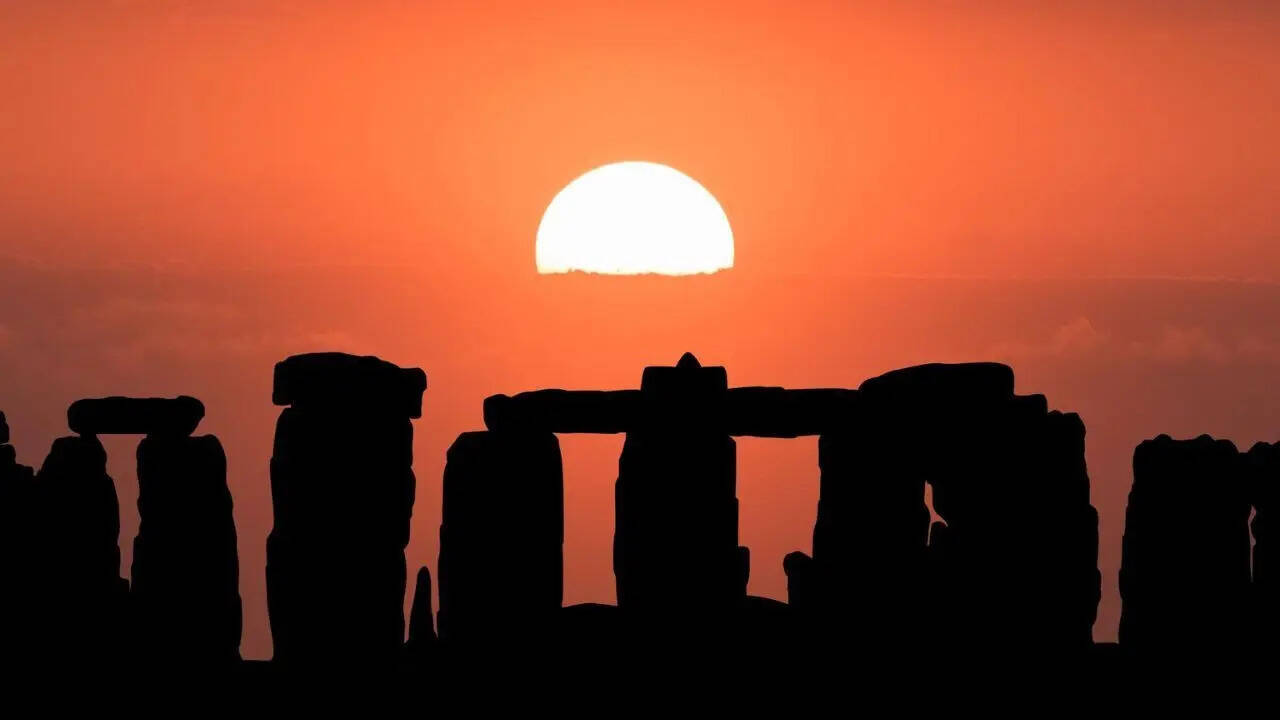
The concept of the "longest day of the year" is frequently reduced to a casual calendar marker, yet it represents a precise, non-static astronomical convergence. For the year 2026, this planetary event occurs on Sunday, June 21, at exactly 08:24 Coordinated Universal Time (UTC). Because this moment happens simultaneously across the globe, localized time zone offsets alter the calendar date for observers in Western territories:
- Pacific Daylight Time (PDT): Saturday, June 20, at 7:24 p.m.
- Eastern Daylight Time (EDT): Sunday, June 21, at 4:24 a.m.
- British Summer Time (BST): Sunday, June 21, at 9:24 a.m.
To evaluate why this date fluctuates, how daylight distribution shifts non-linearly by latitude, and why the day of maximum irradiance fails to align with the day of maximum temperature, we must analyze the structural mechanics of Earth's orbital dynamics. For a different view, see: this related article.
The Three Vectors of Solstice Drift
The Gregorian calendar operates as a rigid mathematical grid of 365 days, with an occasional 366-day leap year correction. Earth’s actual tropical year—the duration required to travel from one vernal equinox to the next—is approximately 365.2422 days. This systematic discrepancy introduces a predictable instability into the timing of the June solstice, driving a three-part chronological shift.
1. Cumulative Fractional Day Drift
Every standard calendar year under-records Earth's orbital journey by roughly 5 hours, 48 minutes, and 45 seconds. Consequently, the exact time of the solstice migrates backward on the clock by roughly six hours annually. This incremental delay pushes the event deeper into the calendar day or over into the subsequent date. Related reporting regarding this has been provided by The Next Web.
2. The Quadrennial Leap Year Reset
The addition of February 29 every four years injects 24 hours back into the calendar system. This abrupt correction forces the solstice date to snap backward by a full calendar day. The structural dance between this quadrennial adjustment and the annual fractional drift explains why the June solstice shimmies between June 20 and June 22. In 2026, we are positioned two years post-leap-year, stabilizing the event firmly on June 21 for the majority of the global population.
3. Precession and Perturbation
Over millennia, axial precession (the slow wobble of Earth’s rotational axis) and gravitational perturbations from other planets alter the perihelion—the point in orbit where Earth is closest to the Sun. This alters the velocity of our planet at different points along its elliptical path, causing the relative lengths of the astronomical seasons to shift over deep time.
The Geometry of Obliquity and Solar Irradiance
The core cause of the summer solstice is the planet's axial tilt, or obliquity, which sits at approximately 23.44° relative to the orbital plane (the ecliptic). The solstice is not an all-day event; it is the singular mathematical instant when the Northern Hemisphere reaches its maximum inclination toward the Sun.
At 08:24 UTC on June 21, 2026, the Sun reaches its absolute zenith directly over the Tropic of Cancer, located at 23.44° North latitude. At this precise point, incoming solar radiation hits the surface at a perpendicular 90° angle.
$$E = E_0 \cos(\theta)$$
Where:
- $E$ is the actual irradiance received at the surface.
- $E_0$ is the solar constant outside the atmosphere.
- $\theta$ is the solar zenith angle.
Because $\theta = 0$ at the subsolar point on the Tropic of Cancer during the solstice, $\cos(0) = 1$, yielding the absolute maximum potential atmospheric energy transfer for that latitude.
The geometry of a tilted sphere spinning in an orbital plane dictates that day length does not scale linearly. Instead, daylight duration increases exponentially as a function of northward latitude during the June solstice:
- Miami, FL (25.8° N): 13 hours, 45 minutes
- New York, NY (40.7° N): 15 hours, 05 minutes
- Anchorage, AK (61.2° N): 19 hours, 21 minutes
- Utqiagvik, AK (71.3° N): 24 hours, 00 minutes (Continuous daylight)
North of the Arctic Circle (66.56° N), the geometric horizon never intersects the solar disk, creating the phenomenon of the midnight sun, where total daylight reaches 100% of the 24-hour cycle.
The Thermal Lag Bottleneck
A common misconception is that the day of maximum solar irradiance must match the hottest day of the year. While June 21, 2026, receives the highest volume of photons, peak surface temperatures across the Northern Hemisphere typically do not materialize until late July or August. This delayed response is driven by a thermodynamic bottleneck known as seasonal thermal lag.
Earth’s surface is composed of diverse materials with vast differences in specific heat capacity. Water requires significantly more energy to raise its temperature by one degree Celsius than rock or soil. The oceans, which cover over 70% of the planet's surface, act as massive thermal heat sinks.
During the weeks leading up to June 21, the Northern Hemisphere receives more energy from the Sun than it radiates back into space. On the solstice, this net energy surplus reaches its peak. The system, however, remains in an unequilibrium state. For several weeks after the solstice, even as the total daily solar input begins its slow decline, the absolute energy input still outpaces the infrastructure's capacity to radiate that heat back out into the vacuum of space.
The net heat budget of the atmosphere, oceans, and landmasses remains positive well into late summer. Peak seasonal temperatures are only realized when the net energy input drops below the level of outgoing longwave radiation, a crossover point that generally occurs four to six weeks following the astronomical solstice.
Perihelion Inversion and the Asymmetry of Sunrises
While the June solstice offers the longest duration between sunrise and sunset, it does not feature the earliest sunrise or the latest sunset of the year. This structural asymmetry surprises observers who expect a clean mathematical symmetry around noon.
The misalignment stems from the Equation of Time, an analytical framework accounting for two distinct variables: the ellipticity of Earth’s orbit and the tilt of its equator. Because Earth’s orbit is an ellipse rather than a perfect circle, its orbital speed varies according to Kepler's second law. The planet accelerates near perihelion (early January) and decelerates near aphelion (early July).
This variance means that apparent solar time (measured by the actual position of the Sun in the sky) diverges from mean solar time (the uniform 24-hour clock kept by mechanical devices). Near the June solstice, a true solar day is slightly longer than 24 hours. This stretches the solar noon backward on the clock day over day.
The structural consequence is clear:
- The earliest sunrise occurs roughly a week before the solstice (mid-June).
- The latest sunset occurs roughly a week after the solstice (late June).
The solstice is simply the mathematical tipping point where the rate of change in day length hits zero before reversing direction.
Architectural Tracking and Spatial Optimization
The predictability of the 2026 solstice provides immediate utility for engineers, architects, and energy planners optimizing localized systems. Because the solar path on June 21 represents the absolute boundary condition for solar altitude angles, it establishes the maximum tolerances required for passive cooling and active solar capturing systems.
Architects calculating roof overhangs use the solstice angle to ensure that high-altitude summer sun rays are blocked from entering south-facing windows, minimizing the thermal load on HVAC systems. Conversely, solar arrays are calibrated against this spatial track to optimize panel tilt angles, balancing the extreme midday yields of June against the lower-yield tracking required for winter energy generation.
The strategic takeaway for structural modeling is absolute: designing for the solstice is not an exercise in tracking an average day, but rather an exercise in mapping the structural limits of our planet's interaction with its star.