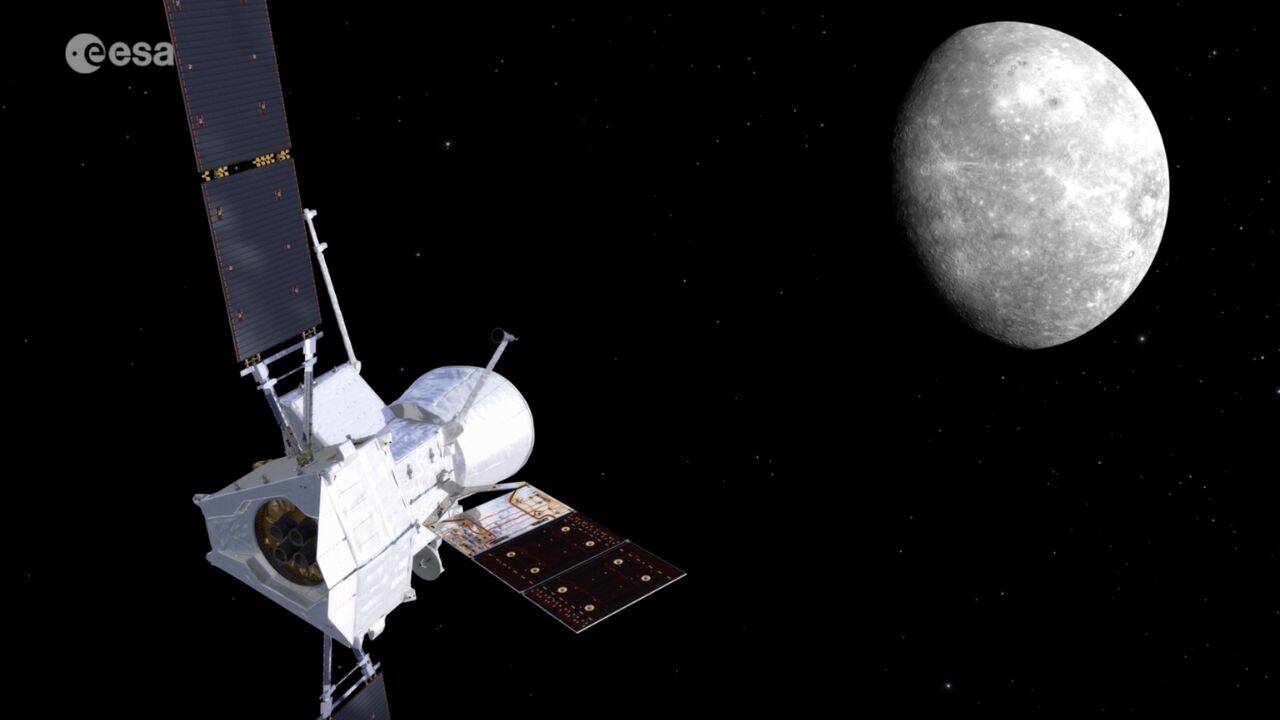
Inserting a spacecraft into orbit around Mercury represents one of the most severe challenges in astrodynamics. While a flight to Saturn requires less net energy despite spanning ten times the physical distance, a mission to the innermost planet demands an aggressive expenditure of delta-v to counter the gravitational dominance of the Sun. BepiColombo, the joint mission between the European Space Agency (ESA) and the Japan Aerospace Exploration Agency (JAXA), provides a definitive case study in managing this deep solar gravity well. Following an eight-year transit spanning 9.3 billion kilometers, the spacecraft permanently deactivated its solar-electric propulsion system on June 15, 2026. This transitioned the mission from an active propulsion cruise to a ballistic arrival sequence culminating in November 2026.
The baseline problem of Mercury exploration is not distance, but velocity management. A direct trajectory inward from Earth accelerates a spacecraft due to solar gravity, causing it to arrive at Mercury with a relative velocity far exceeding the planet's escape velocity of 4.3 kilometers per second. Because Mercury possesses only 5.5% of Earth's mass, its gravitational catch-basin is exceptionally shallow. A spacecraft traveling too fast will simply execute a hyperbolic flyby, escaping back into a heliocentric orbit. Resolving this delta-v deficit requires a highly optimized combination of continuous low-thrust propulsion and resonant gravity assists. Also making news lately: The Brutal Truth Behind the F-15EX and Ghost Bat Pacific Photo Op.
The Braking Architecture: Solar Electric Propulsion vs. Gravity Assists
To decelerate without carrying prohibitive amounts of chemical propellant, BepiColombo utilized a dual-mode deceleration framework: a Solar Electric Propulsion (SEP) system operating in tandem with a multi-planet gravity assist schedule. The Mercury Transfer Module (MTM) contains four QinetiQ T6 ion thrusters. These engines ionize xenon gas using electrical power generated by expansive solar arrays, accelerating the ions through an electrostatic grid to achieve an exhaust velocity of approximately 50,000 meters per second.
While these ion thrusters provide an exceptionally high specific impulse compared to chemical rockets, their thrust-to-weight ratio is low. They cannot provide the rapid, high-magnitude velocity changes needed for conventional orbit insertion. Instead, they must fire continuously over thousands of hours to progressively shrink the spacecraft's perihelion. The balance of the deceleration workload is offloaded to planetary bodies through a sequenced choreography of nine flybys: More information on this are detailed by CNET.
- Earth Flyby (April 2020): Shaped the initial heliocentric orbit to drop the spacecraft's perihelion toward Venus.
- Venus Flybys (October 2020, August 2021): Stripped substantial orbital energy from the spacecraft, dropping the perihelion down to match Mercury's orbital radius without burning mass.
- Mercury Flybys (Six encounters between 2021 and January 2025): Progressively synchronized the spacecraft’s orbital period and inclination with Mercury, reducing the relative velocity to a manageable 1.76 kilometers per second.
[Earth Launch (2018)] ➔ [1x Earth Flyby (2020)] ➔ [2x Venus Flybys (2020-2021)] ➔ [6x Mercury Flybys (2021-2025)] ➔ [Ballistic Orbit Capture (Nov 2026)]
Contingency Re-Engineering: The 2024 Power Anomaly
The operational limits of this trajectory were tested in May 2024, when a hardware malfunction occurred within the power system of the MTM. The anomaly restricted the maximum electrical currents deliverable to the ion thrusters, preventing the system from achieving full rated thrust. In a purely chemical mission, a reduction in available thrust during a critical burn window frequently results in total mission failure. For an ion-driven mission, the penalty is paid in time and structural optimization.
Astrodynamicists at ESA and JAXA re-calculated the trajectory to match the degraded thrust profile. During the fourth Mercury flyby on September 5, 2024, engineers lowered the target altitude closer to the planetary surface than originally planned. This exploit used Mercury's local gravity more aggressively to compensate for the lost engine performance. The strategic trade-off preserved the scientific objectives of the mission but delayed the final orbit insertion from December 2025 to November 2026. This eleven-month penalty demonstrates the high sensitivity of multi-body low-thrust trajectories to power-distribution failures.
The Multi-Orbiter Separation and Capture Phase
The arrival phase beginning in late 2026 marks the end of the integrated Mercury Cruise System. BepiColombo is not a single spacecraft, but a stacked composite of three distinct functional units. Maintaining this combined structure is necessary during the cruise phase to simplify thermal shielding and attitude control, but it is fundamentally incompatible with the distinct scientific objectives of the mission's two independent orbiters.
On September 3, 2026, the mission will initiate the physical separation of the Mercury Transfer Module. Stripped of its active ion engines, the remaining dual-orbiter stack will coast ballistically toward the insertion point. On November 21, 2026, the composite structure enters Mercury's sphere of influence to execute the primary orbit insertion maneuver, using a small auxiliary chemical propulsion system to achieve capture within a highly elliptical polar orbit.
Once initial capture is secured, the stack undergoes a staged deployment:
1. Mio (Mercury Magnetospheric Orbiter)
Developed by JAXA, Mio is optimized specifically to study the planet's highly dynamic magnetic field and plasma environment. The spacecraft is dropped first into an elongated, elliptical orbit (400 x 11,800 kilometers). This wide orbit allows the spacecraft to sample the boundaries of Mercury's magnetosphere and track how it deforms under the impact of the solar wind. To ensure uniform field measurements and survive the extreme thermal radiative environment, Mio spins continuously at 15 revolutions per minute.
2. Mercury Planetary Orbiter (MPO)
Following the release of Mio, the ESA-built MPO utilizes its own chemical thrusters to execute a series of orbit-lowering maneuvers. Over a multi-month period extending into March 2027, MPO will circularize its trajectory into a tight polar orbit (480 x 1,500 kilometers). This low altitude is optimized for nadir-pointing instruments that map surface mineralogy, measure local gravitational anomalies, and capture high-resolution topography.
Thermal Management Constraints
Operating an orbiter around Mercury imposes severe thermal constraints that dictate the structural architecture of both spacecraft. At Mercury's perihelion, the intensity of solar radiation reaches approximately $14.5 \text{ kW/m}^2$, which is roughly ten times the value received at Earth. Furthermore, the spacecraft must contend with planetary infrared radiation: the sunlit surface of Mercury heats up to $450^\circ\text{C}$, acting as a massive thermal radiator that bakes low-orbiting satellites from below.
To prevent critical component failure, MPO does not rely on passive insulation alone. It is designed with a specialized heat pipe radiator panel that faces permanently away from the planet and the Sun, dumping internal thermal energy into deep space. The entire body of MPO is wrapped in high-temperature multi-layer insulation blankets made of aluminized sewing-grade ceramic fabrics. Mio uses a completely different strategy; its exterior is covered entirely in high-efficiency mirrors that reflect incoming solar rays before they can heat the underlying structure, complemented by a dedicated sunshield (MOSIF) that protects it during the cruise phase prior to separation.
Definitive Operational Forecast
The structural decoupling of Mio and MPO in late 2026 will resolve the main limitation of previous Mercury missions. NASA's MESSENGER spacecraft, which orbited the planet between 2011 and 2015, carried a single instrument suite that could not measure spatial variations in the magnetosphere while simultaneously mapping surface geology.
By operating two distinct platforms concurrently in different orbits, BepiColombo will execute simultaneous dual-point measurements. When Mio detects an injection of high-energy electrons from a solar flare into the magnetosphere, MPO can instantly measure the resulting X-ray fluorescence and particle precipitation hitting the surface directly below. This coordinated data collection framework will deliver the first integrated model of how a core-generated planetary magnetic field interacts with an unshielded, airless rocky planet at close proximity to a star.