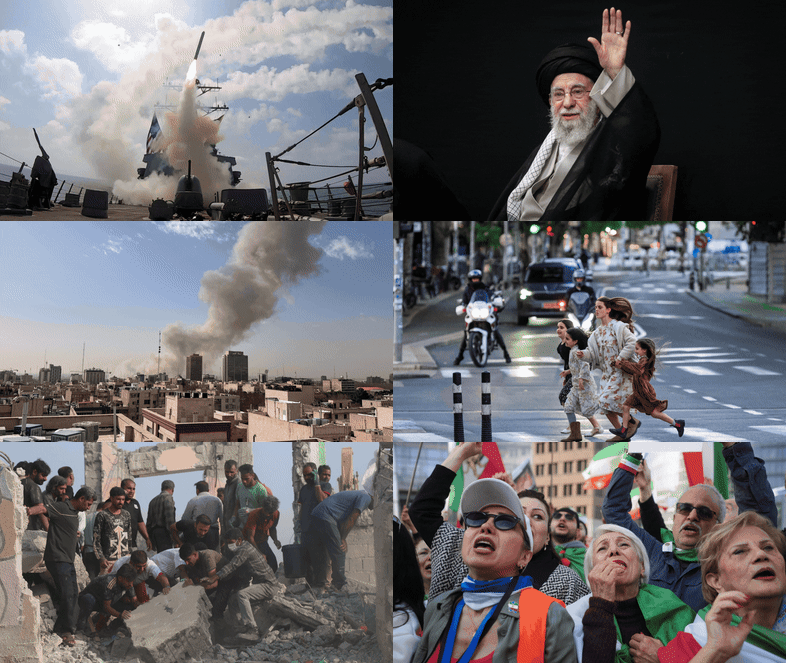
The assassination of a head of state and the subsequent transition from asymmetric proxy engagement to direct interstate kinetic conflict represents a collapse of traditional deterrence frameworks. In the wake of the reported death of Ali Khamenei and the ensuing "force never seen before" rhetoric from the United States executive branch, the geopolitical architecture of the Middle East has shifted from a managed gray-zone conflict to a high-intensity escalatory spiral. This transition is not merely a diplomatic failure; it is a fundamental reconfiguration of the regional power balance, governed by the cold logic of "The Escalation Ladder" and the "Red Line Paradox."
The Logic of Total Deterrence Failure
Deterrence functions only when the cost of an action is perceived as higher than the benefit of the status quo. By targeting the ultimate ideological and political apex of the Iranian state, the United States has removed the incentive for Iranian restraint. In strategic theory, this is the "Nothing Left to Lose" variable. When the survival of the regime's ideological core is terminated, the state shifts its primary objective from preservation to maximum cost-infliction.
The retaliatory strikes hitting nations across the Middle East are not random acts of aggression. They are calculated demonstrations of "Contested Reach." Iran and its remaining command structures are signaling that while the U.S. possesses superior precision-strike capabilities, Iran possesses superior "geographic intimacy." They can strike every major energy node and military installation within a 2,000-kilometer radius using low-cost, high-volume munitions that saturate existing missile defense systems.
The Three Pillars of the Current Conflict
To understand the current kinetic exchange, one must deconstruct the theater into three distinct operational pillars:
- Command Attrition and Ideological Vacuum: The death of a Supreme Leader creates an immediate "Legitimacy Crisis." In the short term, the Islamic Revolutionary Guard Corps (IRGC) typically fills this vacuum with hyper-aggression to signal internal stability. This results in decentralized command structures where local commanders may initiate strikes without waiting for central approval, leading to unpredictable escalatory triggers.
- The Force Never Seen Before Doctrine: This rhetorical stance suggests a shift from "Proportional Response" to "Overwhelming Disruption." In military terms, this implies the use of non-nuclear but strategic-grade assets: B-2 Spirit stealth bombers, cyber-attacks on critical Iranian infrastructure (SCADA systems), and the total interdiction of maritime exports.
- Lateral Escalation: Iran's response is rarely vertical (hitting the same type of target). It is lateral. If the U.S. hits a command center, Iran hits a desalination plant in the UAE or an oil refinery in Saudi Arabia. This forces the U.S. to defend a massive, porous perimeter while Iran focuses its limited resources on narrow, high-impact economic targets.
The Cost Function of Regional Kinetic Engagement
The economic impact of this war is not dictated by the price of missiles, but by the "Insurance Premium Spike" and the "Strait of Hormuz Risk Quotient."
- Maritime Interdiction: Approximately 20% of the world’s petroleum passes through the Strait of Hormuz. A "force never seen before" approach likely includes a blockade. The cost function here is exponential: every day the Strait remains a "hot zone," the global supply chain loses billions in speculative value and actual delivery delays.
- Asymmetric Attrition: A single U.S. SM-6 interceptor costs approximately $4 million. The Iranian Shahed-series drones or Qiam missiles they intercept cost between $20,000 and $150,000. This 40:1 cost ratio is unsustainable for the U.S. and its allies in a prolonged war of attrition.
The Intelligence Bottleneck
A significant limitation in the current U.S. strategy is the "Intelligence Lag." High-value targeting (HVT) provides a temporary tactical shock but often obscures the secondary and tertiary layers of the target's network. The death of Khamenei does not dissolve the IRGC's Quds Force; it radicalizes it. The primary risk is no longer a coordinated state-led war, but a "Hydra Effect" where dozens of semi-autonomous militias across Iraq, Syria, Lebanon, and Yemen initiate independent strike packages against U.S. assets.
This creates a bottleneck for U.S. Central Command (CENTCOM). They must now track and neutralize hundreds of mobile launch platforms instead of a single centralized command hierarchy. The transition from "State-Actor Tracking" to "Networked Insurgency Tracking" at a continental scale requires a level of persistent ISR (Intelligence, Surveillance, and Reconnaissance) that exceeds current capacity.
Structural Failures in Global Energy Security
The retaliatory strikes across the Middle East serve a secondary purpose: the destruction of the "Petrodollar Stability." By targeting non-belligerent neighbors like the UAE or Saudi Arabia, Iran is effectively holding the global economy hostage. This creates a friction point between the U.S. and its regional allies. If the "force never seen before" does not provide an immediate, total shield for Riyadh and Abu Dhabi, those allies will be forced to de-escalate independently, breaking the U.S.-led coalition.
The second limitation of the U.S. posture is the lack of a "Terminal State Definition." What does victory look like after the death of the Supreme Leader? Without a clear governance alternative or a plan for regional stabilization, the U.S. is engaging in "Kinetic Drift"—applying force without a clear political objective. This creates a power vacuum that external actors, specifically Russia and China, are positioned to exploit by offering "Stability through Neutrality" to Gulf states.
The Technological Frontier: Cyber and Electromagnetic Spectrum Operations
While the headlines focus on missile strikes, the true "force never seen before" likely resides in the electromagnetic spectrum. We are witnessing the first large-scale deployment of:
- Cognitive Electronic Warfare: Systems that don't just jam signals but provide false data to enemy sensors, leading them to fire at ghost targets or misidentify friendly assets.
- Grid Interdiction: Cyber-kinetic attacks designed to physically destroy transformers and turbines via software overrides. This goes beyond turning off the lights; it involves the permanent destruction of the physical infrastructure required to sustain a modern population.
Strategic Play: The Pivot to Containment or Total Neutralization
The U.S. is currently at a binary junction.
The first path is "Total Neutralization." This requires a ground invasion and the dismantling of the IRGC infrastructure—a scenario involving millions of troops and a decade of occupation. This is logically and economically unfeasible.
The second path, and the only viable strategic play, is "Targeted De-capitation with Regional Buffer." The U.S. must immediately shift from offensive rhetoric to a "Defensive Consolidation." This involves:
- Automated Shielding: Deploying AI-integrated point defense systems to Gulf energy nodes to negate the cost-asymmetry of Iranian drones.
- Backchannel Transition: Establishing a direct line to the "Pragmatists" within the Iranian regular army (Artesh) to bypass the IRGC and negotiate a ceasefire.
- Economic Exclusion: Instead of "strikes," the U.S. should focus on the total electronic seizure of Iranian overseas financial assets, using them as a "Reconstruction Escrow" to leverage against further IRGC strikes.
The conflict has moved past the point of "warnings." The destruction of the Iranian leadership has triggered a systemic reset. Success now depends not on the volume of "force" used, but on the precision of the political vacuum management that follows. Any further escalation without a defined diplomatic landing zone will lead to a "Sunk Cost Spiral," where both nations expend their strategic reserves for no measurable geopolitical gain.