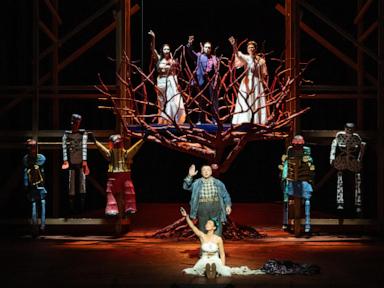
Opera houses usually feel like museums for the dead. They're often stuffy, predictable, and obsessed with 19th-century European problems. But the Metropolitan Opera just broke that mold by bringing the most famous couple in Mexican history back to life. I'm talking about El Último Sueño de Frida y Diego (The Last Dream of Frida and Diego). This isn't just another biopic set to music. It’s a haunting, vibrant exploration of what happens when the veil between life and death wears thin on El Día de los Muertos.
If you’re expecting a standard "greatest hits" of Frida’s pain, you’re in for a surprise. This production moves past the kitschy "Fridamania" we see on tote bags and socks. It treats her as a titan of willpower. The story begins in 1957. Diego Rivera is old, lonely, and dying. He wants his wife back. The catch? She’s been dead for three years.
Why this production matters right now
We’ve seen plenty of attempts to capture the Rivera-Kahlo dynamic. Most of them fail because they focus too much on the cheating and not enough on the creative obsession. This opera, composed by Gabriela Lena Frank with a libretto by Nilo Cruz, actually understands their bond. It’s the first Spanish-language opera ever performed at the Met. That’s a massive deal. It’s about time the largest performing arts organization in the United States acknowledged that some of the most compelling stories in the world don't require an Italian-to-English dictionary.
The music doesn't sound like a Mariachi band walked into Lincoln Center. It’s much more sophisticated than that. Frank uses a rich orchestral palette that feels both ancient and modern. You hear the shadows. You hear the heat of the Mexican sun. The rhythm is unpredictable. It keeps you on edge because death is a character here too.
Breaking down the plot without the fluff
The narrative is straightforward but emotionally heavy. It’s 1957 in a cemetery. Diego is surrounded by the sights and sounds of the Day of the Dead. He’s desperate. He calls out to Frida, begging her to return and guide him to the afterlife. In the underworld, Frida is hesitant. She remembers the physical agony of her life—the bus accident, the surgeries, the "two big accidents" (the bus and Diego).
She eventually agrees to come back for twenty-four hours. But there are rules. No touching. No physical contact. They have to navigate the world of the living as spirits. Seeing these two icons navigate a world that has moved on without them is heartbreaking. It’s a story about the weight of memory and the price of artistic immortality.
Visuals that actually serve the story
Most Met productions rely on massive, rotating sets that cost millions and do very little for the actual plot. Here, the visual language is tied directly to Frida’s paintings. You see the influence of The Two Fridas and her various self-portraits, but it isn’t literal. It’s atmospheric.
The transition between the Mictlán (the Aztec underworld) and the world of the living is handled with incredible grace. The colors shift from muted, earthy tones to the explosive marigold oranges and magenta pinks of the Mexican holiday. It’s a sensory overload in the best way possible. You aren't just watching a play; you're stepping into a mural.
The vocal performances are a revelation
Daniela Mack as Frida is a powerhouse. She doesn't try to mimic Frida’s voice because, honestly, we don't really have definitive recordings of it anyway. Instead, she captures the defiance. Her mezzo-soprano is dark, textured, and capable of cutting through a massive orchestra. When she sings about her broken body, you feel the steel in her spine.
Alfredo Daza’s Diego is equally impressive. He plays Rivera not as a caricature of a womanizer, but as a man literally shrinking under the weight of his own regret. His baritone is warm but carries a weary edge. Their duets are the highlights of the night. They fight. They yearn. They argue about art. It’s exactly what you’d imagine a dinner at the Casa Azul sounded like, just with better acoustics.
Myths about Frida and Diego the opera corrects
People love to romanticize their relationship. They call it a "great love story." It wasn't. It was a beautiful disaster. This production doesn't shy away from that. It shows the resentment. It shows how they used each other as much as they loved each other.
Another misconception is that Frida was just a "suffering artist." The opera highlights her agency. She chooses to return. She chooses how she presents herself. She isn't a victim of her circumstances; she's the architect of her own legend. The libretto by Nilo Cruz—who won a Pulitzer for Anna in the Tropics—is poetic without being flowery. He writes for the throat.
A landmark for the Metropolitan Opera
For decades, the Met has been criticized for being a "museum." This production proves they can still be a living, breathing laboratory for new ideas. By commissioning works like this, they’re reaching an audience that usually ignores the opera. During the performance I attended, the crowd was younger and more diverse than the usual sea of tuxedos and pearls.
There's something deeply moving about hearing Spanish spoken and sung on that specific stage. It’s a recognition of the cultural fabric of the Americas. It’s not a "special event" or a "diversity initiative." It’s just great art that happens to be in Spanish. That’s how you actually grow an art form.
Understanding the Day of the Dead context
If you don't understand El Día de los Muertos, you might miss some of the nuance. It’s not Mexican Halloween. It’s not spooky. It’s a celebration of continuity. The idea is that as long as someone remembers you, you aren't truly gone.
The opera uses this concept as its engine. Diego’s memory is what pulls Frida back. But the opera also asks a terrifying question. What happens when the person remembering you is also about to die? Who keeps the flame alive then? It’s a heavy theme, but the production handles it with a lightness of spirit that keeps it from becoming a slog.
How to get the most out of your visit
Don't go in blind. Take twenty minutes to look at Frida’s diary or some of Diego’s murals at the National Palace. Understanding their scale helps you appreciate the intimacy of the opera. The Met also offers titles on the back of the seats, so don't worry if your Spanish is rusty.
Skip the overpriced champagne at intermission and just stay in your seat to soak in the set design. The way they use light to simulate the blurring of the two worlds is worth the ticket price alone. This isn't a show you watch; it's a show you experience.
If you’re looking for a seat, try the Dress Circle. You want to see the floor patterns and the way the dancers move in the underworld scenes. The perspective from the higher tiers gives you a better sense of the "mural" quality the director was aiming for.
Go see this if you want to remember why we tell stories in the first place. It’s messy, loud, colorful, and deeply human. Just like the people it’s about. This is the new standard for what a modern opera should look like. Grab a ticket before the run ends, or keep an eye out for the Live in HD broadcasts in cinemas. You don't want to miss the moment the Met finally caught up to the 21st century.