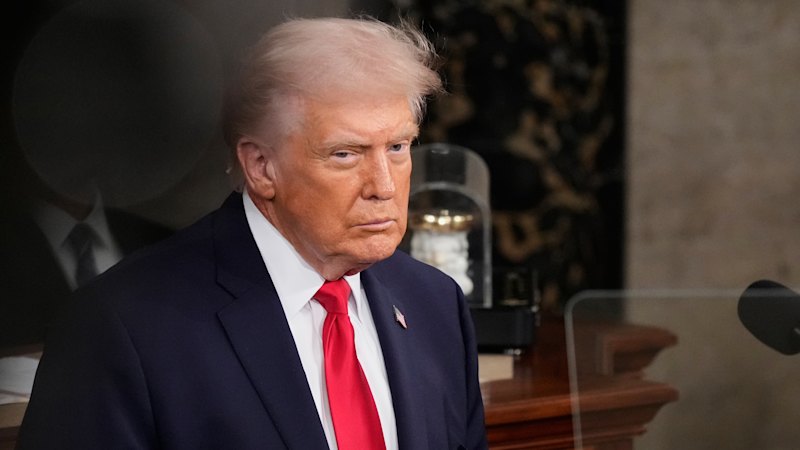
The traditional boundary of insider trading has historically stopped at the edge of corporate boardrooms and physical commodity shipments. However, the rise of regulated prediction markets has created a new class of non-public, high-value information: the literal text of live political speeches. The investigation into Gabriel Perez, Donald Trump’s longtime teleprompter operator, exposes the mechanics of this modern micro-arbitrage.
By allegedly using advanced drafts of presidential addresses to capture over $100,000 in profits on the prediction platform Kalshi, Perez did not exploit corporate balance sheets. Instead, he exploited the structural lag of live information dissemination. This case demonstrates the friction between real-time public speech and the financialization of political rhetoric.
The Architecture of "Mention Markets"
To understand how a technical assistant could extract low-risk yield from presidential addresses, one must understand the structure of Kalshi’s "mention markets". Unlike traditional binary contracts on election outcomes, mention markets resolve based on whether a speaker utters specific words or phrases during a designated public event.
These contracts are structured as binary options, pricing the probability of an event between $0.00$ and $1.00$. If the target word is spoken, the contract settles at $1.00; if the event concludes without the word being spoken, it settles at $0.00.
Under normal market conditions, these contracts price probability based on historical speech analysis, ongoing political news, and immediate context. However, the true pricing of these contracts relies on an information asymmetry timeline:
[Speech Drafted] ---> [Teleprompter Loaded] ---> [Speech Commences] ---> [Word Spoken Live]
       |                      |                         |                      |
  (Strictly Secret)    (Perez Access)            (Public Stream)        (Contract Settles)
For the general public, the probability of a word being spoken fluctuates dynamically as the speech progresses. For an individual with direct access to the teleprompter files, the probability of a word being spoken collapses to near certainty ($1.00$) or absolute impossibility ($0.00$) long before the speaker approaches the lectern.
The Transmission Pipeline and the Points of Arbitrage
As a technical adviser and teleprompter operator since 2016, Perez occupied a unique bottleneck in the communication infrastructure. In political communication workflows, the final speech draft undergoes continuous modification until the moment of delivery.
- Pre-Event Asymmetry: Hours or minutes before a major speech—such as the State of the Union or an address at the World Economic Forum—the operator receives the final, formatted text to load into the teleprompter software. This file contains the precise lexicon of the planned address.
- Intra-Event Hedging: A key finding from the Commodity Futures Trading Commission (CFTC) investigation reveals that Perez did not merely place static pre-speech bets. He actively managed his positions during the speeches. Trump is notoriously prone to off-script improvisations and skipping prepared text. When Trump skipped a paragraph containing a highly priced target word, Perez allegedly executed real-time sell orders to cut losses before the market adjusted to the omission.
This represents an acute form of latency arbitrage. While external traders watched live television broadcasts—which are subject to transmission delays of several seconds—or parsed live transcripts, Perez watched the physical cursor on his operator console move past paragraphs. He possessed perfect foresight of omissions before they occurred on screen.
The Detection Mechanism: Order Flow Anomalies
Prediction markets rely heavily on market makers to provide liquidity and maintain orderly pricing. Because mention markets generally have lower total volumes than major political outcomes, they are highly sensitive to unusual order flow.
Kalshi’s internal surveillance team flagged Perez's account because his trading activity deviated sharply from standard speculative behavior.
| Metric | Typical Speculative Trader | Alleged Insider Account (Perez) |
|---|---|---|
| Timing of Entry | Highly distributed; gradually building positions leading up to the speech. | Concentrated immediately after final draft lock, or mid-speech. |
| Sizing | Sized to match broad sentiment, often spread across multiple correlated words. | Maximum size focused on high-probability, specific long-shots. |
| Exit Execution | Slow reaction to live verbal omissions, dictated by broadcast latency. | Instantaneous liquidation of positions the moment a paragraph was bypassed on the operator screen. |
| Profit Realization Rate | Variable; highly subject to the speaker's rhetorical drift. | Exceptionally high win rate over multiple high-profile addresses. |
By consistently buying undervalued "Yes" contracts for obscure phrases that were locked into the teleprompter, or shorting highly priced "Yes" contracts when he saw a section bypassed, the account's trading profile signaled access to a deterministic data feed.
The Regulatory Gap and Legal Precedents
The CFTC's intervention, coupled with the White House placing Perez on unpaid administrative leave, highlights a major regulatory gray area. Traditionally, insider trading prosecution under the Securities Exchange Act of 1934 requires a breach of fiduciary duty related to securities. Because prediction markets deal in event contracts regulated by the CFTC rather than traditional equities, the legal frameworks are still adapting.
The CFTC relies on its anti-fraud and anti-manipulation authority under the Commodity Exchange Act (specifically Section 6(c)(1) and Rule 180.1), which mimics the SEC's Rule 10b-5. Under this framework, trading on material, non-public information (MNPI) in violation of a duty of trust owed to an employer—in this case, the federal government—constitutes fraud.
This is not an isolated vulnerability. The federal government is currently prosecuting multiple cases where non-public information was used to trade on prediction platforms:
- Defense Sector Misconduct: A special forces soldier was charged after allegedly betting on the outcome of a classified military operation targeting Venezuelan President Nicolás Maduro.
- Corporate Search Data: A Google employee faced allegations of betting on search volume trends using proprietary internal metrics.
- Legislative Self-Trading: The CFTC has previously scrutinized instances of political figures and staff placing wagers on the timing or passage of bills they are actively drafting or voting on.
Systemic Risk and the Future of Event Contracts
The vulnerability of mention markets to insider exploitation poses a fundamental threat to their viability. If market makers realize they are consistently trading against individuals with access to teleprompters, draft speeches, or internal corporate press releases, they will widen their spreads or withdraw liquidity entirely. This dynamic risks collapsing the market structure.
As prediction markets scale, platforms are forced to adopt more rigorous safeguards:
- Workplace Disclosure Mandates: In response to this investigation, platforms like Kalshi have instituted policies requiring traders to disclose their employment and blocking them from trading in areas where they have informational access.
- Whitelisting and Exclusions: Major brokerages, including Robinhood, have deliberately omitted mention markets from their prediction offerings due to the inherent difficulty of policing insider manipulation.
- Algorithmic Circuit Breakers: Future exchanges will need to deploy automated blocks that freeze trading on specific contracts when order flow correlates too perfectly with the physical progression of an event.
The strategic play for prediction platforms is clear: they must decide whether the retail engagement generated by novelty mention markets is worth the reputational and regulatory friction of policing them. If they cannot guarantee that the underlying information cannot be front-run by staff, these hyper-specific contracts will likely be phased out in favor of broader, macro-level event markets.