The recent U.S. strikes against Iranian-backed targets have sent a massive ripple through the Indo-Pacific that most analysts didn't see coming. While Washington's focus is currently pinned on the Red Sea and the Persian Gulf, the real fallout is happening in the strategy rooms in Taipei. This isn't just about distant explosions. It’s about a fundamental shift in how Taiwan views its own survival.
When American missiles hit targets in the Middle East, it signals two things to the world. First, that the U.S. is still willing to use force to protect global shipping lanes. Second, and more importantly for Taiwan, it proves that the demand for high-end interceptors and precision munitions is officially outstripping supply. If you're sitting in Taipei watching the U.S. deplete its stockpile of SM-2 and SM-6 missiles to swat down low-cost drones, you’re getting nervous. You should be. If you found value in this piece, you should check out: this related article.
The Drone Math That Keeps Taipei Awake
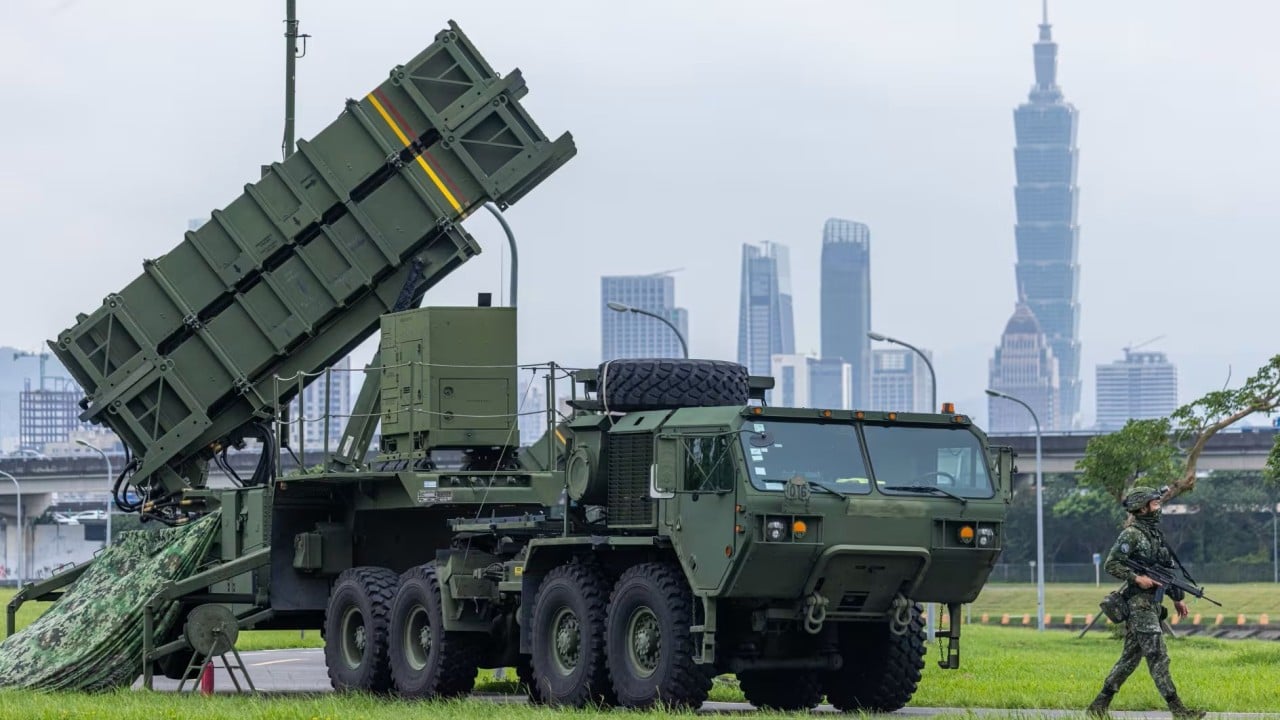
Taiwan has long relied on a "porcupine strategy." The idea is to make an invasion so painful and costly that Beijing never tries it. But the recent activity in the Middle East has exposed a glaring flaw in the traditional air defense model. We're seeing a massive cost asymmetry.
Think about it this way. A Patriot missile or a sea-based interceptor can cost several million dollars per shot. The drones and "suicide" loitering munitions used by Iranian proxies often cost less than a used Honda Civic. If China decides to swarm the Taiwan Strait with thousands of cheap, mass-produced drones, Taiwan’s current inventory of high-end missiles will vanish in days. For another look on this development, refer to the latest coverage from The Guardian.
Experts like Su Tzu-yun from the Institute for National Defense and Security Research have been vocal about this. The math simply doesn't add up. Taiwan can't win a war of attrition where they spend $3 million to stop a $20,000 threat. This realization is forcing a pivot toward directed-energy weapons and electronic warfare—tech that doesn't "run out" of bullets. But that technology is still years away from being a reliable shield.
Energy Security is the Real Weak Link
Most people focus on the missiles. I think the bigger threat is the fuel. Taiwan imports about 98% of its energy. A huge chunk of that comes through the very waters the U.S. is currently trying to stabilize in the Middle East. If the Strait of Hormuz or the Bab el-Mandeb strait stays volatile, Taiwan’s energy costs skyrocket.
But it’s worse than just price. It’s about physical access.
Taiwan has enough liquefied natural gas (LNG) in reserve to last maybe eight to eleven days. That’s it. If a conflict in the Middle East disrupts global shipping, or if China uses a "quarantine" tactic to slow down tankers, Taiwan’s power grid fails before the first shot is even fired. The U.S. strikes on Iran remind Taipei that their lifeblood flows through a very dangerous neighborhood.
The government is trying to push for more renewables and even reconsidering their stance on nuclear power, but those are long-term fixes for a short-term crisis. Right now, Taiwan is an island powered by a very long, very fragile straw.
Why the U.S. Presence is a Double Edged Sword
There's a heated debate in Taipei right now about American reliability. On one hand, the strikes show the U.S. won't be pushed around. On the other, every Tomahawk missile fired in the Middle East is one fewer available for the Pacific.
The U.S. industrial base is struggling. We aren't in the 1940s anymore; we can't just turn car factories into tank plants overnight. It takes years to build these sophisticated systems. If the U.S. gets bogged down in a multi-front "forever war" against Iranian proxies, the "pivot to Asia" becomes a myth.
Taiwanese lawmakers are starting to ask the tough questions. Can they really count on a rapid resupply if the U.S. is already tapped out? The answer is likely no. This is why we're seeing a sudden, frantic push for domestic missile production. The Hsiung Feng series is great, but Taiwan needs more of them, and they need them yesterday.
Lessons from the Red Sea for the Taiwan Strait
The Red Sea has become a laboratory for modern naval warfare. We're seeing merchant ships attacked with ballistic missiles—something that was once considered a "carrier killer" exclusive. This changes the risk profile for every commercial ship heading to Kaohsiung or Keelung.
If China mimics these tactics, they don't need a full-scale D-Day style invasion. They just need to make the insurance premiums for shipping so high that no captain will sail to Taiwan. By watching how the U.S. handles Iranian-backed threats, China is getting a free masterclass in how to counter Western naval dominance. They're taking notes on response times, intercept success rates, and the political will of the American public.
What Needs to Change Immediately
Taiwan's defense ministry needs to stop buying "prestige" platforms and start buying "attrition" platforms. Big destroyers are targets. Short-range, mobile, and cheap defense systems are the future.
- Diversify energy sources away from the Middle East. This means more deals with the U.S., Australia, and even exploring domestic geothermal potential.
- Mass-produce the "Brave Eagle" and other domestic drones. You fight fire with fire, and you fight swarms with swarms.
- Harden the power grid. Decentralized micro-grids are much harder to knock out than a few massive power plants.
The window for "business as usual" closed the moment those missiles hit targets in Yemen and Iraq. The Middle East might be thousands of miles away, but for the people of Taiwan, the heat from those explosions is felt right at home. The era of relying on a distant superpower's surplus is over. It's time for Taiwan to build its own shield.
Stop looking at these regional conflicts as isolated events. They're interconnected. A shortage of components in a factory in Kentucky affects the safety of a street in Taipei. That's the reality of 2026. The debate is no longer about if Taiwan should change its strategy, but how fast it can do it before the next crisis hits.