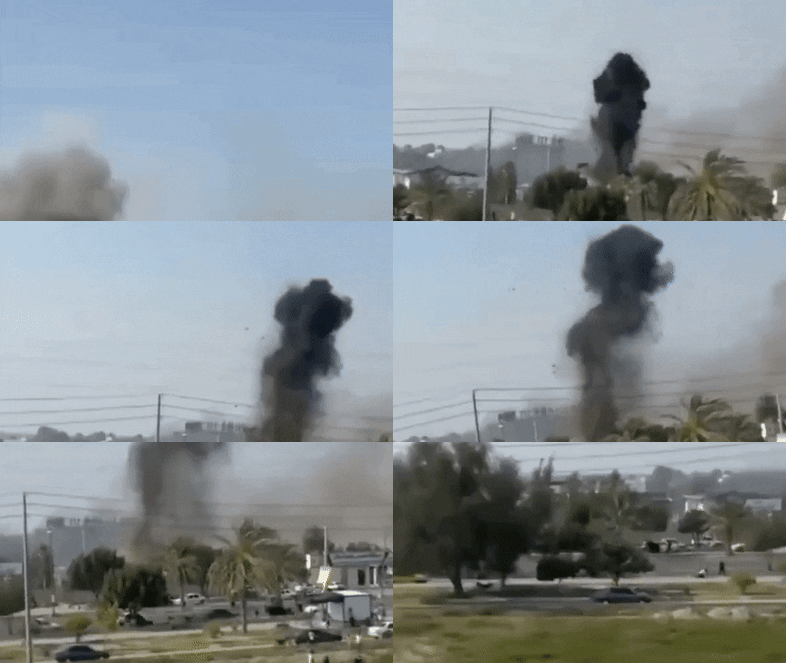
The fog of war usually takes months to clear, but in the case of the Shajareh Tayyebeh elementary school in Minab, the timeline is moving much faster. On February 28, 2026, a girls' primary school in southern Iran became a graveyard for over 170 people, mostly children. Since then, the White House has maintained a "not us" stance, with President Trump recently suggesting that faulty Iranian munitions were to blame. But a new seven-second video released by the Mehr News Agency—and subsequently verified by major investigative outlets—tells a much more precise and damning story.
The footage doesn't just show an explosion. It shows a Tomahawk cruise missile, a weapon synonymous with the U.S. Navy, slamming into an Islamic Revolutionary Guard Corps (IRGC) naval compound right next to the school. Honestly, it’s the kind of evidence that changes the entire conversation from "who did this?" to "how did this happen?"
The Smoking Gun in Seven Seconds
This video, geolocated by the investigative collective Bellingcat to a construction site across from the Minab naval base, captures the unmistakable profile of a Tomahawk. It’s got the distinctive wings and the steady, low-altitude trajectory of a weapon designed for surgical precision. The problem? That precision seems to have been applied to the wrong set of coordinates.
The video captures the missile hurtling toward a building within the IRGC complex, likely a medical clinic that had ties to the Guard. But here’s the kicker: as the camera pans, you can already see thick, black smoke rising from the adjacent school. This suggests the school wasn't collateral damage from a single stray blast, but rather one of many targets in a coordinated "precision" strike.
When Targeting Intelligence Fails
Military analysts are starting to point toward a "targeting failure" rather than a mechanical malfunction. Satellite imagery shows that the school and the naval base used to be part of the same IRGC compound. Between 2013 and 2016, a wall was built, and the school was separated, gaining its own entrance and operating as a civilian educational facility for years.
If the U.S. military was working off outdated maps or intelligence from a decade ago, they might have seen the entire block as a valid military target. It's a terrifying thought. You've got the most advanced satellite tech in the world, yet someone in a room thousands of miles away might have authorized the strike based on a 2012 floor plan.
- The Munition: Tomahawk cruise missiles are used exclusively by the U.S. in this conflict. Israel doesn't operate them.
- The Timing: The strike happened during the opening wave of joint U.S.-Israeli operations on February 28.
- The Damage: Satellite photos from Planet Labs show at least seven buildings in the immediate area were hit, including the school. This wasn't a "one-off" accident; it was a saturation of the area.
Dissecting the Official Denial
President Trump’s claim that "it was done by Iran" because they’re "very inaccurate" doesn't hold much water when you look at the visuals. Iranian air defense missiles, like those from the S-300 or local Bavar-373 systems, typically explode in the air to shred incoming targets. They don't look like cruise missiles performing a terminal dive into a building.
Pentagon officials, including Defense Secretary Pete Hegseth, have been more cautious, stating an investigation is "ongoing." But inside the beltway, the narrative is shifting. Reports from the Wall Street Journal and Reuters indicate that military investigators themselves now believe U.S. forces were likely responsible.
The Human Cost of Precision
We’re talking about girls between the ages of seven and twelve. They were in their morning classes when the ceiling came down. UNESCO has already called this a "grave violation" of international law. Whether it was an intelligence blunder or a deliberate strike on a "dual-use" facility, the result is the same: the deadliest civilian casualty event since the war began.
If you’re following this, don't expect a formal apology anytime soon. Admissions of "collateral damage" usually come wrapped in layers of bureaucratic justification. However, the sheer volume of open-source intelligence—from TikTok videos of the aftermath to high-res satellite shots of the crater patterns—makes the "faulty Iranian missile" theory look increasingly thin.
What Happens Next
The pressure on the administration is going to ramp up as more forensic evidence from groups like Airwars and BBC Verify hits the public domain. You can expect:
- Congressional Inquiries: Expect bipartisan calls for a review of the "Targeting Cycle" used during the February 28 opening gambit.
- UN Scrutiny: Independent investigators will likely push for access to the site to collect shrapnel, though Iran's current internet blackout and the ongoing war make that difficult.
- Targeting Protocol Changes: Behind the scenes, the U.S. will likely tighten its rules of engagement for "urban-adjacent" military sites to avoid another PR disaster of this scale.
Keep a close eye on the Pentagon’s daily briefings. The shift from "we didn't do it" to "we're looking into it" is usually the first sign that the truth is about to break.