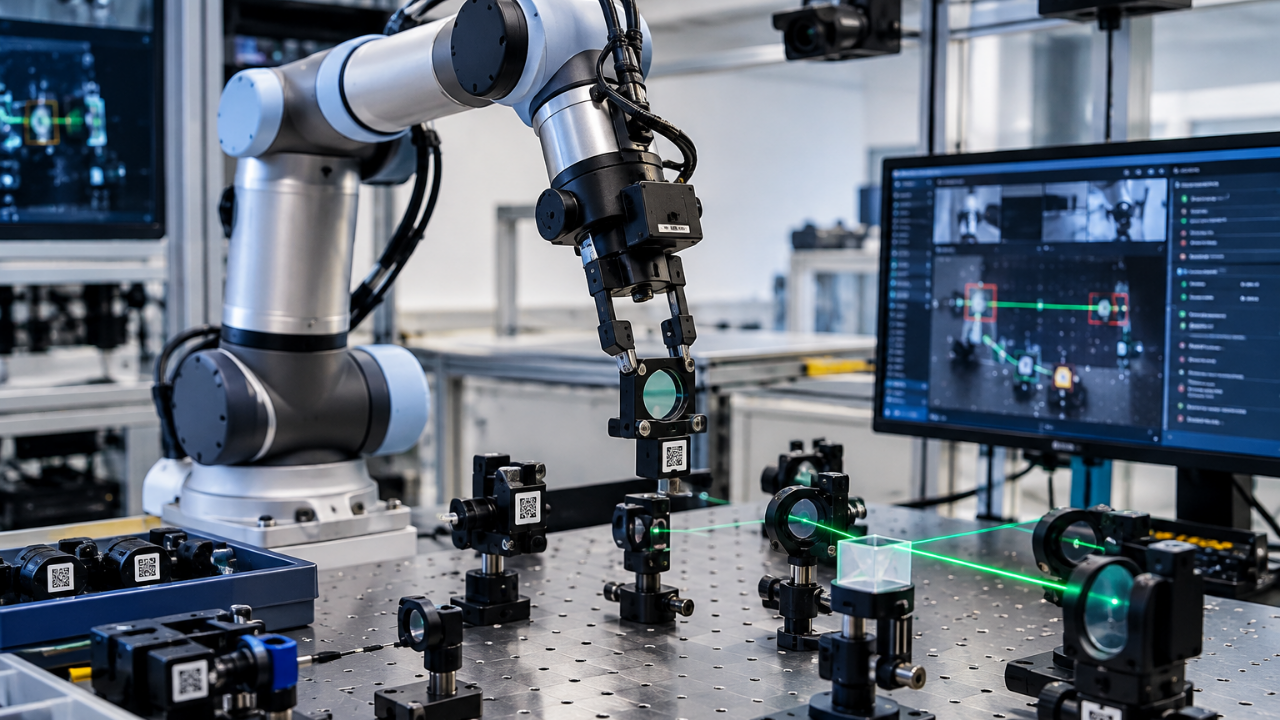
Building a working laser cavity used to mean hours of tedious, hair-pulling alignment in a heavily controlled optical lab. You spent your days tweaking mirrors by fractions of a micrometer while praying thermal drift wouldn't ruin your entire afternoon. Then MIT researchers changed the rules. They built an autonomous robotic system that constructs a working laser cavity in just fifty maneuvers under thirty minutes.
Even better, it fixes itself when something goes wrong.
If you think this is just another academic tech demo, you're missing the point entirely. This is a massive shift in how we handle precision hardware assembly. Let's break down why this matters and what most tech roundups miss about the breakthrough.
How the MIT Robotic Laser Builder Works
Building a laser isn't just about putting parts in a box. It's about sub-micron alignment. A standard laser cavity requires mirrors, gain media, and lenses positioned with absolute perfection. If a single optical component tilts by a fraction of a degree, photons scatter and the laser refuses to fire.
Human optical engineers do this through trial and error, adjusting kinematic mounts while watching feedback loops on a spectrometer. It's slow, tedious work.
The MIT team took a different route. They designed an automated robotic setup capable of interacting directly with optical hardware. Instead of relying on pre-programmed coordinates, which fail the moment a table vibrates or a part shifts slightly, the system uses closed-loop feedback. It makes an adjustment, reads the optical output, evaluates the success rate, and calculates the next move.
Fifty maneuvers later, you have a functional laser.
What blows my mind isn't just the speed. Thirty minutes is fast, sure, but the self-correction mechanism is where the magic happens. During testing, researchers intentionally disrupted the setup. They bumped components and blocked paths. Did the system crash or throw a fatal error? No. It recalibrated on the fly, adjusted the mirrors, and restored laser emission without human intervention.
Why Manual Alignment Is Becoming Obsolete
For decades, optical engineering has been constrained by human limitations. We are slow, we get tired, and our hands shake. When you are building complex photonic circuits or quantum computing hardware, manual alignment becomes a severe bottleneck.
Think about quantum optics labs. Researchers spend weeks aligning complex arrays of mirrors and beam splitters just to run a single experiment. If this robotic approach scales, laboratories can automate the tedious parts of hardware setup.
You stop wasting PhD-level talent on turning tiny screws. Instead, you let the machine handle the physical assembly while human engineers focus on system design and high-level problem solving.
The Real-World Obstacles Nobody Talks About
Let's keep things grounded. Transitioning a clever lab demo into a commercial tool is never simple.
First, there's the cost and complexity of the hardware setup itself. Precision robotic arms, machine vision systems, and sensitive optical sensors aren't cheap. Setting up an automated bay requires significant upfront capital. For small research groups, it might still be cheaper to hire a postgrad to turn the screws by hand.
Second, tolerances in industrial environments are brutal. A lab bench at MIT is isolated from heavy vibrations. Put that same robot on a factory floor next to a stamping press or a loading dock, and optical drift will test the limits of the self-correction algorithm.
Yet, the proof of concept is undeniable. The software side of hardware assembly is finally catching up to mechanical automation.
What This Means for the Future of Photonics
We are watching the early stages of lights-out manufacturing for precision optics. When machines can assemble and calibrate their own optical paths, production costs for advanced sensors, medical lasers, and communication hardware drop sharply.
You won't need an elite cleanroom technician for every routine assembly task. The robot handles the grunt work, stays awake twenty-four hours a day, and doesn't get frustrated when a mirror shifts by a micrometer.
Stop thinking of robotics as just mechanical arms welding car frames on a Detroit assembly line. The real frontier is microscopic precision, automated self-correction, and hardware that builds itself.
Take a close look at your own engineering workflows. If you are still relying entirely on manual calibration for precision tasks, you are working too hard.