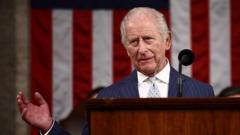
The diplomatic utility of the British Monarchy resides in its capacity to deploy "soft power" as a non-partisan extension of the Foreign, Commonwealth and Development Office (FCDO). King Charles III’s visit to the United States—culminating in what Palace officials described as a "high stakes" speech—functions as a sophisticated mechanism for maintaining the "Special Relationship" during a period of intense geopolitical volatility. While media narratives focus on the optics of the royal presence, the underlying objective is the stabilization of UK-US trade interests and the reinforcement of shared defense commitments through high-level symbolic alignment.
The Strategic Architecture of the High Stakes Address
A royal address in the United States is never a mere social formality; it is a calibrated intervention designed to achieve three specific diplomatic outcomes:
- Continuity Signaling: Following the death of Queen Elizabeth II, the primary risk to the UK’s soft power was the potential decay of historical rapport. The speech serves as a formal re-ratification of the bilateral bond, signaling to the US executive branch and the public that the transition of power has not diminished the UK’s commitment to its primary ally.
- Multilateral Policy Alignment: By framing environmental sustainability and global security within the context of a shared moral duty, the King provides a non-political "bridge" that allows both governments to pursue common agendas (such as the AUKUS pact or net-zero targets) without the friction of party-political debate.
- Economic Soft-Landing: State visits act as a lubricant for trade. The "high stakes" nature of the speech refers to the necessity of maintaining British relevance in a US market increasingly dominated by domestic protectionist policies and shifting Pacific interests.
The Mechanism of Symbolic Neutrality
The Monarch operates under a strict constitutional constraint: the inability to legislate or take partisan stances. This constraint is not a weakness but a strategic asset. In a polarized American political environment, a royal visit is one of the few diplomatic events capable of garnering bipartisan engagement.
The speech utilizes the logic of the supra-political. By speaking on themes of heritage, global stewardship, and historical alliance, the King occupies a rhetorical space that elected officials cannot. This creates a "neutral zone" where diplomatic ties are reinforced at a cultural and institutional level, insulated from the volatility of election cycles.
Quantifying the Value of Royal Diplomacy
The efficacy of a royal visit is measured through a combination of media saturation, high-net-worth engagement, and legislative access.
- Reach and Impression Equity: The Palace views the US visit as a massive branding exercise. The visibility of the King in major US hubs generates billions of global impressions, which serve as an indirect subsidy for British tourism and luxury exports.
- The Access Multiplier: A "high stakes" royal event provides a platform for British trade envoys to meet with US governors and CEOs who might otherwise be unavailable. The Monarchy acts as the ultimate "door opener," reducing the cost of acquisition for high-level diplomatic and commercial meetings.
- Stabilization of the Special Relationship: In quantitative terms, the visit mitigates the "diplomatic discount" that occurs when a nation’s influence is perceived to be waning. By maintaining a high-profile presence in the US, the UK ensures its voice remains prioritized in the National Security Council and the State Department.
Bottlenecks and Friction Points
Despite the success of the address, the Palace must navigate several structural limitations:
The first limitation is the Legacy Contradiction. In a modern US context, the historical weight of the Monarchy is increasingly scrutinized through the lens of post-colonialism. Any "high stakes" speech must balance traditional prestige with a modern sensitivity to historical grievances. Failure to strike this balance risks alienating younger American demographics and progressive policy-makers.
The second limitation involves Policy Overlap. The King’s long-standing advocacy for environmental issues occasionally brushes against the boundaries of political neutrality. If the speech is perceived as lobbying for specific US legislation, it risks triggering a backlash from factions within the US Congress who view foreign intervention—even from a monarch—with suspicion.
The Three Pillars of the Palace Strategy
To ensure the visit achieved its intended impact, the Palace utilized a three-pillar framework to structure the King’s engagements and rhetoric.
Pillar I: Institutional Anchoring
This involves reinforcing the ties between UK and US institutions. The King does not just meet with the President; he engages with military veterans, scientific bodies, and cultural organizations. This "bottom-up" diplomacy ensures that the relationship is anchored in shared institutional DNA rather than just the rapport between two heads of state.
Pillar II: Moral Leadership on Global Commons
By focusing on "The Global Commons"—specifically climate change and biodiversity—the King leverages his decades of expertise to position the UK as a thought leader. This is a strategic move to ensure the UK remains a necessary partner for the US in solving 21st-century problems that transcend borders.
Pillar III: Economic Narrative Shift
The visit is used to reframe the UK as a hub for innovation and green technology. The King’s meetings with US tech leaders and financiers are designed to pivot the narrative away from a "post-Brexit decline" toward a "Global Britain" that is open for investment and partnership in emerging sectors.
Cause and Effect in Royal Communications
The Palace's description of the speech as "high stakes" reveals an internal recognition of the diminishing returns of traditional royal theater. In a saturated media market, the Monarchy must prove its utility through substantive contribution to the national interest.
- Cause: Rising isolationist sentiment in US politics.
- Effect: The UK must increase the frequency and quality of its soft power interventions to remain top-of-mind for US policymakers.
- Cause: Shifting demographics in the US.
- Effect: The King’s speech must adopt a more inclusive, globally-minded tone to maintain relevance with a diverse American audience.
This causal chain dictates the content of the address. It is no longer enough to celebrate the past; the Monarchy must actively participate in the construction of a shared future.
The Cost Function of Diplomatic Failure
A poorly received speech or a "low stakes" visit would result in a tangible loss of British influence. If the US public or political class perceives the Monarchy as a relic of the past with nothing to offer the present, the UK loses its most potent tool for differentiation on the world stage. The "Special Relationship" would then be forced to rely solely on economic and military data, where the UK’s relative power is smaller compared to the Cold War era.
Strategic Recommendation for British Statecraft
The UK government and the Palace must transition from a model of "Prestige Diplomacy" to one of "Functional Diplomacy." The "high stakes" moment of the US visit should not be viewed as a standalone event but as the launch of a sustained, thematic engagement strategy.
To maximize the ROI of royal soft power, future engagements should:
- Integrate Royal Visits with Trade Mission Targets: Align the King’s itinerary with specific high-growth sectors (e.g., AI, renewable energy, biotechnology) to provide a "halo effect" for British firms.
- Leverage Digital Diplomacy: The "high stakes" message must be disseminated through decentralized digital channels to reach the US population that does not consume traditional broadcast media.
- Address the Post-Colonial Narrative Directly: Use the platform of the Monarchy to lead sophisticated discussions on global history and reconciliation, turning a potential liability into a demonstration of modern leadership.
The strategic play here is to use the King not as a historical artifact, but as a high-level diplomatic asset capable of navigating the complexities of 21st-century geopolitics. By doing so, the UK ensures that the "Special Relationship" remains a vital, living alliance rather than a nostalgic sentiment. The success of the US visit will ultimately be judged by the subsequent ease with which UK-US policy goals are aligned over the next 24 to 36 months.