The snow in Moscow doesn't melt for the cameras; it is swept away by underpaid municipal workers before the state television crews arrive. If you stand outside the Ritz-Carlton, just a stone's throw from the Red Square, the air tastes of diesel, old stone, and silent anxiety.
Inside, the heating is turned up to an oppressive degree. Crystal chandeliers catch the light, casting long shadows over velvet armchairs where Westerners with millions of followers now sit, sipping tea. They believe they are there to witness history. They believe they are the brave truth-tellers breaking through a digital iron curtain.
They are wrong. They are the new props in an old theater.
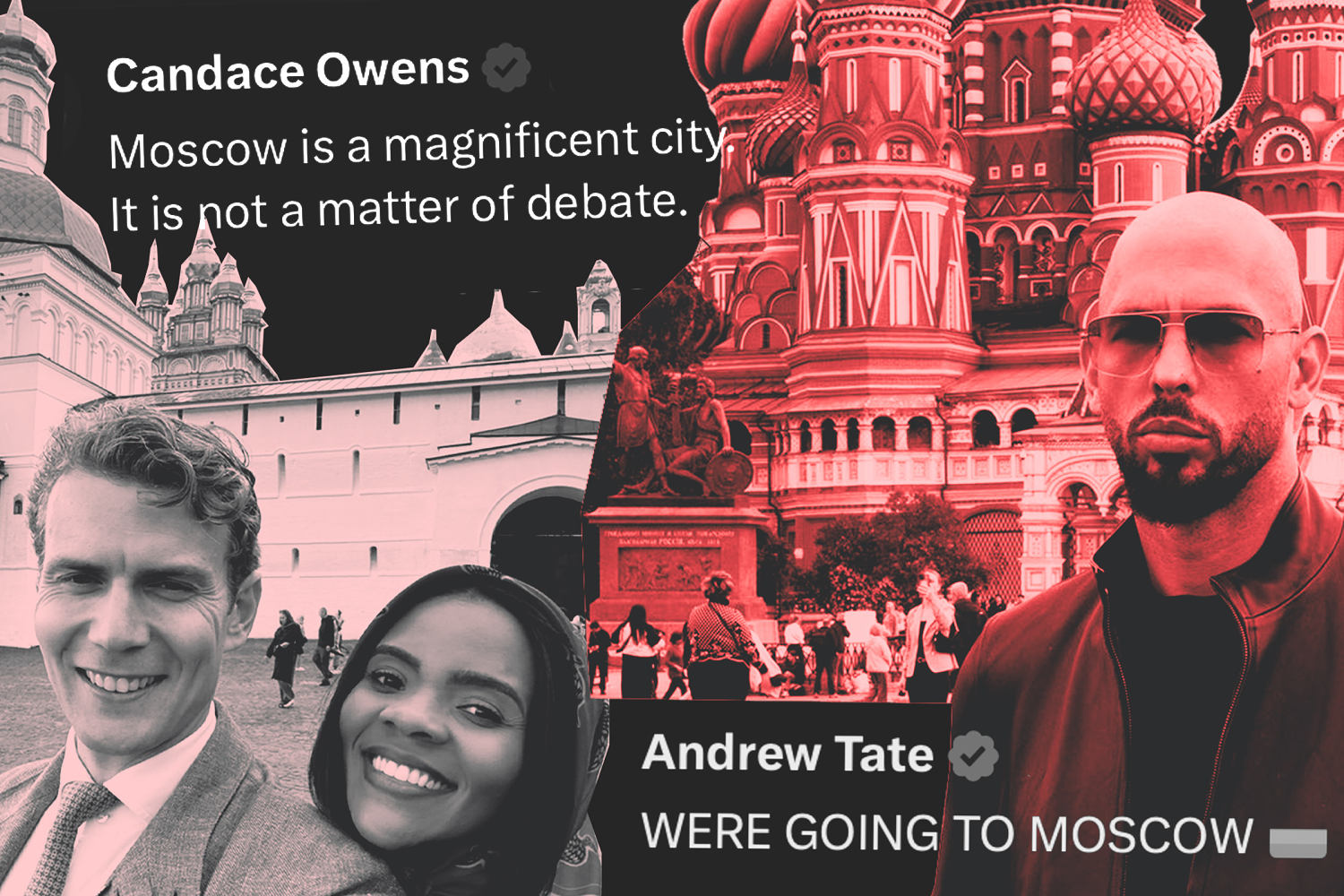
When Candace Owens and the Tate brothers—Andrew and Tristan—landed in Russia, the event was treated by their digital enclaves as a radical act of journalism. To the Western algorithms that feed on outrage, it was a glitch in the matrix. But to the grey-suited strategists inside the Kremlin, it was Tuesday. It was a highly successful, low-cost bureaucratic operation designed to manufacture a single, fragile illusion: the Great Thaw.
The Soft Power of Hard Men
To understand why a country undergoing intense international isolation would roll out the red carpet for an American commentator and two British-American internet personalities, you have to look past the ideology. You have to look at the geometry of the internet.
Consider the modern attention economy. It does not reward nuance. It rewards grievance. For years, the Kremlin’s traditional propaganda networks like RT and Sputnik have faced heavy restrictions across the Western world. Their state-backed anchors, stiff and obviously scripted, could no longer penetrate the feeds of everyday citizens in Ohio, Manchester, or Lyon.
Then came the pivot.
The Kremlin realized it didn’t need to build its own megaphones if it could simply lease the ones already tuned to the correct frequency.
Enter the influencers.
Andrew and Tristan Tate represent a specific, hyper-aggressive brand of masculine counter-culture. Candace Owens commands a massive, deeply loyal audience distrustful of mainstream media institutions. When these figures arrive in Moscow, they do not see the political prisoners, the suppressed local journalists, or the grinding economic realities of a nation on a total war footing. They see clean subway stations. They see cheap groceries. They see a version of traditionalism that they feel has been stripped from their own home countries.
The Kremlin spun their presence not as a political alliance, but as proof of a cultural awakening. Russian state media outlets immediately began clipping their broadcasts, translating their praise of Moscow into Cyrillic subtitles for a domestic audience. The message to ordinary Russians was clear: Look, the most popular voices in the West realize we are right.
Inside the Room Where the Script is Written
Let us look at a hypothetical, yet highly accurate, composite of how these interactions play out behind the scenes.
A digital creator receives an invitation. The logistics are handled through intermediary public relations firms based in Dubai or Belgrade. The flights are business class. The hotels are historic. There is an unspoken understanding that the creator will have "unprecedented access."
When the cameras start rolling, the host is introduced to a Russia that looks like a pristine postcard. They are taken to the Cathedral of Christ the Saviour. They are shown the bustling cafes of Arbat Street. The sensory overload is intentional. If you are surrounded by opulent architecture and polite handlers, it feels cynical to ask about the lack of an independent press. It feels rude to mention the names of activists who disappeared into the penal colony system for holding up a blank piece of paper.
This is the psychological mechanism of the political safari. The visitor feels like an intrepid explorer, a dissident intellectual defying Washington or London. In reality, they are being guided down a highly curated corridor.
The real tragedy is the asymmetry of the exchange. The influencer gets a spike in engagement, a few million views, and the thrill of being controversial. The host state gets something far more valuable: a localized laundering of its geopolitical image.
The Illusion of the Alternative
We live in a moment characterized by a profound, systemic institutional rot in the West. Trust in media, government, and corporate structures has collapsed to historic lows. It is a terrifying, uncertain reality to navigate. When people lose faith in their own backyard, they naturally look across the fence.
The danger arises when that search for an alternative blinds us to the realities of authoritarianism.
Russia’s current strategy relies heavily on this blindness. By framing itself as the last bastion of traditional values and freedom of speech, the Kremlin appeals directly to the alienation felt by millions of Westerners. When Candace Owens speaks about the erosion of family structures or the Tates rail against the "Matrix," their critiques resonate with people who feel left behind by rapid cultural shifts.
But the Moscow version of these values is a digital mirage.
The state that claims to protect traditional family values has some of the highest divorce and abortion rates in Europe. The system that claims to offer an alternative to Western censorship operates a surveillance apparatus so pervasive that liking the wrong post on social media can result in a multi-year prison sentence.
When Western influencers praise the "freedom" they feel in Moscow, they are confusing the privilege of the tourist with the reality of the citizen. They are allowed to speak freely because their speech aligns with the state's immediate objectives. The moment that alignment shifts, the hospitality vanishes.
The Digital Iron Curtain Has Two Sides
The internet was supposed to make borders obsolete. We believed that information would flow so freely that propaganda would become impossible to maintain. We forgot that human psychology is older than the fiber-optic cable.
What we are witnessing now is not a thawing of relations between East and West. It is the consolidation of a new kind of border—one built out of algorithms, confirmation bias, and the commodification of dissent. The Kremlin does not need Westerners to love Russia; it simply needs them to distrust their own societies enough to become paralyzed.
As the influencers pack their designer luggage and head back to the airport, the cameras turn off. The municipal workers continue to sweep the snow from the cobblestones outside the Kremlin walls. The state television broadcasts move on to the next segment, having extracted exactly what they needed from their guests.
The influencers will return to their studios, upload their vlogs, and check their analytics. They will view the comment sections as a battlefield where they have struck a blow against the establishment. They will feel like heroes.
Meanwhile, a few miles away from their luxury hotel, in a quiet apartment with the blinds drawn, a Russian journalist deletes her browser history, packs a small bag, and listens for the sound of heavy footsteps on the stairs.