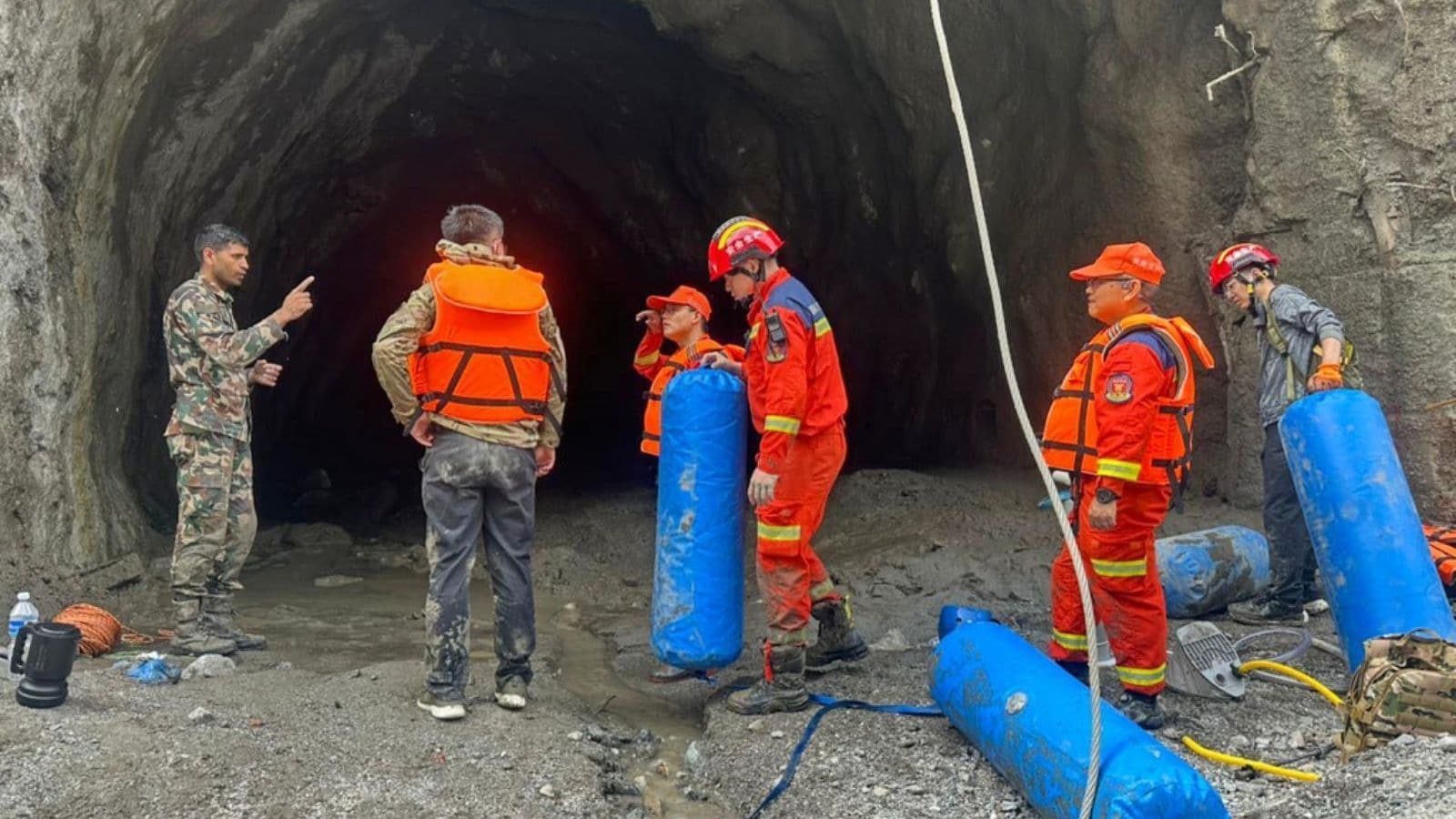
The water did not knock politely. It arrived at midnight, tasting of clay and centuries of undisturbed earth, carrying the roof beams of homes that had stood before our grandparents were born.
When the river finally retreated, it left behind something heavier than debris. It left a silence.
In the capital, thousands of miles away from the choked valleys where the rescue helicopters still burned fuel they could ill afford, men in sharp suits leaned over polished mahogany tables. They debated timing. They spoke of optics, of political survival, of the delicate calculus of accountability. Rahabar Ansari, a prominent voice from the Rastriya Swatantra Party, stood before the microphones with a stark message that cut through the parliamentary fog: this is not the right time to investigate the lapses that turned a seasonal monsoon into a catastrophic human eraser.
The rationale offered to the public was simple, almost seductively logical. Pointing fingers now would shatter the fragile unity required for rescue operations. It would paralyze an already overburdened administration. Instead, the government’s gaze must pivot outward, toward foreign capitals and international donor conferences, seeking the immense pools of capital required to rebuild shattered highways, broken bridges, and drowned fields.
Logic is a cold comfort to someone sleeping on a wet mattress under a blue tarpaulin.
Consider what happens next in the quiet villages of Nepal, far from the parliamentary chambers of Kathmandu. Maya sits on an overturned plastic bucket where her kitchen used to be. She has lived through three major floods, each one supposedly a once-in-a-century anomaly. She knows the sound of the hillside groaning before it gives way. She also knows the sound of political promises evaporating into the dry autumn air.
When leaders argue that accountability must wait for reconstruction, Maya experiences a different kind of waiting. She waits for clean water that tastes of bleach rather than river rot. She waits for a transparent accounting of why the early warning system failed, why the river embankments breached so easily, and where the disaster relief funds went before the first drop fell. To tell her that investigations must pause so that officials can secure foreign aid is to tell her that her grief is secondary to a bureaucratic fundraiser.
Yet, the state machinery faces a brutal arithmetic. Reconstruction costs billions of rupees. The national treasury is strained, bleeding from past economic shocks and the perpetual friction of governance. Foreign funding is not merely an option; it is an oxygen mask. International donors, however, are notoriously skittish. They do not write blank checks to governments embroiled in bitter partisan bloodletting over who ignored meteorological warnings. From a purely strategic standpoint, Ansari and his political peers are making a pragmatic calculation. Projecting stability to the international community unlocks the vaults in Washington, Geneva, and Tokyo.
Stability. That is the magic word. But whose stability?
There is a profound tension here between institutional survival and human justice. If you investigate too early, the government collapses under the weight of its own negligence, and reconstruction stalls entirely in the ensuing chaos. If you never investigate, the systemic rot that caused the disaster is baked into the new foundations. You simply rebuild the same vulnerable houses in the same dangerous paths, waiting for the next midnight deluge to wash them away again.
We have seen this script before. It is worn at the edges.
History is littered with well-funded reconstruction projects that forgot the people they were meant to save, prioritizing glossy infrastructure over resilient communities. When foreign aid arrives, it often flows through a maze of middlemen, consultants, and contractors, leaving only a damp crumb for the family whose land was swallowed by the torrent. If the Nepali state seeks international billions without first establishing an uncompromised mechanism for oversight—even if that mechanism is delayed—the money risks becoming a monument to impunity.
Transparency cannot be treated as a luxury item, something to be bolted on after the heavy lifting is done. It is the mortar.
The Rastriya Swatantra Party positions itself as an alternative to the old guard, a breath of technological and administrative competence in a system choked by stagnation. Yet, when faced with the ultimate test of accountability, even the modern reformers echo the ancient political refrain: not yet. The phrase echoes down the corridors of power across the globe, whispered by leaders whenever their own institutions falter under pressure.
Not yet.
The phrase allows politicians to manage crises instead of solving them. It creates a perpetual suspension bridge between disaster and amnesia. By the time the right time arrives—when the foreign funds are secured, when the ribbon-cuttings are finished, when the television cameras have packed their lenses and moved on to the next tragedy—the public has moved on. The anger has cooled. The mud has dried. The systemic failures that let the floodwaters in are quietly codified as normal life.
We must look past the polished press releases and confront the raw geometry of survival. The rebuilding of a nation requires more than cement and steel imported from abroad. It requires a radical honesty about vulnerability. It requires admitting that human lives were lost not merely because the sky opened up, but because drainage systems were ignored, zoning laws were bypassed, and warnings were filed away in damp drawers.
As the government looks outward to foreign donors, it must simultaneously look inward with unsparing clarity. International partners are watching. They are listening for the rhetoric of reform, but they are looking for the substance of integrity. A state that refuses to examine its own failures today is simply asking the international community to finance tomorrow's catastrophe.
The river has gone back to its bed, narrow and sullen, carrying the memory of the valley toward the plains. Down in the mud, Maya turns a sodden page of a child's schoolbook, drying it in the pale afternoon sun, waiting for a future that has promised everything except the truth.