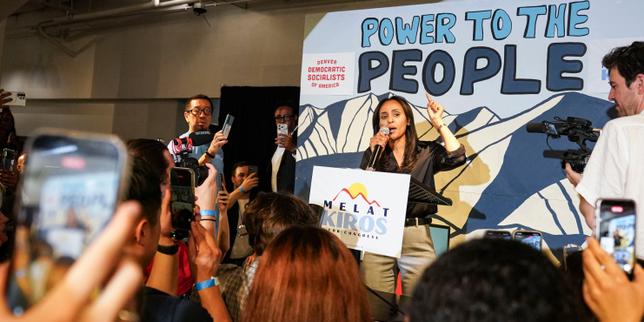
The political commentary class loves a David and Goliath story. For years, mainstream media outlets have obsessed over a specific narrative: the traditional, corporate Democratic establishment is allegedly on the ropes, constantly "jostled" and "disrupted" by a rising tide of an uncompromising, radical new left. It is a compelling drama. It sells newspapers.
It is also entirely wrong.
What pundits mistake for a foundational ideological shift is actually a highly predictable, carefully managed branding exercise. The narrative that a radical left wing is taking over the Democratic Party collapses the moment you look at raw legislative data, fundraising mechanics, and actual policy outcomes. The establishment isn't shaking in its boots. It is smiling, fundraising off the noise, and quietly consolidating power.
The Co-Optation Engine
Let’s dismantle the premise of the "radical takeover" immediately. In political science, true radicalism requires an existential challenge to existing power structures. What we see instead within the modern Democratic Party is a textbook example of recuperation—the process by which radical ideas are absorbed, diluted, and neutralized by the very establishment they seek to overthrow.
Look at the legislative track record. When the chips are down on major budgetary votes, debt ceiling agreements, or military appropriations, the self-described radical wing almost invariably votes with party leadership.
- The Rhetoric: Defund the system, dismantle corporate monopolies, and rewrite the social contract.
- The Reality: Incremental adjustments to tax credits, minor regulatory tweaks, and symbolic resolutions that carry zero legal weight.
I have spent over a decade analyzing policy formulation and party whipping strategies. The pattern is always the same. The "insurgent" wing generates massive social media engagement, drives small-dollar donations, and dominates the cable news cycle. Then, when the actual bill is drafted behind closed doors by committee chairs, those fiery talking points are systematically stripped out. The insurgents line up, cast their votes for the watered-down compromise, and claim it as a stepping stone.
That isn't a disruption. That is functioning exactly as the establishment intends. The radical wing acts as an effective focus group and a highly efficient marketing department for a party that desperately needs to signal youth and vitality to its base while maintaining its core commitments to capital markets and institutional stability.
The Illusion of Social Media Capital
The fatal flaw in the "emerging left" thesis is the conflation of online metrics with institutional power.
A viral tweet or a trending hashtag does not equal a whipped vote on the House floor. The currency of Washington remains unchanged: seniority, committee assignments, donor networks, and institutional leverage.
Institutional Power = (Seniority × Committee Control) + Stable Capital Networks
The insurgent left operates on an entirely different, highly volatile currency: attention.
The Attention Economy vs. The Committee Room
Consider the structural reality of the House of Representatives. Power flows downward from the Speaker and the Rules Committee. A freshman or sophomore lawmaker with five million social media followers still possesses exactly one vote and zero power to bring a bill to the floor.
When mainstream analyses warn of an establishment "bousculé" (shaken) by radicals, they ignore how structural power works. The establishment controls the purse strings of the Democratic Congressional Campaign Committee (DCCC). It controls the redistricting processes. It controls the committee assignments that lawmakers need to deliver tangible benefits back to their districts.
When a genuine outsider threatens an entrenched incumbent, the party machine reacts with brutal, clinical efficiency. Millions of dollars from aligned political action committees pour into primary races to protect the status quo. The few insurgents who do slip through the net are quickly faced with a choice: play ball with leadership to secure committee seats, or remain a permanent, powerless backbencher who writes press releases that nobody reads. Most choose to play ball.
Dismantling the Primary Delusion
"But look at the primary upsets!" the defenders of the radical narrative scream. They point to a handful of high-profile insurgent victories in deep-blue urban districts as definitive proof of a national shift.
This is a classic sampling bias error.
If you isolate ultra-progressive enclaves in New York, Boston, or San Francisco, you can easily manufacture a trend line that looks like a revolution. But zoom out to the midterms and special elections across the wider American electorate—the districts that actually decide the congressional majority.
In the competitive suburbs of the Midwest and the Sun Belt, the candidates who actually win elections look exactly like the traditional establishment: pragmatic, business-friendly, risk-averse moderates. The national party leadership knows this. They willingly sacrifice a few safe seats to the ideological fringe because it satisfies the activist base without risking their ability to compete for the vital center.
The premise of the question "Is the Democratic Party moving permanently to the left?" is fundamentally flawed. A more accurate question is: "How does the Democratic Party use its left wing to maintain its centrist equilibrium?"
By allowing a controlled burn on the ideological left, the party leadership can position itself to the broader electorate as the adults in the room—the reasonable moderate alternative to both right-wing populism and left-wing idealism.
The Capital Factor: Follow the Money
Let’s talk about the money, because numbers don't lie, even if politicians do.
The narrative of a grassroots-funded revolution relies heavily on the success of platforms like ActBlue and the explosion of small-dollar donations. It’s a beautiful sentiment—the idea that ordinary citizens are out-funding the billionaire class.
But it’s an accounting trick.
While small-dollar donations are excellent for funding individual campaign operations and digital ad buys, they pale in comparison to the massive institutional capital deployed by traditional political action committees, dark money groups, and high-net-worth bundlers.
| Funding Source | Target Metric | Ultimate Leverage |
|---|---|---|
| Small-Dollar Grassroots | Public Attention / Ad Buys | High visibility, low structural policy control |
| Institutional PACs / Bundlers | Leadership PACs / Independent Expenditures | High structural policy control, low visibility |
When major legislation—like infrastructure packages or healthcare regulations—is actually negotiated, the entities holding the real leverage are the ones funding the leadership PACs that distribute money to vulnerable members across the country. The radical wing cannot scale its funding model to protect thirty moderate Democrats in swing districts. The establishment can. Therefore, the establishment calls the shots.
The True Cost of Symbolic Politics
There is a distinct downside to my contrarian view that activists hate to admit: this system breeds profound cynicism.
When you continuously cycle through a process of high-minded radical rhetoric followed by predictable establishment compromise, the electorate notices. The danger to the Democratic Party isn't that a radical left will take over; the danger is that the constant commodification of progressive ideals will alienate the very voters they need to survive.
By treating radicalism as a lifestyle brand rather than a legislative strategy, the party creates a vacuum. It leaves working-class voters—who care far more about inflation, wages, and tangible economic security than ideological purity contests—feeling abandoned by an elite class that prefers fighting culture wars to building real material power.
Stop looking at the podiums. Stop analyzing the tweets. Stop believing the hand-wringing editorials from mainstream commentators who need to invent an internal party civil war to keep their columns interesting.
The establishment isn't losing the battle for the soul of the party. The establishment already won, and they are using the supposed radicals to guard the gates.