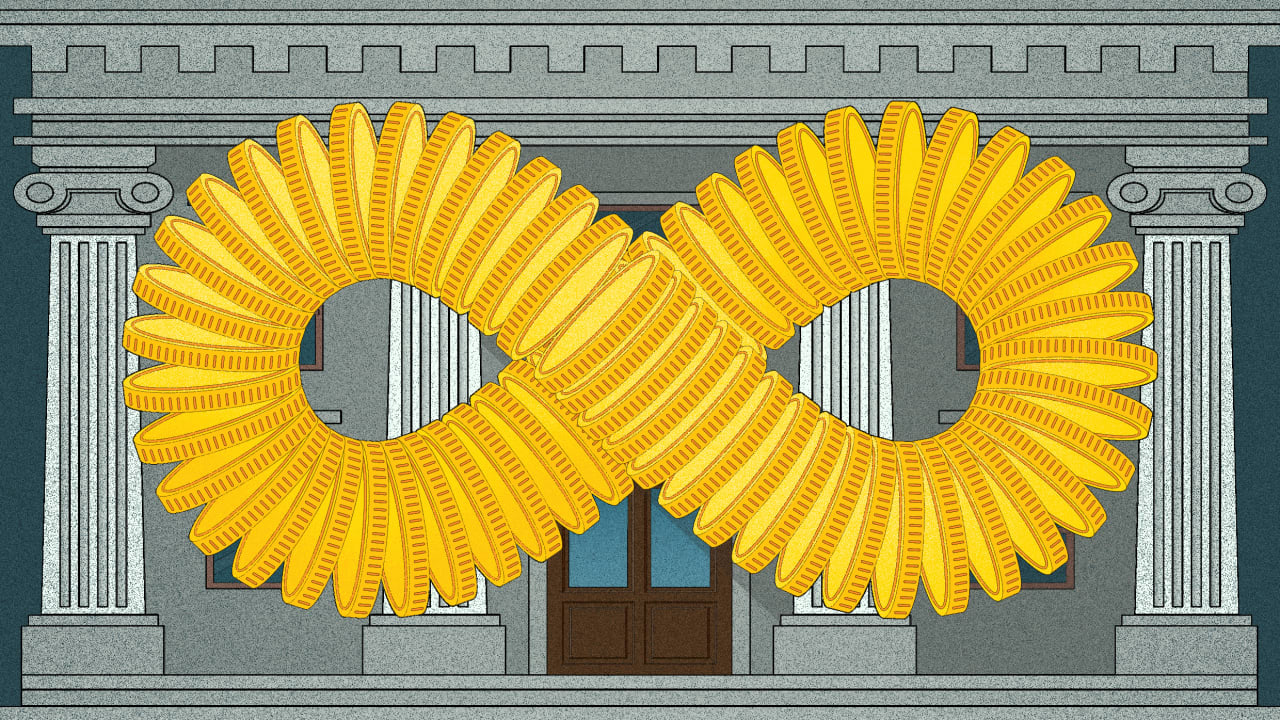
Mark Carney recently confirmed what decades of quiet central bank data already whispered. When the United States Federal Reserve moves, the Bank of Canada has little choice but to follow. Despite the theoretical freedom of a floating exchange rate, the practical reality is a tether that barely allows for a few inches of slack. This is not about a lack of sovereignty in the legal sense; it is about the cold, mathematical gravity of being a mid-sized economy parked next to the world’s largest capital market.
The central premise often sold to the Canadian public is that the Bank of Canada (BoC) sets interest rates based strictly on domestic inflation and employment. While that remains the official mandate, the "Carney admission" highlights a structural trap. If the Fed keeps rates high to combat American inflation while the BoC tries to cut them to save a struggling Canadian housing market, the resulting currency depreciation creates a new wave of imported inflation. You cannot decouple from the giant without paying a price that most politicians—and central bankers—find stomach-turning. Read more on a connected subject: this related article.
The Currency Trap and Imported Inflation
The mechanism is straightforward but brutal. Canada imports a massive volume of goods, services, and industrial components from the United States. When the interest rate differential between the two nations grows too wide, investors move their capital into the higher-yielding U.S. dollar. The Canadian dollar (CAD) then drops.
A weaker CAD makes every piece of machinery, every gallon of gas, and every crate of California produce more expensive. This "imported inflation" eventually hits the Consumer Price Index (CPI), forcing the BoC to raise rates anyway, regardless of whether the domestic economy is ready for them. The BoC is essentially forced to import American monetary policy to protect the purchasing power of the Canadian consumer. Additional journalism by Financial Times highlights comparable views on this issue.
Consider the current divergence. The American economy has shown a strange, post-pandemic resilience, fueled by massive fiscal spending and a less interest-rate-sensitive mortgage market. Canadians, conversely, are sitting on a powder keg of short-term variable mortgages and five-year renewals. A Canadian homeowner feels a rate hike within months; an American homeowner with a thirty-year fixed mortgage barely notices.
The Productivity Gap Problem
We often focus on interest rates, but the deeper issue is the widening chasm in productivity between the two nations. Since the mid-2000s, Canadian business investment has stagnated while American investment in technology and intellectual property has soared.
When a country is less productive, its currency should naturally weaken. However, the BoC cannot allow the currency to reflect this reality too quickly because it would trigger the aforementioned inflationary spiral. We are trapped in a cycle where we keep rates high enough to support a currency that our underlying economic performance doesn't actually justify.
The Political Illusion of Choice
Ottawa politicians enjoy talking about "Made-in-Canada" solutions. It plays well in the suburbs of Toronto and Vancouver. But the fiscal policy of the federal government often runs directly counter to the monetary needs of the central bank. While the BoC tries to cool the economy, federal spending continues to add fuel to the fire, forcing the bank to keep rates higher for longer than they might otherwise prefer.
This creates a pincer move on the Canadian middle class. They are hit with higher taxes and government debt on one side, and restrictive interest rates—mandated by the Fed’s trajectory—on the other. The "salute" to Washington isn't a sign of weakness by the BoC governor; it is a recognition that the Canadian economy lacks the internal momentum to chart its own course without causing a currency collapse.
Capital Flight and the Great Canadian Discount
Investors are not sentimental. If the risk-adjusted return in the U.S. is higher, the money leaves. We see this in the steady stream of Canadian pension fund capital flowing into American private equity and infrastructure rather than domestic projects.
If the BoC were to cut rates significantly more than the Fed, the flight of capital would accelerate. The resulting "Great Canadian Discount" on the dollar would make our assets cheap for American buyers, leading to a massive sell-off of Canadian corporations and resources—hardly a sovereign outcome for a G7 nation.
The Housing Crisis and the Fed Constraint
The most painful part of this relationship is its effect on Canadian housing. Canada has one of the highest household debt-to-GDP ratios in the developed world. A significant portion of that debt is tied to mortgages with short-term renewal windows.
If the Fed keeps rates high because the U.S. labor market is too hot, the BoC is forced to keep Canadian rates high even if the Canadian housing market is cooling or crashing. This is a fundamental misalignment. One economy is overheating; the other is choking on its own mortgage debt. Yet, the BoC must stay within a reasonable range of the Fed’s target to prevent a currency free-fall.
The Historical Precedent of the 1980s
In the late 1970s and early 1980s, Paul Volcker’s Fed hiked rates aggressively to kill inflation. The BoC had no choice but to follow suit, pushing Canadian interest rates even higher—peaking at over 20%. The Canadian economy went into a deep, painful recession.
We are not in the 1980s yet, but the same structural forces are at play. When the world’s reserve currency becomes expensive, every other nation must decide whether to import that high-interest rate or export its own capital. Canada is uniquely vulnerable due to the sheer volume of trade and investment crossing the border every hour.
The "whistle" Carney refers to isn't a direct order. It's the market's demand for a return on capital that compensates for the risk of holding a "commodity currency." If Canada fails to provide that return, the currency tanks, the cost of living spikes, and the BoC is forced back to the table anyway.
The real question isn't whether the BoC salutes Washington. It's whether Canadian policymakers have any plan to build an economy productive enough to eventually walk away from the drill.
Would you like me to analyze the specific sectors of the Canadian TSX most vulnerable to a widening interest rate spread between the Fed and the BoC?
_Detail+1.jpg)