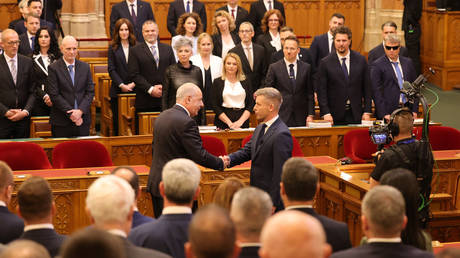
The mainstream media is suffering from a collective panic attack over Hungary. Headlines are screaming about an impending constitutional breakdown. Commentators are wringing their hands over the new Prime Minister’s aggressive rhetoric, claiming his threats to bypass the constitution and oust the president will tear down the fabric of Hungarian democracy.
They are missing the entire point.
What the international press labels a constitutional crisis is actually a masterclass in domestic political positioning. Having spent over a decade analyzing European constitutional law and watching Brussels clash with Budapest, I can tell you that the lazy consensus has it completely backward. The new Prime Minister isn't about to shred the constitution. He can’t. Instead, he is using the threat of constitutional upheaval as a highly effective lever to consolidate power, mobilize his base, and force a compromise that standard political maneuvering could never achieve.
Stop looking at the legal text. Start looking at the leverage.
The Legal Reality That Dictates the Game
To understand why the mainstream narrative is flawed, you have to look at the actual mechanics of Hungarian governance. The standard commentary treats Hungary as if it operates under a fragile, easily malleable framework that any populist leader can rewrite on a whim.
It doesn't.
The Basic Law of Hungary, enacted in 2011, was specifically engineered to be incredibly rigid against challenges from political opponents. To pass a constitutional amendment or remove a sitting president, a supermajority of two-thirds of the parliament is required. The current political reality is that the new Prime Minister does not possess this unchecked legislative dominance.
When a politician lacking a two-thirds majority threatens a unilateral constitutional overhaul, they aren't drafting a legal roadmap. They are issuing a press release.
Let's break down the actual mechanism for removing a president in Hungary. It requires a formal procedure initiated by one-fifth of the parliament, followed by a two-thirds vote to refer the matter to the Constitutional Court. The Court—which is packed with judges appointed during the previous era—then has to rule on whether the president willfully violated the constitution.
The new PM knows this. He knows the Constitutional Court would block any illegal maneuver instantly. Therefore, the threat itself is the objective, not the execution.
The Strategy of Controlled Escalation
If you cannot legally remove the president, why base your entire early platform on doing exactly that? Because it creates a highly effective political foil.
In political strategy, an entrenched opposition figure in the presidency is more useful alive than dead. By framing the president as an illegitimate remnant of the old regime who is actively blocking the will of the people, the new Prime Minister achieves three distinct goals.
- Shifting Accountability: Any failure to deliver on economic promises or legislative reforms over the next twelve months can be blamed entirely on presidential obstruction.
- Base Mobilization: Nothing unites a fractured coalition faster than a shared, high-profile enemy. The presidency becomes a symbol of the old guard that needs to be defeated.
- Negotiating Leverage: By threatening the nuclear option of constitutional circumvention, the PM forces the president's camp to negotiate on ordinary legislation from a position of fear.
I have watched political factions across Central Europe burn millions of euros in political capital trying to play by the traditional rules of consensus diplomacy, only to be neutralized by entrenched bureaucrats. The new Hungarian administration is avoiding that trap. They are creating a crisis atmosphere because crisis simplifies the political landscape into a binary choice: you are either with the new government or you are with the obstructionists.
Dismantling the People Also Ask Misconceptions
The public discussion around this transition is filled with fundamental misunderstandings about how power operates in Budapest. Let's address the most common flaws in the public debate.
Can the Hungarian Prime Minister legally remove the president?
No. The legal framework requires a two-thirds parliamentary majority and the approval of the Constitutional Court. Without both, any attempt is legally void. The current administration lacks the numbers to do this cleanly, meaning any talk of forced removal is a rhetorical tactic designed to pressure the president into a voluntary resignation or a political compromise.
Is Hungary heading toward a total constitutional breakdown?
This question assumes that the written constitution is the only thing maintaining stability in Hungary. The reality is that stability is maintained by a complex network of economic interests, institutional habits, and European Union financial oversight. A total breakdown would freeze EU funds permanently and tank the Hungarian forint. The new PM is a pragmatist, not an anarchist. He will push the boundaries of rhetoric to the absolute limit, but he will stop exactly one millimeter short of a true systemic collapse that would bankrupt his own government.
Why doesn't the European Union intervene immediately?
The EU operates on mechanisms like Article 7, which requires unanimity among member states to impose meaningful sanctions. Brussels cannot intervene based on tough talk or political threats. Until a concrete, illegal legislative act is passed, the EU has no legal standing to act. The new administration understands the slow, bureaucratic nature of the European Commission perfectly and uses that sluggishness to its advantage.
The Hidden Cost of the Contrarian Playbook
While the threat of constitutional change is brilliant theater, it is not without severe downsides. This strategy is a high-stakes gamble that carries a massive premium.
The primary risk is economic. Foreign investors do not always distinguish between political posturing and actual systemic instability. When a Prime Minister talks about bypassing the constitution, international markets react to the words, not the hidden strategy. The cost of borrowing for Hungary risks rising, and the risk premium on Hungarian bonds will widen as long as this rhetoric dominates the news cycle.
Furthermore, this tactic has a hard expiration date. You can only blame the president for obstruction for so long before the public demands actual results. If the president refuses to blink, refuses to resign, and calls the PM’s bluff, the administration will be exposed as legally powerless.
The Reality of Power in Budapest
The international community needs to stop reacting to every fiery speech out of Budapest as if it represents a new authoritarian blueprint. It is a standard, aggressive opening gambit in a long-term negotiation over the control of Hungarian institutions.
The new Prime Minister is not trying to destroy the constitutional order; he is trying to renegotiate his place within it. By threatening the impossible, he ensures that his actual, more moderate demands will look reasonable when he finally brings them to the negotiating table.
Turn off the television pundits. Ignore the panicked editorials. The constitution will survive, the president will likely serve out a compromised term, and the Prime Minister will get exactly what he actually wanted: absolute control over the narrative and a submissive opposition.
Stop watching the fistfight on the stage and start looking at who is controlling the lights.