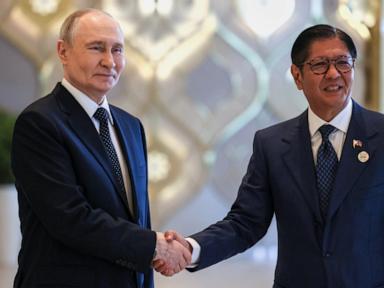
Mainstream newsrooms love a clean, heroic narrative. When the headlines broke claiming that Philippine President Ferdinand Marcos Jr. successfully negotiated the release of 24 Filipino nationals detained in Russia after a direct intervention with Vladimir Putin, the media machine did exactly what it always does. It credited top-level diplomacy. It painted a picture of a calculated geopolitical chess move where a smaller nation leveraged personal rapport to secure human freedom.
It is a beautiful story. It is also entirely wrong.
As someone who has spent two decades analyzing bilateral trade disruptions and state-level labor disputes across emerging markets, I can tell you that global politics does not work like a Hollywood script. Dictators do not hand over detainees as personal favors because another head of state asked nicely. The "lazy consensus" surrounding this incident treats the release as a triumph of soft power. In reality, it was a transactional liquidation of low-value assets, orchestrated not for humanitarian goodwill, but to clear the deck for much larger, structural dependencies that Manila is actively ignoring.
To understand what actually happened, we have to stop looking at the press releases and start looking at the mechanics of state transaction.
The Illusion of the Personal Favor
The premise that Marcos Jr. simply "talked to Putin" and solved a complex judicial or administrative detention overnight ignores the rigid, bureaucratic transactionalism of the modern Russian state.
When a authoritarian regime releases foreign nationals, it is never an act of mercy. It is an act of currency management. Detained foreign workers are geopolitical chips. They are held when tension is useful, and they are spent when a specific, immediate return is required.
Consider the timing. Russia is currently navigating severe international isolation, looking to solidify its footprint in Southeast Asia through energy exports, military hardware agreements, and agricultural trade. The Philippines, traditionally a staunch ally of the United States, represents a critical swing state in the Pacific.
By releasing 24 citizens, Moscow did not concede anything. It manufactured a zero-cost diplomatic gift. It allowed Manila to claim a domestic victory while costing Russia absolutely nothing. The 24 workers were not political prisoners of high strategic value; they were bureaucratic leverage points. The mainstream narrative celebrates the release without ever asking what Manila quietly traded away in the background—or what expectations have now been set for future concessions.
The Hidden Capitalist Mechanics of Labor Export
To truly demystify this event, we have to look at the underlying structural issue: the Philippine economic model of labor export. The Philippine state relies heavily on Overseas Filipino Workers (OFWs) to keep its domestic economy afloat via foreign remittances. According to data from the Bangko Sentral ng Pilipinas, personal remittances regularly account for nearly 10 percent of the nation’s Gross Domestic Product.
This creates a structural vulnerability that seasoned analysts recognize immediately, but politicians refuse to admit. The Philippine government is effectively an agency that exports human capital and imports cash. When those human assets run into legal or geopolitical walls abroad, the state is forced into an asymmetric bargaining position.
Imagine a scenario where a corporation relies entirely on a single supplier for its raw materials, but that supplier operates in a volatile, lawless territory. The corporation will repeatedly overpay, tolerate abuses, and sign unfavorable contracts just to keep the supply chain moving. That is the exact position of the Philippine Department of Foreign Affairs when dealing with hostile or volatile jurisdictions like Moscow or the Middle East.
When the media praises a president for "saving" workers, they are treating the symptom while ignoring the disease. The real story isn't that 24 people were freed. The real story is that the Philippine economic architecture continuously forces its citizens into high-risk, under-regulated foreign labor markets because it cannot create high-paying jobs at home. It then spends massive diplomatic capital to bail them out when the inevitable geopolitical friction occurs.
The Asymmetric Ledger of Hostage Diplomacy
Let's look at the hard numbers and the real trade-offs. What does a state actually lose when it engages in this type of high-profile transactional diplomacy?
- Loss of Strategic Ambiguity: By engaging directly with Putin to request a favor, Manila complicates its relationship with Western allies who are actively enforcing sanctions against Moscow. You cannot easily negotiate micro-level humanitarian favors with an international pariah while simultaneously trying to maintain macro-level strategic defense alignments with the G7.
- The Precedent Penalty: When you show the world that a personal phone call from a head of state can bypass legal frameworks, you incentivize other volatile regimes to detain your citizens. It signals that your migrant population is an effective lever to force direct communication and political concessions from the highest levels of your government.
- Resource Misallocation: The diplomatic energy, intelligence assets, and ministerial hours spent negotiating the administrative release of two dozen individuals could have been spent negotiating systemic labor protections, binding bilateral treaties, or diversifying trade routes away from high-risk zones.
I have watched governments make this mistake repeatedly. They burn millions of dollars in political goodwill for a short-term public relations win that lasts for one news cycle. Meanwhile, the systemic vulnerabilities remain completely untouched.
The Flawed Questions the Public is Asking
If you look at the public forums and the standard media analysis, the questions being asked are fundamentally broken.
The public asks: "How did Marcos convince Putin?"
The brutal, honest answer is: He didn't. Putin looked at the ledger, realized that keeping 24 migrant workers was yielding diminishing returns, and traded them for a massive PR victory that makes him look reasonable to Southeast Asian audiences while driving a subtle wedge between Manila and Washington.
The public asks: "Is it safe for workers to return to Russia?"
This is the wrong question entirely. The right question is: Why is the Philippine government still allowing deployment to regions where standard legal protections are non-existent and where workers can be converted into political bargaining chips at a moment's notice?
The Unconventional Blueprint for Migrant Statecraft
If Manila actually wants to protect its people and project real power, it needs to abandon the theatricality of personalistic diplomacy. Stop relying on late-night phone calls between strongmen. Instead, execute a cold, calculated shift in strategy.
First, implement an aggressive, data-driven risk-rating system for migrant destinations. If a country does not possess an independent judiciary, transparent labor laws, and a verifiable track record of honoring human rights, deployment ceilings must be systematically lowered. Treat human capital the way a disciplined hedge fund treats financial capital: diversify away from high-risk, low-yield environments.
Second, establish an ironclad sovereign indemnity fund. Instead of begging for the release of citizens or paying legal fees on an ad-hoc basis, create a formalized, well-capitalized legal defense infrastructure stationed permanently in volatile trade hubs. Force host countries to deal with an aggressive, highly compensated wall of international lawyers rather than a pliable diplomatic corps seeking political favors.
Third, acknowledge the downside. This approach will hurt. It means capping deployment to lucrative but dangerous markets. It means a temporary drop in remittance inflows. It means facing the wrath of labor agencies and desperate workers who want to go anywhere that pays. But it is the only way to break the cycle of geopolitical blackmail.
The standard commentary will continue to tell you that the resolution of this incident is a victory for Philippine foreign policy. Do not buy it. A system that requires the leader of a nation to personally petition a foreign autocrat to release two dozen ordinary workers is not a system that is winning. It is a system that is fundamentally compromised.
Stop celebrating the rescue. Start questioning the vulnerability that made the rescue necessary in the first place.