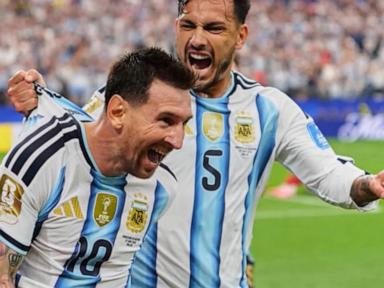
The media collective collectively lost its mind when Lionel Messi lifted the World Cup trophy. The narrative was written before the final whistle even blew in Lusail: validation, completion, the definitive end to the "Greatest of All Time" debate. Commentators wept. Editors scrubbed their drafts to insert words like "destiny."
It was lazy journalism at its absolute peak.
The collective sports media spent decades peddling a flawed premise: that a single, seven-game tournament held every four years is the ultimate metric of footballing execution. It is not. The obsession with international trophies as the gold standard of individual genius is a analytical failure. If you believe the World Cup magically elevated Messi into a new tier of football royalty, you do not understand the sport. You understand theater.
Let us dismantle the romanticism and look at the brutal mechanics of how elite football actually works.
The Mathematical Absurdity of the International Sample Size
To understand why using the World Cup to measure a player's true baseline is foolish, you have to look at the numbers. Club football is a grinding, highly optimized machine. Over a 38-game domestic season, plus a dozen or more elite Champions League fixtures, luck irons out. The best tactical systems win. The highest-performing individuals consistently float to the top because the sample size is large enough to eliminate statistical noise.
The World Cup is the exact opposite. It is a high-variance, knockout lottery wrapped in flags.
Consider the raw data of a typical international career. A player might feature in three or four World Cups if they are exceptionally lucky and play for a powerhouse nation. That equates to roughly 15 to 25 games spread across twelve years. To base a definitive evaluation of a two-decade career on a sample size that small is statistical malpractice.
If a hedge fund manager made three trades a year and got lucky on two of them, you wouldn't call them a financial genius; you would call them a survivor of variance. Yet, when an international team strings together four wins in a row during a knockout bracket, we attribute it to metaphysical destiny.
Tactical Regression and the Illusion of Quality
The standard of play at the international level is vastly inferior to elite club football. This is a cold truth that tournament broadcasters desperately try to hide.
Pep Guardiola’s Manchester City or Carlo Ancelotti’s Real Madrid spend ten months a year, six days a week, drilling specific positional plays, pressing triggers, and defensive transitions. They achieve a level of automation and synergy that is impossible to replicate in a two-week international training camp.
International football is, by necessity, tactically primitive. National team managers do not have the time to implement complex positional systems. Instead, they rely on:
- Low-block defensive structures to minimize mistakes.
- Individual moments of brilliance to score.
- Physical endurance and emotional momentum.
When you watch a World Cup match, you are watching a slower, less coordinated version of the sport compared to a Champions League quarterfinal. Judging Messi—or any elite player—by how they perform in a compromised tactical ecosystem is nonsensical. Messi’s true masterclass was spent over fifteen years breaking down hyper-organized, deeply drilled European club defenses week in and week out, not scoring penalties against rotating international squads.
The Flawed Premise of Self-Actualization
People constantly ask: "Does a player need a World Cup to be considered truly great?"
The premise of the question itself is broken because it views football as an individual sport disguised as a team game. It ignores the compounding variables that an individual player cannot control.
Imagine a scenario where Gonzalo Higuaín buries his clear-cut chance in the 2014 World Cup final against Germany. Argentina wins 1-0. Messi lifts the trophy eight years earlier. Does that conversion by a teammate suddenly alter Messi’s intrinsic passing vision, his dribbling efficiency, or his expected goals (xG) metrics over his entire career? Of course not. It changes nothing about the player; it only changes the metadata around him.
Relying on tournament trophies to define individual capability leads to absurd logical conclusions. By that broken framework, safe squad players who happened to sit on the bench for victorious nations possess a superior footballing legacy than generational geniuses who happened to be born in countries with weak footballing infrastructure. Legacy is not a collective group project where the smartest kid gets all the credit.
The Downside of the Fairytale Narrative
There is a distinct downside to the universal worship of the Qatar tournament outcome. By treating the 2022 trophy as the necessary final piece of the puzzle, the sports world implicitly validated the critics who spent years claiming Messi was incomplete without it.
It conceded ground to the bad-faith arguments that required an international trophy to prove what was already visible on videotape and in data registries for over a decade. It signaled to the next generation of players that consistency, sustained elite output, and revolutionary tactical intelligence matter less than a hot streak in a winter tournament.
The industry wants you to believe the World Cup is the pinnacle because it sells jerseys, drives television ratings, and creates clean, cinematic narratives that even casual fans can digest. But clean narratives are almost always a lie. Football is messy, chaotic, and driven by systemic patterns, not scriptwriters.
Stop looking at the gold trophy as a validation of what you already knew. Lionel Messi did not become a historical entity because his team won a penalty shootout against France. He was already there, operating in a reality that a seven-game tournament could never hope to measure. Stop buying the theater. Look at the machine.