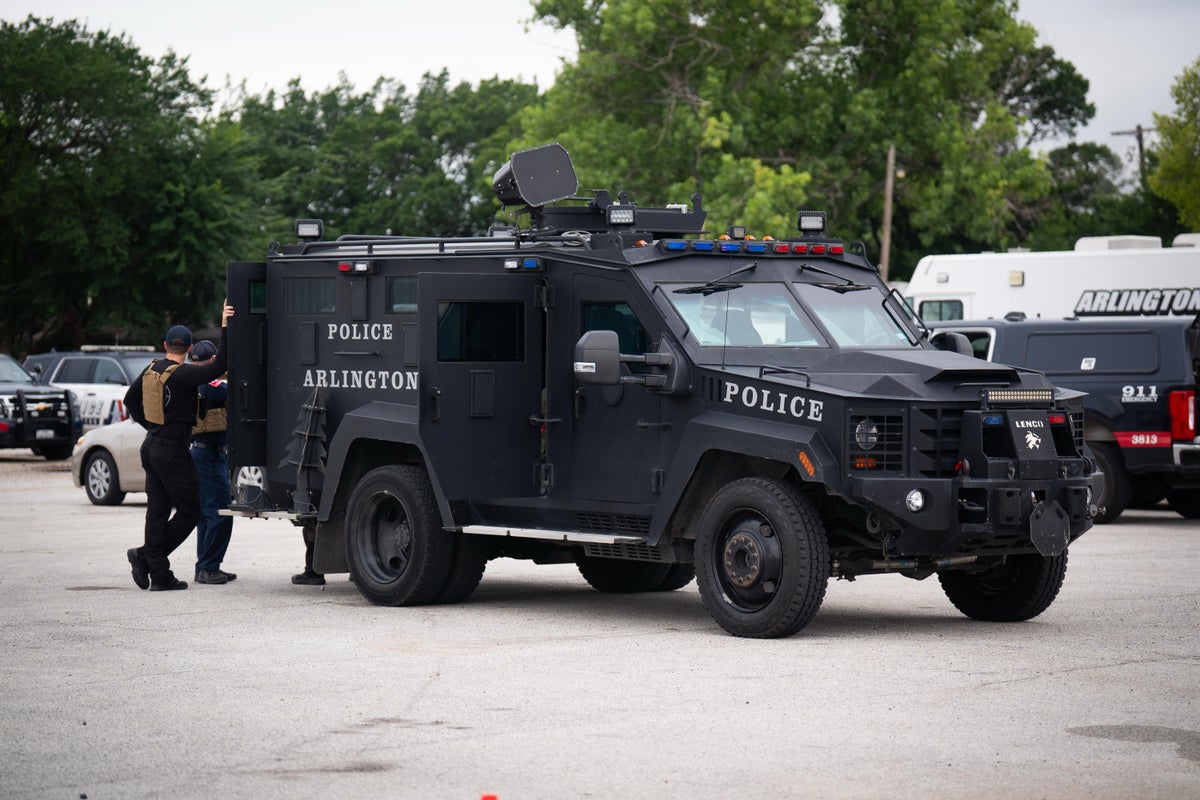
Mainstream news outlets love a tactical vest. They see a heavily armed officer, they see a SWAT team van, and the headline practically writes itself. "Chaos." "Terror." "Security Breach."
We saw it again with the breathless reporting surrounding the deployment of armed officers near an England World Cup venue. The narrative was served on a silver platter: an international sporting event under siege, vulnerable fans, and a sudden, terrifying escalation of force.
It is a comforting narrative for editors because panic sells papers. It is also completely wrong.
What the public just witnessed was not a failure of security or a sudden spike in existential danger. It was the exact opposite. It was a textbook demonstration of routine operational scaling. The media treated a standard logistical pivot like a catastrophic anomaly because they do not understand how modern, high-profile policing actually functions.
The Logistics of Fear vs. The Reality of Deployment
Standard news reporting operates on a flawed premise: that the presence of heavily armed police correlates directly to the immediate severity of a threat. If the police bring big guns, the danger must be massive.
This is a fundamental misunderstanding of modern crowd management and counter-terrorism doctrine.
In high-stakes environments—like the perimeter of a World Cup venue—specialist units are not deployed because something has gone catastrophically wrong. They are staged, positioned, and occasionally moved through public spaces precisely so that nothing can go wrong.
When you see a tactical unit near a stadium, you are looking at preventative posture, not reactive desperation.
The competitor media framing implies that the neighborhood surrounding the venue suddenly transformed into a war zone. Let's look at the actual mechanics of police logistics. During a global tournament, policing agencies operate under a tiered response framework.
- Tier 1: Baseline Visibility. Standard patrol officers managing traffic, flow, and basic anti-social behavior.
- Tier 2: Tactical Contingency. Specialized units stationed at strategic choke points, ready to move instantly.
- Tier 3: Active Intervention. The actual engagement of a verified threat.
The incident reported as a major scare was a Tier 2 unit executing a routine containment protocol for an isolated, non-terror-related issue that happened to occur within the wider geographic footprint of the tournament. The event did not breach the stadium. It did not target fans. It was a localized police matter dealt with by the assets already assigned to the zone.
To call this a "World Cup security incident" is like saying a traffic accident three miles from an airport is an aviation crisis.
The Cost of the "Lazy Consensus"
I have spent years analyzing operational security frameworks for major public events. I have seen organizations spend millions of dollars rewriting perfectly functional security briefs just because a sensationalized headline scared their board of directors.
When the media panics, politicians react. When politicians react, resources get misallocated.
The lazy consensus demands that every time an armed officer is spotted near a football shirt, we must debate whether global sporting events are inherently unsafe. This hyper-fixation on visible, dramatic security assets ignores the real, grinding work of event safety.
While the cameras are tracking a single tactical vehicle, they are completely missing the actual vulnerabilities that keep security directors awake at night.
What Actually Matters in Stadium Security
- Access Control Integrity: The boring, slow-moving lines at the turnstiles where digital ticketing systems can fail and cause dangerous crowd crushes.
- Communication Interoperability: Whether the private security contractors inside the stadium can actually talk to the municipal police force outside the gates on the same radio frequency.
- Logistical Fatigue: The reality that security personnel working 14-hour shifts lose the cognitive sharpness required to spot actual anomalies.
A SWAT team sitting in a van is a deterrent, but it is a blunt instrument. The obsessed focus on these units pulls attention away from structural operational flaws. We are looking at the theater of security rather than the mechanics of it.
Dismantling the Panic Queries
If you look at what people actually ask online during these events, the anxiety is palpable. The questions themselves reveal how deeply the media's flawed premise has taken root. Let's answer them honestly.
Are World Cup venues safe for international fans?
Yes. They are among the most heavily scrutinized, heavily fortified, and meticulously planned spaces on the planet. The density of surveillance, intelligence sharing, and rapid-response capability makes a tournament footprint statistically safer than the high street of most major cities on a standard Saturday night. The danger is not inside the zone; the danger is the hyper-reactive crowd panic caused by false alarms outside it.
Why do police bring heavily armed units to sports matches?
Because of math, not immediate threat. It is a calculation of response times. In a dense crowd of 80,000 people, standard vehicles cannot move quickly. Tactical units are pre-positioned in nearby sectors so that their transit time to any potential incident is reduced to seconds rather than minutes. Their presence is an administrative optimization of geography, not an indicator of an imminent attack.
The Discomforting Truth About Modern Security
Here is the nuance the breathless articles refuse to touch: perfect security is an illusion, but the current system works remarkably well because it treats these incidents as predictable variables.
The real risk of the competitor's reporting style is that it desensitizes the public while simultaneously escalating anxiety. It turns a standard operational pivot into a spectacle.
When a specialized unit resolves a localized dispute near a venue cleanly, quickly, and without civilian casualty, that is a victory for structural planning. It means the perimeter held. It means the response tiers worked. It means the systems designed to isolate the tournament from external disruptions functioned exactly as engineered.
Stop looking at the weapons and starting looking at the outcomes. The deployment wasn't a sign that the venue was unsafe. It was the proof that the venue was protected.
The match went on. The fans went home. The system worked. Turn off the news.