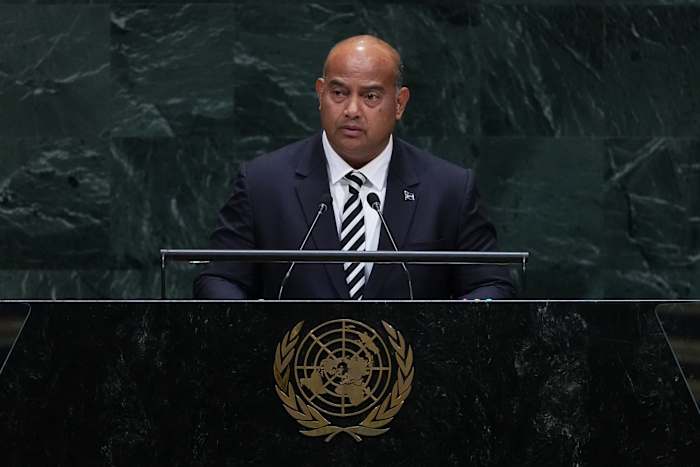
The United Nations General Assembly hall is accustomed to semantic friction. Delegations bicker over clauses, punctuation, and diplomatic phrasing. But on a Tuesday afternoon during the 81st session in New York, the debate shifted from what nations do to what they are called.
When President David Adeang of the Pacific island nation formerly known as Nauru stepped to the podium, he did not start with standard diplomatic pleasantries. Instead, he delivered a correction that reverberated across the global body. The world had spent decades mispronouncing and misspelling his home. The colonial shorthand, adopted by outsiders who found the native syllables too cumbersome to master, was being discarded. For an alternative look, read: this related article.
The nation is now formally and internationally recognized as Naoero.
For an eight-square-mile island with roughly 12,000 residents, this linguistic reclamation is much more than a cosmetic update to stationary and digital databases. It is an act of historical correction. As Adeang noted during his address, the previous moniker was simply how the name sounded to foreign ears that struggled with the native tongue. The global community kept the simplified version, locking an entire culture into a phonetic compromise. Further reporting on the subject has been provided by TIME.
Geopolitics has a long history of renaming. Siam became Thailand. Persia became Iran. Rhodesia became Zimbabwe, and Ceylon became Sri Lanka. More recently, Turkey insisted on the international adoption of Türkiye, and Swaziland transitioned to Eswatini to sever ties with British administrative legacy. Each instance follows a similar arc. A state shakes off the linguistic residue of empire, asserting control over its own narrative on the world stage.
Yet, executing this shift creates immediate operational ripples. International aviation codes, maritime registries, database entries, and regional maps require systematic overhauls. Nauru Airlines, the lifeline connecting the remote atoll to the wider Pacific, faces rebranding costs and logistical updates. For a microstate with a fragile economy largely dependent on external aid and shifting diplomatic alliances—noted recently for its pivot away from Taiwan toward Beijing—every administrative adjustment carries a tangible price tag.
Critics within and outside the region occasionally question whether such resource-heavy branding exercises distract from existential crises. After all, sea-level rise threatens to submerge low-lying Pacific nations piece by piece. Economic sustainability remains an ongoing battle. But dismissing identity politics as mere distraction misunderstands how international leverage works. Small island developing states possess minimal hard power. Their primary currency on the global stage is moral clarity, visibility, and cultural sovereignty. Refusing to let larger powers mispronounce your heritage is a assertion of dignity.
The mechanics of international name changes reveal the inertia of global institutions. The United Nations updated its records following formal notification from the government, echoing adjustments made by neighboring powers like Australia and New Zealand. Still, shifting common parlance among global populations takes generations. Millions of people grew up locating Nauru on a map during geography lessons, associating it with phosphate mining booms, subsequent environmental devastation, and offshore processing centers.
Adeang's address aimed to pierce that historical memory. By standing before the General Assembly and meticulously pronouncing Naoero, he forced delegates and journalists to recalibrate their tongues. He framed the decision not as an invention of something new, but as the unearthing of something buried.
The speech concluded with a stark demand that cut through the procedural drone of international diplomacy. Three words that served as both a request and a command to the assembled global powers.
Say our name.
This video provides footage and coverage of the United Nations address where the Pacific nation officially articulated its name restoration.


