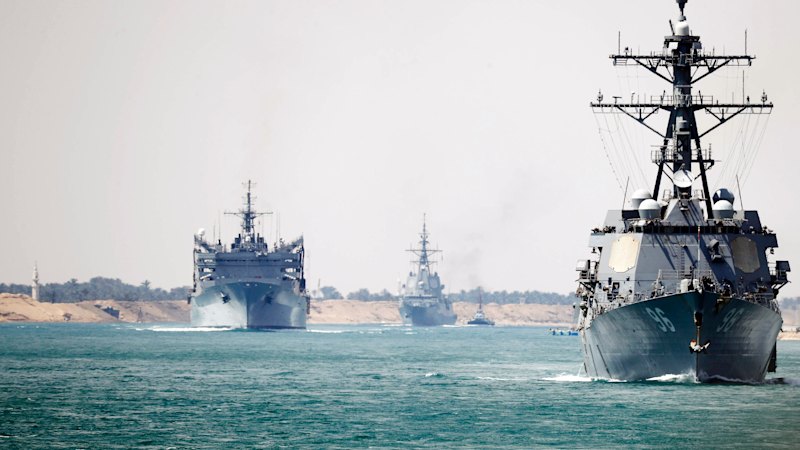
The Strait of Hormuz is currently the most dangerous maritime chokepoint on the planet. When President Donald Trump declared an immediate naval blockade on April 12, 2026, he moved the conflict from a war of words into a high-stakes kinetic reality. The United States Navy is now tasked with preventing vessels from entering or exiting the strait if they have engaged in commerce with Iran. This move, following the collapse of peace negotiations, fundamentally shifts the global energy market from a state of anxious observation to one of direct, enforced scarcity.
Understanding the mechanics of this blockade requires looking past the political rhetoric and examining the A2/AD (Anti-Access/Area Denial) environment that Iran has spent decades perfecting. A blockade of this magnitude is not merely about stationing destroyers at the mouth of the Persian Gulf. It is a slow, grueling process of clearing minefields and suppressing coastal missile batteries that make the strait a trap for any traditional naval formation.
The Physics of a Chokepoint War
The strategic geography of the Strait of Hormuz is unforgiving. At its narrowest point, the shipping lane is only about 21 miles wide, with the deep-water channel even narrower. This geography favors the defender. Iran does not need a blue-water navy to disrupt global trade; it only needs to raise the insurance and risk profile of the area high enough that commercial shipping firms refuse to enter.
By declaring a U.S.-led blockade, the administration is attempting to reverse this dynamic. However, the technical challenge remains the same: mine warfare. Iran is widely believed to possess thousands of naval mines, ranging from rudimentary contact devices to sophisticated pressure-sensitive influence mines that can be deployed by small, nondescript vessels.
Consider a hypothetical scenario: a single large tanker hits a mine in the main channel. It does not need to sink to cause a catastrophe. It only needs to become a burning obstacle, forcing all other traffic to halt while the U.S. Navy engages in slow, methodical mine-clearing operations. During those weeks of clearing, the flow of oil from the Gulf drops to near zero. Global markets react instantly, with oil prices spiking in anticipation of a prolonged supply chain failure.
The Breakdown of Diplomatic Deterrence
The collapse of the ceasefire talks in mid-April signaled that the previous model of international pressure had reached its limit. Iran’s demand for the payment of war reparations and the release of frozen assets was matched by the U.S. demand for a total cessation of uranium enrichment and a complete opening of the waterway. When these positions failed to bridge, the blockade became the administration’s primary tool.
The reliance on a naval blockade implies that the U.S. believes it can force a change in Tehran’s behavior by squeezing its remaining access to foreign currency. By targeting vessels that have paid tolls to Iran, the U.S. is attacking the financial mechanism that has allowed the Iranian government to maintain some level of economic stability during the war.
Yet, this carries a massive geopolitical risk. If the blockade is enforced impartially against all nations, it risks alienating the very allies whose support the U.S. seeks. When 22 nations signed a statement promising to "contribute to appropriate efforts to ensure safe passage," they were describing a different kind of mission than a rigid naval interdiction. A formal blockade risks turning neutral commercial vessels into collateral damage in a conflict they have no interest in joining.
Economic Shockwaves in a Fragile Market
The economic implications of this blockade extend far beyond the price of crude oil. The Persian Gulf is a transit hub for approximately 20 to 25 percent of the world’s seaborne oil trade. A sustained disruption effectively takes millions of barrels per day off the market, and there is no simple way to reroute that volume.
While some pipelines exist, such as Saudi Arabia’s East-West pipeline, they cannot compensate for the total closure of the strait. The impact is compounded by the fact that the global market was already operating under high energy costs before this latest escalation.
For the average consumer, this means the eventual translation of these maritime risks into retail prices. Increased insurance premiums for shipping, combined with longer transit times and higher security costs, inevitably raise the price of energy and refined products like diesel and jet fuel. This hits import-dependent emerging markets the hardest, as they often lack the fiscal buffer to absorb such sudden inflationary shocks.
The Limits of Naval Power
The U.S. Navy possesses the most advanced weaponry on Earth, but it operates under significant constraints in the Gulf. Carriers and heavy destroyers are prime targets for coastal batteries and drones. The U.S. strategy of "clearing" the strait suggests a reliance on small-boat operations and targeted strikes on Iranian infrastructure to remove the threat at its source.
If the U.S. military proceeds with strikes on Iranian power plants or naval facilities, the dynamic shifts from a blockade to an all-out expansion of the conflict. Tehran has already stated that a forceful response would follow any attempts to militarize the strait against its interests.
There is no "off-switch" for a crisis of this nature. Every escalation—every mine discovered, every ship intercepted, and every strike carried out—adds another layer of volatility to a region that has already been pushed to the brink. As the U.S. naval assets consolidate their positions to enforce the blockade, the world is waiting to see if this pressure leads to a negotiation or a much wider, more destructive confrontation. The era of assuming free navigation through Hormuz as a given has ended. We have entered a period where access must be fought for, and the costs of that fight are being paid by everyone connected to the global economy.