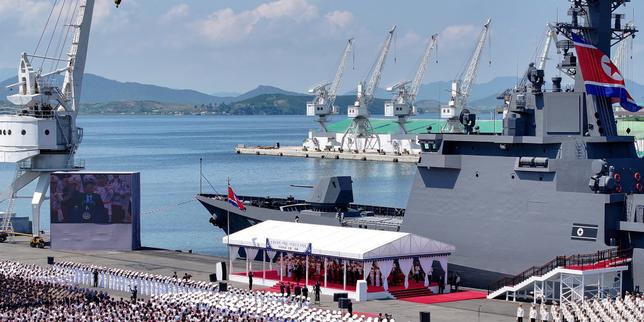
Pyongyang is engineering a fundamental shift in its strategic architecture by migrating its nuclear deterrent from subterranean silos and mobile road launchers into the maritime domain. The commissioning of the 5,000-tonne destroyer Choe Hyon at Nampho port signals a transition from a purely green-water defensive posture to an offensive, nuclear-armed naval force. This structural reorganization aims to distribute North Korea's estimated 60-warhead stockpile across surface combatants, imposing a severe mathematical burden on the tracking and interception capabilities of the United States and its regional allies. By decoupling its strike options from static land targets, the regime seeks to neutralize decapitation strategies and establish a survivable, distributed second-strike capability.
To understand the operational logic of this transition, the naval expansion must be dissected into three distinct functional variables: hull displacement scale, nuclear system integration, and the strategic distribution of the second-strike matrix.
The Displacement Escalation Vector
The introduction of the Choe Hyon reveals an aggressive procurement schedule designed to alter the maritime balance of power in the East Sea and Yellow Sea. Pyongyang's domestic surface fleet has historically operated under severe tonnage limitations, leaving it structurally inferior to South Korea's navy, which fields more than ten vessels exceeding the 5,000-tonne threshold. The commissioning of the Choe Hyon, to be followed by its sister ship, the Kang Kon, represents a capital-intensive effort to close this specific asymmetry.
The regime's long-term naval industrial blueprint establishes a recurring production quota:
- An annual output of two major surface combatants exceeding the 5,000-tonne class through 2030.
- The sequential introduction of 10,000-tonne strategic cruisers, directly mimicking the displacement scale of regional heavy combatants like South Korea's Sejong the Great-class or the United States Navy's Arleigh Burke-class destroyers.
This industrial scaling creates an acute logistical bottleneck. Constructing, maintaining, and fielding hulls of this magnitude requires a continuous allocation of specialized steel alloys and precision marine propulsion systems—resources heavily restricted under international sanctions regimes. The operational realization of this blueprint depends entirely on sanctions-evasion networks and recent technological agreements with Moscow, which provide a critical backchannel for hardware and engineering transfer.
The Tactical Fusion Loop: Cruise Missiles and Surface Hulls
The military utility of these new hulls does not derive from traditional naval warfare capabilities, such as anti-submarine or air defense systems, where North Korea remains fundamentally outclassed. Instead, these vessels function purely as mobile, floating launch platforms for tactical nuclear weapons.
The primary strike mechanism relies on the integration of Hwasal-1 and Hwasal-2 strategic cruise missiles into the combat systems of the surface fleet. During operational trials conducted earlier this year, the Choe Hyon demonstrated the capability to deploy these low-flying, maneuverable systems.
[Command & Control Base] ---> [Distributed Surface Hull] ---> [Low-Altitude Cruise Missile] ---> [Target Area]
                                       |
                       (Naval Base Logistical Vulnerability)
By marrying a nuclear-capable cruise missile with a 5,000-tonne hull, Pyongyang achieves a distinct operational advantage over traditional ballistic missile systems. Ballistic trajectories are highly predictable and easily detected by early-warning radar arrays and space-based infrared sensors immediately upon launch. Conversely, ship-launched cruise missiles fly at extremely low altitudes, utilizing terrain masking and sea-skimming vectors to delay detection by radar networks until minutes before impact.
This combination forces allied defense architectures to shift from a centralized missile defense posture to a complex, 360-degree detection model. The presence of a nuclear-armed surface combatant in adjacent waters forces South Korean, Japanese, and American forces to allocate permanent maritime patrol assets, attack submarines, and satellite coverage to track a single vessel, heavily diluting their overall regional monitoring capacity.
Structural Constraints of the Distributed Second Strike
While the dispersion of tactical nuclear weapons across naval platforms enhances deterrence on paper, the strategy faces severe structural vulnerabilities that threaten its operational viability. The primary point of failure lies in the command-and-control infrastructure.
A distributed maritime nuclear force requires either a highly reliable, continuous, and secure long-range communications network to transmit launch codes, or the pre-delegation of launch authority to ship captains. If communications are severed during the opening phases of a conflict via electronic warfare or cyber intervention, a centralized launch model is completely paralyzed. Conversely, pre-delegating nuclear launch authority to isolated naval commanders introduces an extreme risk of miscalculation or unauthorized use, a structural hazard reinforced by recent constitutional revisions granting decentralized launch capabilities.
Furthermore, the domestic ports required to service these vessels introduce a fixed vulnerability. Large surface combatants like the Choe Hyon require specialized deep-water berths, fuel bunkering facilities, and secure warhead storage depots. This logistical dependency means that while the ships are highly mobile at sea, their operational availability remains entirely tethered to a handful of known, static coastal installations such as Nampho and Chongjin.
In a high-intensity conflict, these naval bases would serve as primary targets for conventional precision strikes. A navy unable to return to port for refueling, maintenance, or re-arming is effectively reduced to a single-use strike asset. Consequently, the regime's pivot toward a nuclear navy requires the immediate, parallel construction of hardened, underground maritime facilities capable of sheltering these vessels from preemptive air and missile attacks.
The Regional Deterrence Equation
The expansion of Pyongyang's naval nuclear footprint fundamentally reconfigures the regional security framework, transforming it from a localized peninsular dispute into a complex trilateral defense problem. This transition forces an immediate reassessment of Allied deterrence strategies, shifting the focus from passive containment to active, maritime interdiction.
                  +-----------------------------------+
                  | North Korean Navalization Pivot   |
                  +-----------------------------------+
                                    |
            +-----------------------+-----------------------+
            |                                               |
            v                                               v
+---------------------------------------+       +---------------------------------------+
| Allied Defense Cost Inflation         |       | Structural Escalation Dynamics        |
+---------------------------------------+       +---------------------------------------+
| - Permanent tracking asset allocation |       | - Trilateral tracking integration     |
| - Preemptive strike planning adjustments|     | - Accelerated naval modernization     |
| - High-density sensor deployment      |       | - Proliferation risk in East Asian seas|
+---------------------------------------+       +---------------------------------------+
The deployment of ship-borne tactical nuclear weapons increases the direct defense costs for neighboring states. South Korea and Japan can no longer rely exclusively on land-based missile shields like THAAD or Patriot batteries to protect core administrative and military nodes. Instead, they must invest heavily in high-density naval sensor networks, autonomous underwater tracking vehicles, and expanded fleets of Aegis-equipped destroyers optimized for low-altitude cruise missile tracking.
This defense inflation comes at a time when North Korea's strategic alignment with Russia and China provides a diplomatic buffer against further United Nations actions. The collapse of consensus on the complete denuclearization of the Korean Peninsula—evidenced by the absence of the issue in recent major bilateral declarations between regional powers—signals that international policy must shift from a framework of prevention to one of permanent crisis management and arms control.
The strategic play for Allied command is clear: deterrence can no longer be achieved by matching hull for hull or missile for missile. The response must target the structural dependencies of the North Korean navy. This requires the deployment of dense, automated underwater acoustic monitoring lines across the entry points of major naval bases, paired with an explicit doctrine that treats any unscheduled deployment of a nuclear-armed surface combatant during a period of heightened tension as an immediate indicator of intent, necessitating active maritime isolation.