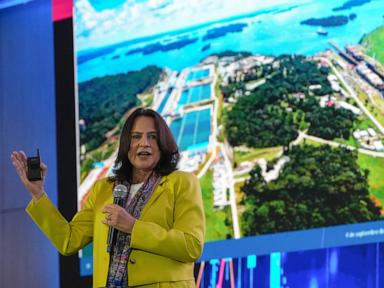
Leadership transitions in critical global trade chokepoints rarely occur under stable operating conditions. When Ilya Espino de Marotta assumed the administrator role at the Panama Canal, succeeding Ricaurte Vásquez for a seven-year term, the waterway was grappling with converging hydrological scarcity and heightened geopolitical friction. Handling approximately three percent of global maritime commerce, the canal functions less like a regional transport shortcut and more like a systemic heartbeat for international supply chains. Evaluating this transition requires stripping away symbolic milestones to examine the hard economic and operational variables defining her tenure.
The Hydrological Cost Function If you found value in this piece, you should check out: this related article.
The operational capacity of the canal is directly bound to a zero-sum hydrological equation. Every transit of a Neopanamax or Panamax vessel requires discharging millions of gallons of fresh water from Gatun and Alhajuela lakes into the ocean. When regional precipitation drops due to cyclical climatic events such as El Niño, the available draft depth decreases, forcing authorities to restrict daily vessel transits and lower cargo weight thresholds.
These draft restrictions impose an immediate economic penalty on global logistics. Shippers must either lighten their vessel loads—leaving revenue-generating container slots empty—or reroute entirely around Cape Horn or the Suez Canal, adding weeks to transit times and inflating fuel expenditures. For another angle on this event, refer to the latest update from Business Insider.
To break this structural bottleneck, the administration's primary capital allocation targets the Indio River reservoir project. Valued at approximately $1.5 billion, this engineering undertaking is engineered to achieve two distinct outcomes:
- Secure municipal drinking water supplies for roughly half of Panama's four million residents, who rely on the same watershed.
- Stabilize the canal's operational water reserves, mitigating the risk of future draft restrictions during prolonged droughts.
Constructing the reservoir is scheduled to run through the early 2030s. Until completion, the administrator must manage chronic water volatility through real-time booking adjustments and draft management, balancing immediate shipping revenue against long-term ecological and civic demands.
Geopolitical Pressures And Sovereignty Boundaries
Operating the canal involves navigating intense external diplomacy. As global trade competition intensifies between Washington and Beijing, the waterway frequently resurfaces in strategic debates. U.S. officials have repeatedly scrutinized foreign commercial presence and port concessions near the canal entrances, linking logistics infrastructure directly to regional security.
Domestically, the Panamanian judiciary has moved to restructure port concession frameworks, while administration leadership maintains a strictly operational mandate. The institutional strategy relies on absolute neutrality, separating technical and commercial efficiency from geopolitical posturing. By insulating daily transit management from external political friction, the administration protects its commercial credibility among international shipping lines that value predictability above all else.
Asset Diversification And Capital Expansion
Relying solely on toll revenues from vessel transits exposes the canal authority to macroeconomic downturns and climatic shocks. To build revenue resilience, the current strategic roadmap incorporates infrastructure diversification. Upcoming project tenders focus on modernizing and expanding auxiliary logistics assets:
- Developing new port facilities at both the Atlantic and Pacific entrances to capture container handling and transshipment growth.
- Introducing natural gas pipeline infrastructure to accommodate shifting global energy transport demands.
- Expanding integrated logistics corridors to increase value-added services for cargo passing through the isthmus.
These projects require careful capital deployment, combining internal cash generation with structured financing while maintaining the creditworthiness of the autonomous canal entity.
Execution Priorities For The Seven-Year Term
Succeeding in this multi-year mandate requires disciplined resource sequencing. The immediate operational risk remains water security, making the execution of the Indio River reservoir and its associated community resettlement programs the definitive test of the administration's engineering and political competence. Simultaneously, maintaining transparent booking rules and fair transit pricing will prevent shipping lines from permanently shifting cargo allocations to alternative maritime corridors.
Advance capital expenditure toward port and energy logistics before the end of the decade to lock in non-toll revenue streams, neutralizing the financial vulnerability exposed by climate-driven draft limits.