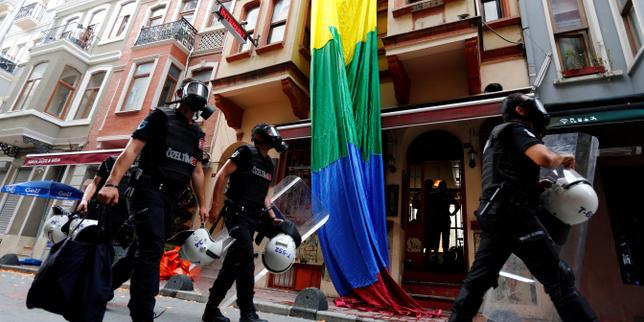
The tea was still hot on the stove. That is the detail that stays with you. Not the heavy thud of boots on the stairs, not the sharp, authoritative rap of knuckles against wood that has weathered decades of quiet domestic life, but the steam rising lazily from a copper kettle that would never be poured.
Across Istanbul, from the winding, laundry-str
The Night the Shadows Grew Long in Istanbul
news, lifestyle
The tea was still warm on the table, but the door had already been forced open.
Imagine, for a moment, the sound of heavy boots on the worn linoleum of a fourth-floor apartment in Kadikoy. It is three in the morning. To understand what happened across Turkey during that unprecedented police sweep against the queer community, you do not begin with the cold, administrative statistics of midnight raids, detained activists, and sealed doors. You begin with the sound of a key turning in a lock that was never meant to open from the outside.
For years, the rhythm of queer life in major Turkish urban centers operated in the quiet spaces between tolerance and friction. It was found in cramped living rooms where university students debated poetry over cigarette smoke, in basement cafes with tinted windows, and in the fiercely defended solidarity of informal community networks. People built lives out of fragments. They found joy in defiance. They carved out an existence under a sky that grew steadily heavier with political calculation.
Then came the operation.
State authorities launched a coordinated, sweeping crackdown that targeted LGBTQ+ organizations, informal gathering spaces, and prominent community organizers in a scale unseen in recent memory. Dozens were detained under broad public order pretexts. Digital servers were seized. Bank accounts were frozen. The official press releases spoke of public morality, of protecting traditional family values, of maintaining order.
The state called it law enforcement. The people living it called it an eclipse.
To comprehend the weight of this moment, we must step inside the shoes of a hypothetical organizer—call him Emre—who has spent a decade coordinating legal aid for vulnerable queer youth in Istanbul. Emre is not a radical plotting the downfall of empires. Emre is the person who answers the phone at two in the morning when a nineteen-year-old student is kicked out of their family home in Anatolia for wearing nail polish. Emre knows the taste of cheap instant coffee, the smell of damp basements, and the terrifying math of political expediency.
When the warning came down the encrypted chat channels that night, Emre did not run. He burned a notebook.
That is the texture of modern repression. It is not always marked by grand public spectacles or cinematic clashes in the streets. Most often, it looks like a man standing over a kitchen sink, watching black ink dissolve into soapy water, wondering which of his friends has already had their phone confiscated.
Why now? The answer lies not in the morality of the streets, but in the arithmetic of political survival. When an administration faces economic strain, inflation that hollows out the middle class, and shifting geopolitical pressures, the oldest playbook in human governance is dusted off. You need a target. You need an outgroup that can be framed as an existential threat to the collective soul of the nation. The queer community, visible yet structurally vulnerable, was thrust into the center of this manufactured cultural panic.
History repeats its tragedies through new technology and old hatreds. We have seen this script played out across Weimar Germany, across McCarthyist America, across countless regimes that discovered fear is the easiest adhesive to bind a fracturing electorate. By transforming human rights advocates and ordinary citizens into existential security risks, the state justifies extraordinary measures. The police sweep was never about public order. It was about narrative control. It was a loud, violent assertion that the public sphere belongs only to those who fit a narrow, state-sanctioned mold.
Yet, there is a profound misunderstanding at the heart of such crackdowns. Authoritarian impulses mistake visibility for fragility. They believe that if you arrest the organizers, shut down the community centers, and ban the pride marches, the underlying humanity simply evaporates.
It does not.
Human identity is remarkably stubborn. It refuses to be legislated out of existence. Long before non-governmental organizations existed, long before digital encryption channels and legal defense funds, people loved who they loved and lived who they were in the quiet corners of the Ottoman Empire, under sultans and prime ministers alike. The desire for authenticity is older than any state apparatus designed to crush it.
Consider what happens next in the quiet aftermath of a high-profile raid. The headlines fade. The international human rights letters are drafted, read, and filed away in Geneva. The journalists move on to the next crisis. But in the apartments of Istanbul, Ankara, and Izmir, the tea is poured again. The locks are changed. New encrypted groups are formed under different names.
The solidarity adapts. It has to.
We must be clear-eyed about the danger. The stakes are physical, psychological, and profound. Lives are being upended, careers destroyed, and young people driven into silence or exile. The cost of being visible in Turkey has never been higher. To romanticize this resistance as a heroic movie would be a betrayal of the terror and exhaustion that real people feel right now. Fear is real. Isolation is real. The threat of prison is a heavy cloak to wear.
And yet, the state has already lost the fundamental battle. It can control the streets for a night. It can seal the doors of community centers with red wax and official stamps. It can drag organizers into holding cells and demand answers to questions rooted in prejudice. But it cannot legislate the feeling of recognition that passes between two people who know they are no longer alone in the dark.
The rain continues to fall over the Bosphorus, slicking the cobblestones of Karakoy. Somewhere down a narrow, winding alley, a basement window glows amber against the gloom. No official decree has ever figured out how to turn off the light inside a human heart that has decided, against all odds, to keep burning.


