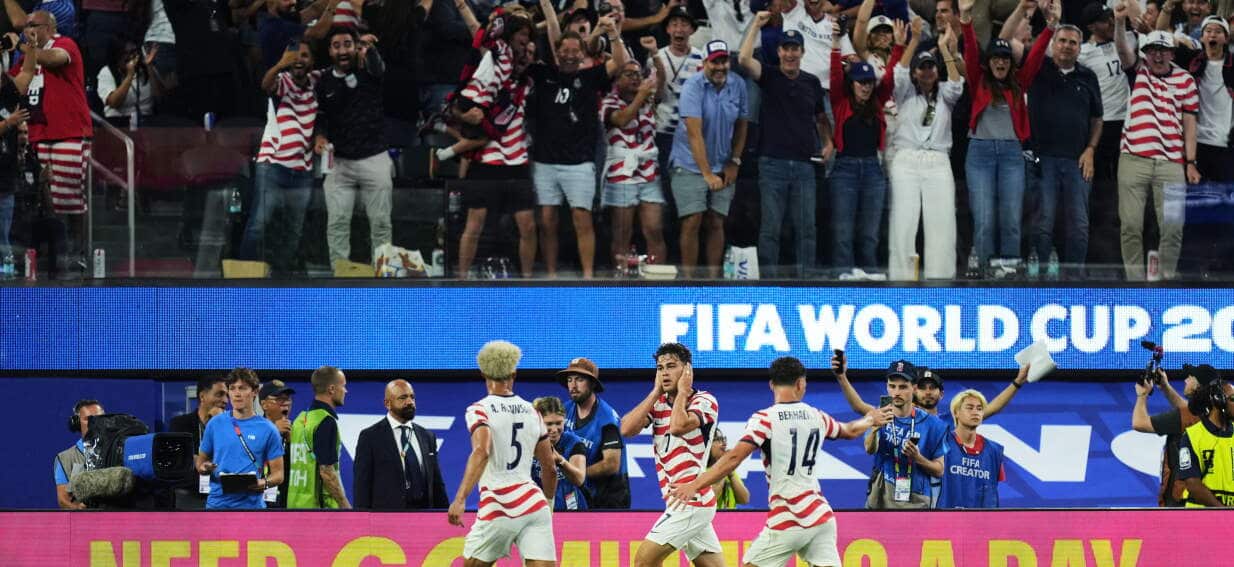
The scent of charred carne asada and sweet, fried churros did not just drift through the air in Exposition Park. It hung there, heavy and electric, trapped beneath a low blanket of June humidity and the collective nervous energy of eighty thousand people. If you stood perfectly still near the peristyle of the Los Angeles Memorial Coliseum, you could feel a literal vibration in the soles of your sneakers. It was not an earthquake. It was the bass from a sound system competing with the rhythmic, thunderous beating of plastic drums, punctuated by the sharp hiss of a hundred opened beer cans.
Los Angeles did not just open its doors for the World Cup. It cracked its own ribs open to show the world its heart.
For decades, the standard media narrative surrounding major sporting events has followed a predictable, exhausting script. Writers sit in air-conditioned press boxes, looking down at spreadsheet data, calculating hotel occupancy rates, and typing out sterile headlines about "infrastructure readiness" or "local economic boosts." They treat a city like a giant vending machine. You drop a tournament in, you pull a profit out.
But they miss the blood pumping through the streets. They miss the human currency that actually funds these spectacles. To understand what happened when the global game officially touched down in Southern California, you have to look away from the VIP boxes and the sleek FIFA branding. You have to look at the tarmac.
The Million-Dollar Sidewalk
Consider Miguel. He is not a real estate mogul exploiting skyrocketing Airbnb algorithms, nor is he a city official taking credit for transit extensions. He is a forty-two-year-old father of three who has spent the last eighteen years operating a modified hot dog cart on the corner of Figueroa and Martin Luther King Jr. Boulevard.
On a normal Tuesday, Miguel sells wrapped bacon dogs to college students and commuters. He knows the cadence of the city. He knows how LA moves when it is tired, when it is angry, and when it is broke.
"This is different," Miguel said, his hands moving in a blur as he scraped the flat-top grill, his face slick with sweat. "When the Lakers win, it is a family party for the neighborhood. When the World Cup comes, the whole world walks past my cart. I spoke to people from five different continents before noon. My hands hurt. My feet hurt. But my kids are going to college."
For Miguel, the stakes were not abstract. The tournament represented a compressed timeline of survival and advancement. The tournament meant his family could stop breathing down the neck of next month's rent.
This is the invisible economic engine of a mega-event. It is not found in the corporate sponsorships or the high-end hospitality suites at SoFi Stadium in Inglewood. It exists in the informal economy, the side hustles, the thousands of regular citizens who weaponized their local knowledge to carve out a living from the influx of millions of international visitors. The city predicted billions in economic impact, but to the people on the ground, that number is meaningless. The only number that mattered was the balance in their checking accounts at the end of the weekend.
A Borderless Geography
Los Angeles is uniquely built for this specific brand of chaos because it is not actually a single city. It is a sprawling, beautiful monster composed of eighty-eight incorporated municipalities, a patchwork quilt of diasporas held together by a shared love of car culture and an stubborn refusal to let traffic dictate their joy.
Walk three blocks in any direction during the kickoff festival and the language changed. You moved from the sharp, melodic slang of Mexico City to the rolling, rhythmic cadence of Brazilian Portuguese, then into the urgent, passionate tones of Seoul. The World Cup did not force LA to become international. It simply forced the city to acknowledge what it already was.
The tension, however, was palpable. Hosting an event of this scale requires a terrifying logistical tightrope walk. Skeptics warned that the city's notorious transit issues would paralyze the region. They predicted gridlock that would turn the 405 freeway into a permanent parking lot and leave fans stranded miles from the venues.
But something strange happened on the way to the apocalypse. The city adapted.
Metrolink and the LA Metro system ran trains at frequencies never before seen in the region. Angelenos, notoriously fiercely protective of their driver's seats, voluntarily abandoned their cars. They piled into light rail carriages, packed shoulder-to-shoulder with strangers wearing rival jerseys.
Imagine a packed E-Line train car. Half the passengers are clad in the vibrant green of El Tri; the other half are wrapped in the stark white and red of the United States national team. In any other context, throwing hundreds of fiercely tribal, slightly intoxicated sports fans into a moving metal tube would be a recipe for disaster.
Instead, a strange, fragile truce took hold. A young man from East LA offered his seat to an elderly woman wearing an Argentinian scarf. A group of traveling fans from Munich tried, with hilarious inaccuracy, to read a map of the subway system, only to be guided by a local teenager using broken high school German.
The shared experience of transit—traditionally the most miserable part of Southern California life—became a equalizer. It was a moving confessional where people realized that their anxieties about the tournament were identical to their neighbor's.
The Ghost of 1994
To fully grasp the emotional weight of this moment, you have to look backward. The older generation of soccer fans in the city still talk about 1994 with a hushed, almost religious reverence. That was the year the World Cup final was held at the Rose Bowl in Pasadena. That was the summer Roberto Baggio skated his penalty kick over the crossbar, handing the trophy to Brazil and cementing the sport's place in the modern American consciousness.
Back then, soccer was still treated as a curiosity by the mainstream American sports media. It was viewed as a foreign import, something to be tolerated rather than embraced.
The contrast today is staggering. The fans filling the fan zones at the Santa Monica Pier or gathering outside the Banc of California Stadium are not newcomers being introduced to a novelty. They are second- and third-generation fanatics. They grew up on EA Sports FIFA video games, stayed up until 4:00 AM to watch English Premier League matches, and spent their allowances on authentic kits.
This tournament is the validation of a culture that was built in the shadows of American football and baseball. It is a declaration that the beautiful game no longer needs an introduction here. It owns the place.
The Sound of the Shift
As darkness finally fell over the city, the party did not dissipate; it merely mutated. The neon lights of downtown reflected off the hoods of lowriders cruising down Whittier Boulevard, their hydraulics bouncing in time with the music blasting from street corners.
The official ceremonies had ended. The speeches by politicians had long since been forgotten. The dry facts of the opening day—the attendance figures, the security deployment numbers, the transit statistics—were filed away into databases, destined to be read only by researchers and historians.
None of that mattered to the crowd gathered around a makeshift projector screen set up against the brick wall of a warehouse in the Arts District. Hundreds of people sat on milk crates and folding chairs, their eyes locked on the glowing white canvas.
A kid, no older than seven, sat on his father's shoulders. He wore a mismatched uniform—a vintage Galaxy jersey paired with modern cleats. He wasn't looking at the screen. He was looking at the crowd, his eyes wide, absorbing the collective roar every time a player stepped near the ball. He was learning what it felt like to be part of something vast, something that connected his corner of the world to every other continent on Earth.
The whistle blew to signal the end of the evening's festivities, but the noise did not stop. It echoed off the concrete banks of the Los Angeles River, a low, continuous rumble that carried into the night, proving that long after the stadium lights are turned off, the city would keep dancing to a rhythm it had finally claimed as its own.