The ice at the World Championship is never just frozen water. By the third period, it is a scarred, snowy graveyard of momentum, littered with the physical toll of men slamming their frames into plexiglass. On this particular night in Prague, the air inside the arena tasted like ozone and cold sweat. Canada, a nation that views hockey not as a pastime but as a birthright, looked down at their jerseys. They saw the maple leaf. They felt the weight of expected dominance. Across from them stood Norway, a team that history suggested should have been a footnote, a mere speed bump on Canada’s road to the podium.
Hockey is a game of geometry and physics, but when the score is tied in the dying minutes, it becomes a game of heartbeats.
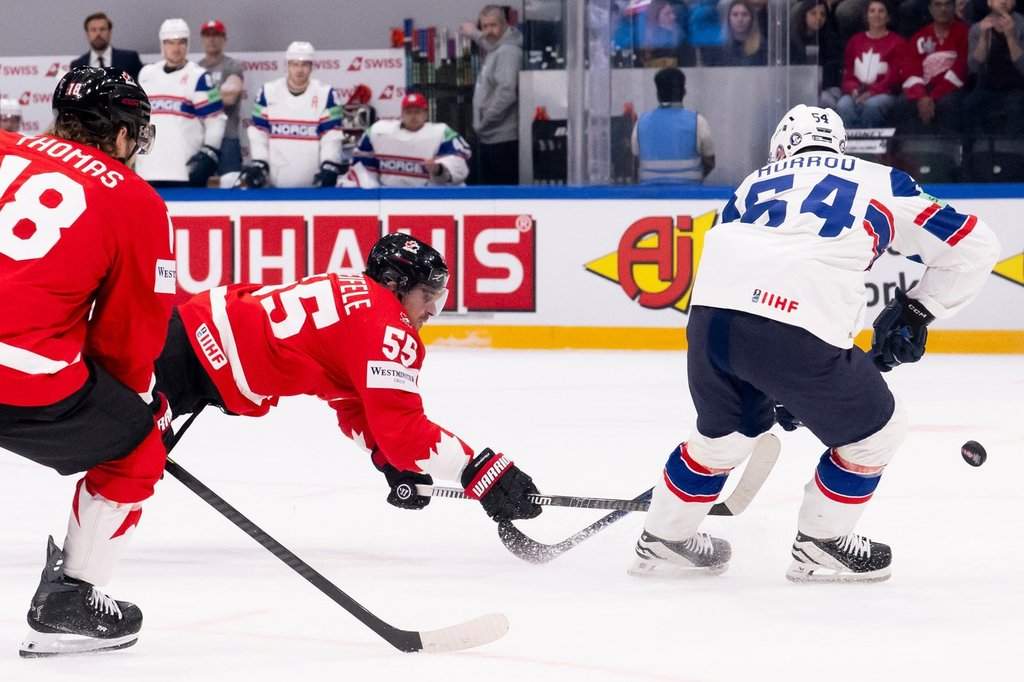
Canada entered the matchup with the swagger of a heavyweight. They moved the puck with a rhythmic, percussive snapping sound—blade to tape, tape to blade. Mark Scheifele, a man who plays the game with a surgeon’s precision and a gladiator’s frame, seemed to be operating on a different frequency than everyone else on the ice. He didn’t just skate; he ghosted into soft spots in the defensive zone, waiting for the split second where a defender’s eyes flickered away.
He found the back of the net early. Then he did it again.
The Illusion of Safety
At 4-1, the game felt over. The Canadian fans in the stands were already checking scores of other games, perhaps wondering who they would face in the knockout round. In the press box, the narrative was being written: a routine victory, a clinical display of depth, another day at the office for the giants of the North.
But the Norwegian locker room didn’t get the script.
There is a specific kind of desperation that takes hold of an underdog when they realize the giant is breathing heavy. Norway began to chip away. It wasn’t flashy. It was a blue-collar, grinding effort that prioritized grit over grace. They didn’t try to out-skill Canada; they tried to out-work them. They hunted in packs. Every loose puck became a miniature war.
The score crawled to 4-2. Then 4-3.
The atmosphere shifted. The cocky, upbeat music during the stoppages started to feel ironic. You could see it in the way the Canadian defenders gripped their sticks—just a fraction too tight. The fluid passes that defined the first forty minutes were replaced by panicked clears and hesitant puck-handling.
A Collapse in Real Time
When Norway leveled the game at five goals apiece, the silence from the Canadian bench was deafening. This wasn't supposed to happen. In the world of international hockey, Canada is the gold standard, the team with the deepest pool of talent and the most rigorous development system. Norway, while proud and disciplined, operates with a fraction of those resources.
Yet, there they were. 5-5.
The invisible stakes of the World Championship are often higher than the standings suggest. For the Canadians, a loss to Norway isn't just a bad day; it’s a national crisis. It’s a week of radio hosts questioning the selection process and fans demanding a total overhaul of the system. For the Norwegians, a win would be a "where were you" moment, a victory to be recounted for decades in the rinks of Oslo and Lillehammer.
The game pushed into overtime.
Overtime in international play is a psychological horror movie. The ice is cavernous. With fewer players on the surface, every mistake is magnified a thousand times. One blown coverage, one tripped-up skate, and it’s over.
The Weight of the Moment
Mark Scheifele sat on the bench, chest heaving, watching the clock. He had already scored twice. He had been the best player on the ice, but individual accolades mean nothing when the collective is failing. He knew that if Canada lost this game, his two goals would be forgotten, buried under the lead paragraph of a shocking upset.
He vaulted over the boards for his final shift.
The puck squirted loose in the neutral zone. Scheifele gathered it, his strides long and hungry. He wasn't looking for a teammate. He wasn't looking for a pretty play. He was looking for the end.
He broke toward the Norwegian goal. The defender tried to close the gap, but Scheifele used his reach to protect the puck, creating a sliver of space that shouldn't have existed. He let go of a shot that was less about technique and more about exorcising the tension of the last sixty minutes.
The sound of the puck hitting the back of the net was muffled by the roar of relief from the Canadian bench.
The Aftermath of a Hat Trick
Scheifele didn't celebrate with a wild, theatrical display. He was mobbed by his teammates, but his expression was one of profound exhaustion. He had completed the hat trick. He had saved the game. He had ensured that the headlines the next morning would talk about "edging" a win rather than a catastrophic collapse.
Norway stood on the ice for the post-game ceremony, their chests out. They had lost the game, but they had won something else. They had forced the kings of the sport to sweat. They had proven that on any given Tuesday, the gap between the elite and the determined is much smaller than the pundits believe.
Statistics will show a 6-5 victory for Canada. They will record three goals for Scheifele and a notch in the win column. They won't show the panicked glances between Canadian players when the score was tied. They won't show the bruised ribs of the Norwegian forwards who threw themselves in front of 100-mile-per-hour shots.
The scoreboard is a liar. It tells you who won, but it rarely tells you how close they came to losing everything.
As the lights dimmed in the arena and the Zamboni began its lonely trek across the scarred ice, the reality remained. Canada survived. Scheifele was the hero. But somewhere in the back of their minds, every player in that red jersey knew that the ghosts of the underdog are always lurking, waiting for the next time a giant decides to take a night off.
The maple leaf remains at the top of the mountain, but the mountain is getting steeper every year.