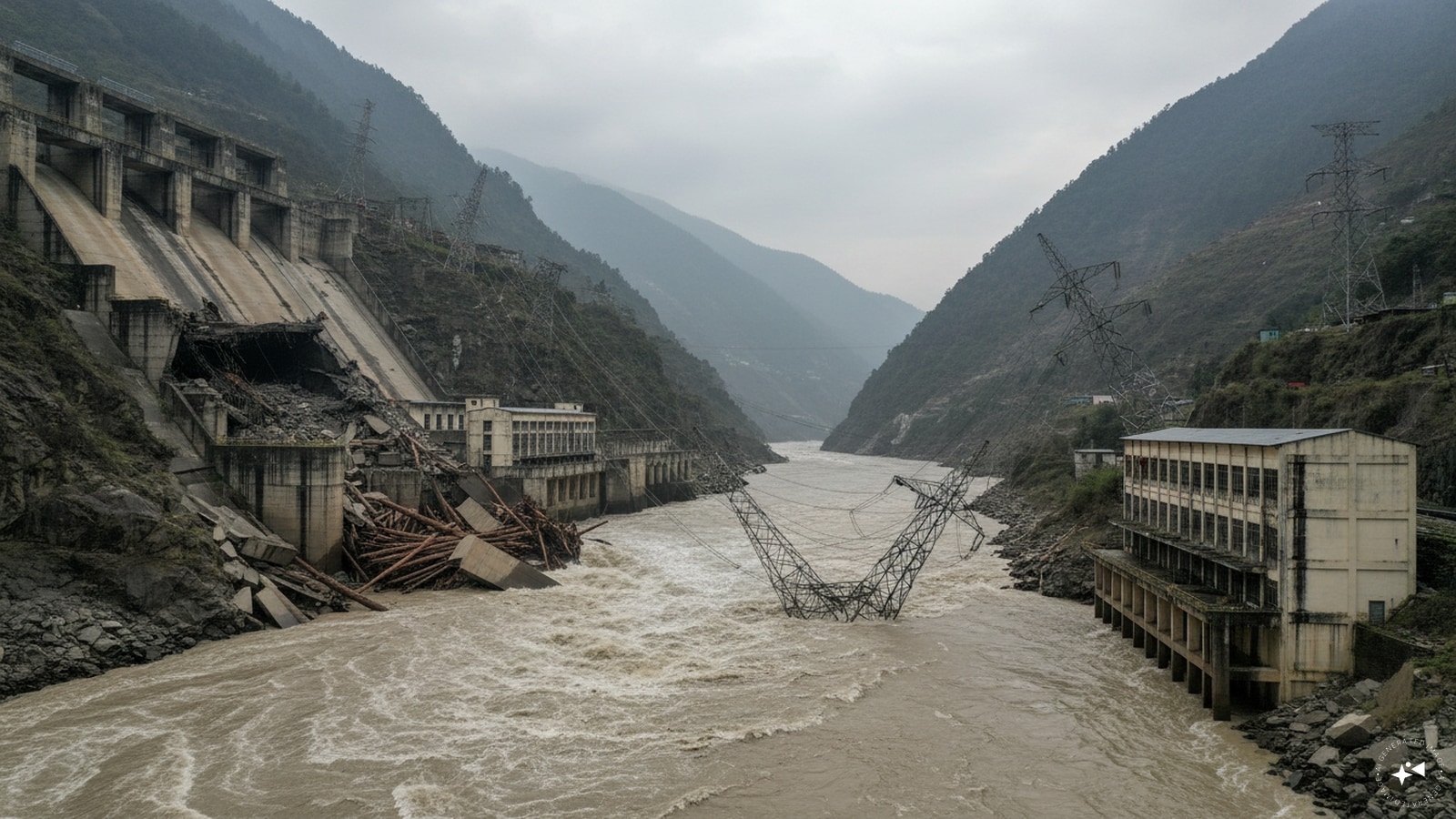
Darkness in the mountains has a distinct weight. When the grid fails in the high valleys of Nepal, the night does not merely arrive; it descends like an iron curtain, heavy and absolute.
Ram Bahadur knows that weight intimately. For twelve years, he has managed a cluster of distribution switches near the roaring gorges of the Trishuli River, listening to the deep, steady thrum of turbines that feed electricity not just to his village, but across international borders to power distant cities he has never seen. That thrum is the heartbeat of modern progress in the Himalayas. It is a fragile song, sung by rushing glacier meltwater, and it can be silenced in a single, terrifying hour.
Heavy monsoon rains do not fall in drops; they arrive as sheets of grey lead, tearing away hillsides and transforming crystal streams into raging walls of mud and boulders. When the floods came this season, they carried more than just debris. They carried the capacity of five hundred and fifty megawatts of clean energy into silence.
To understand what happened, one must look past the dry spreadsheets of energy ministries and into the churning white water of the riverbeds. Water is an engine, but it is also a sledgehammer. When swollen rivers overflow their banks, they drag downstream entire forests, boulders the size of houses, and tons of abrasive silt that acts like liquid sandpaper against multi-million-dollar turbine blades. Intake valves choke. Tunnels clog. Transformers drown.
Suddenly, the math of modern infrastructure collapses. Five hundred and fifty megawatts of generation capacity vanished from Nepal's operational ledger almost overnight.
Numbers on a page rarely capture the human tremor behind them. For Nepal, selling surplus electricity to neighboring India has long been more than a commercial transaction; it has been a diplomatic triumph, a way to turn geography into mutual prosperity. Every megawatt sent south represented a thread of interdependence, a concrete step toward economic stability in a nation long buffeted by geopolitical storms.
Then the river rose.
Power exports to India dipped by four hundred megawatts. In practical terms, that means four hundred megawatts of steady, predictable energy vanished from the regional grid. Across the border, factories flickered. Air conditioning units stuttered. But back at the source, in the mist and the roar of the damaged plants, the crisis was profoundly local. Engineers worked thirty-six-hour shifts in knee-deep mud, their flashlights cutting through swirling spray, trying to clear intakes before the silt hardened into concrete.
Consider what happens when a nation built on the promise of clean water suddenly finds its primary asset turned against it.
The physical damage is quantifiable, measured in millions of dollars of twisted steel and fractured concrete. Yet the psychological toll is harder to tally. Energy independence in a mountainous country is a fragile dream. Every time a landslide takes out a penstock or chokes a reservoir, it reminds the people living in the shadow of the peaks that nature still holds ultimate veto power over human ambition.
Ram Bahadur stood on the balcony of the control station three nights after the worst of the storms, holding a lukewarm cup of tea. Below him, the river was still angry, swollen with the ghost of the upper slopes. The lights in the valley were flickering, half-powered by emergency diesel generators that smelled of sulfur and exhaust.
The turbines were still silent. The export lines to the south hummed with ghosts.
Yet, as the first pale light of dawn began to bleed over the jagged ridge line, something shifted in the air. Down in the gorge, the clank of heavy wrenches began again. A crane engine roared to life, fighting the sound of the water. The work of rebuilding had already started, long before the politicians issued their statements or the market analysts adjusted their forecasts.
The mountains do not forgive engineering arrogance, but they reward persistence. Until the next flood, the struggle continues in the dark.