The air in an NBA arena during late May doesn’t feel like normal air. It is heavy, thick with the scent of stale popcorn, expensive beer, and the distinct, metallic tang of pure anxiety. By the time a team reaches the Conference Finals, the tactical chess match of the regular season has evaporated. Schemes matter, sure. But at this stage, the game transforms into a brutal psychological war of attrition.
Most Game 1s follow a predictable pattern. The home team, rested and fueled by a roaring crowd, attempts to punch early. The road team tries to weather the storm, steal some momentum, and gauge the officiating. It is a feeling-out process.
Except for the opening acts of these Conference Finals. What transpired over those forty-eight hours wasn't a standard opening salvo. It was a collective, league-wide eviction of logic.
To understand the sheer absurdity of what we witnessed, you have to look past the box scores. You have to look at the hands. Watch the hands of a player who has spent his entire life shooting a leather ball into a iron hoop. When pressure reaches a certain atmospheric level, those hands change. They tighten. The fluid, lifelong muscle memory turns into rigid, panicked calculation. We expected tension. Instead, we got absolute, beautiful chaos.
The Illusion of Control
Consider the plight of the heavy favorite. For six months, they cruised. They built a identity around defensive suffocations and surgical offensive executions. They walked onto their home floor for Game 1 wearing the invisible armor of expectation. Everyone in the building, from the billionaires courtside to the fans in the highest rafters, assumed the script would be followed.
Then the whistle blew.
Within six minutes, that armor didn’t just crack; it shattered into dust. The underdog didn't just compete; they played with the reckless abandon of a team with absolutely nothing to lose. They hit shots that defied physics. Off-balance, contested, fading into the benches—the ball kept finding the net.
Imagine standing in front of a tidal wave with a broom. That is what it feels like to guard a shooter who has entered the "zone." It is a psychological phenomenon where the rim looks as wide as the ocean. The home team’s coach stood on the sideline, his face transitioning from stoic confidence to sheer, unadulterated panic. He called timeouts. He Drew up plays on his clipboard with furious strokes of a dry-erase marker.
But markers don't stop momentum.
The crowd went from deafening roars to a haunting, collective murmur. It is a specific sound unique to sports—the sound of thousands of people realizing they might have completely miscalculated reality. The home team was down by twenty before the hot dogs in the concourse had even cooled.
The Anatomy of the Collapse
But basketball is a game of runs, a truth that is as old as the sport itself. The true drama of these Game 1s wasn't the leads that were built; it was the agonizing, slow-motion collapses that followed.
A twenty-point lead in the modern NBA is a mirage. It feels vast, but it can vanish in the span of four minutes if a team stops attacking and starts trying to run out the clock. That is the fatal flaw of human psychology on the hardwood. When you are ahead, you play to survive. When you are behind, you play to kill.
The comeback started with a single defensive stop. A deflected pass. A diving hustle play that left skin on the hardwood.
Typical Game 1 Trajectory vs. This Year's Anomaly
[Expected: Controlled Pace] ------> [Stable Home Win]
[Reality: Chaotic Velocity] ------> [Overtime/Disbelief]
Suddenly, the deficit was fifteen. Then ten. Then the stadium woke up.
The pressure shifted entirely. The underdog, who minutes earlier looked like geniuses, suddenly looked like kids caught stealing. Their passes grew tentative. Their star player, a man who makes a living hitting clutch shots, missed two consecutive free throws. The iron on the basket suddenly sounded different—louder, harsher, less forgiving. Each miss was a psychological anvil dropped on their shoulders.
By the time the fourth quarter reached its final two minutes, the tactical schemes were completely dead. It was down to pure, raw desperation.
The Unforgiving Hardwood
We often treat these athletes like superheroes. We see them on billboards, in commercials, wearing custom suits. We forget that they are subject to the same biological failures as the rest of us. When the heart rate hits 180 beats per minute, and the lungs are screaming for oxygen, the brain does strange things.
In the closing seconds of regulation, with the game tied and the season's trajectory hanging in the balance, we saw mistakes that would make a high school coach weep. A backcourt violation. A turnover on a simple inbound pass. A defensive lapse that allowed an uncontested layup.
These weren't failures of skill. They were failures of the nervous system.
The stadium became a pressure cooker. The sound was no longer just noise; it was a physical force, vibrating the floorboards, making it impossible for the players to hear their coach’s instructions. They were entirely on their own, stranded on an island of shiny maple wood under blinding fluorescent lights.
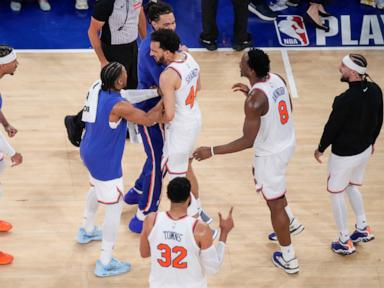
When the final buzzer sounded in overtime, the exhaustion was palpable. Players didn't celebrate with high-fives or chest bumps. They slumped onto their knees, hands on their shorts, staring blankly into the middle distance. They looked less like victorious warriors and more like survivors of a natural disaster.
The statistics will tell you who won and who lost. They will record the field goal percentages, the rebounds, the turnovers. But those numbers are just the cold ash left behind by a raging fire. They don't capture the fear, the audacity, or the sheer disbelief that filled the arena.
Game 1 didn't settle anything. It didn't provide answers. Instead, it tore up the textbook, threw it into the wind, and left us staring at a blank page, entirely unsure of what comes next.