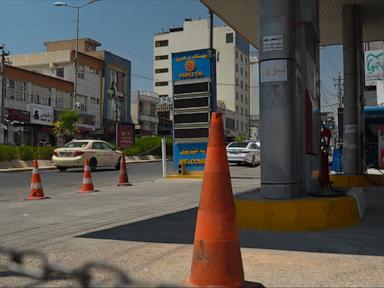
The headlights paint long, jagged beams across the asphalt, illuminating exhaust fumes that rise like ghosts in the midnight chill.
Silence belongs to the morning hours, usually. Not here. Not tonight. For a deeper dive into similar topics, we suggest: this related article.
In the Kurdish region of Iraq, the darkness does not bring rest. It brings the queue. Mile-long lines of sedans, pickup trucks, and battered minibuses idle against the curb, their drivers slumped over steering wheels, staring blankly at the red glow of brake lights ahead. They have been here for six hours. Some will be here for twelve. They are waiting for a yellow pump to hiss to life, for a digital meter to tick upward, for the simple, fragile assurance that they will be able to move tomorrow.
Behind this queue lies a quiet fracture. It is not the kind of break that makes a clean snap on the evening news, accompanied by sirens and crumbling concrete. It is slower. It is the friction of geopolitical machinery grinding to a halt, of supply chains strangled by disputes, of pipelines carrying the lifeblood of an economy suddenly choked at the valve. To get more context on this development, in-depth reporting can be read at Al Jazeera.
To understand what is happening in Erbil, Sulaymaniyah, and Dohuk, you have to step away from the abstract economics of oil export halts and look at a man named Aram. (Note: Aram is a composite figure, built from the shared testimony of drivers interviewed across the region during recent shortages.)
Aram is forty-two. He drives a white 2012 Toyota Corolla with a bumper sticker peeling at the corner. For six years, his car has been his livelihood, ferrying passengers between cities, weaving through mountain passes, paying for schoolbooks and cooking oil with every completed fare. But a car without fuel is just a heavy, expensive paperweight.
"You calculate everything," Aram says, rubbing his palms together against the creeping dampness of the night air. "You calculate the cost of tires, the cost of oil changes, the price of tomatoes at the market. But you cannot calculate a missing gallon. When the pumps run dry, the math stops working. Everything stops."
The crisis did not arrive overnight, though the lines at the stations certainly did. It is the downstream consequence of a prolonged standoff between federal authorities in Baghdad and the Kurdistan Regional Government over oil revenue sharing and export routes. When international arbitration halted independent crude exports through Turkey, the region's internal refineries took the blow. Subsidized fuel allocations tightened. Distribution networks stuttered. And the burden cascaded downward, pooling heavily at the very bottom of the economic ladder—at the concrete islands where attendants pull heavy rubber hoses toward thirsty tanks.
Consider what happens next in this chain reaction.
When fuel becomes scarce, prices on the black market surge. A tank that once cost a manageable sum balloons to swallow a day's wages, then two. For delivery drivers, bakers relying on generators, and rural teachers commuting to mountain schools, the arithmetic becomes brutal. Do you buy fuel to work, or do you buy food for the table? You cannot do both when the cost of movement triples under the cover of artificial scarcity.
We often talk about energy independence as a political talking point, a matter for diplomats in suits leaning across polished mahogany tables. We measure it in barrels per day, in arbitration rulings, in constitutional interpretations. But the true measure of energy security is visceral. It is the smell of unburnt diesel hanging heavy in an alleyway at three in the morning. It is the exhaustion etched into the face of a father who has not slept because his shift ended at his day job and his second shift began in a gas queue.
The vulnerability is structural. Economies built heavily on the extraction of a single resource live on a razor's edge. When the pipeline flows, prosperity feels permanent. When the valve closes, the shockwaves ripple instantly through every layer of society, exposing how fragile the daily routine truly is. A bakery cannot bake without electricity from a local generator. A hospital relies on diesel reserves to keep incubators warm when the public grid flickers out. The gas line is not merely a traffic nuisance; it is the visible symptom of a deep systemic fever.
As the clock ticks toward 4:00 AM, the line inches forward thirty feet.
A horn honks, sharp and brief, born of fatigue rather than anger. The driver two cars ahead steps out, stretches his stiff back, and lights a cigarette, staring up at the dark silhouette of the Zagros Mountains guarding the horizon. He does not know when the next shipment will stabilize prices, or when the political deadlock in the capitals will yield to compromise. He only knows that his fuel gauge is currently hovering near the red line, and the station ahead has posted a handwritten sign warning that rationing is in effect.
He gets back into his car. He clicks the seatbelt into place. He waits for the metal to move.


