The coffee in my tin cup was cold before the siren started.
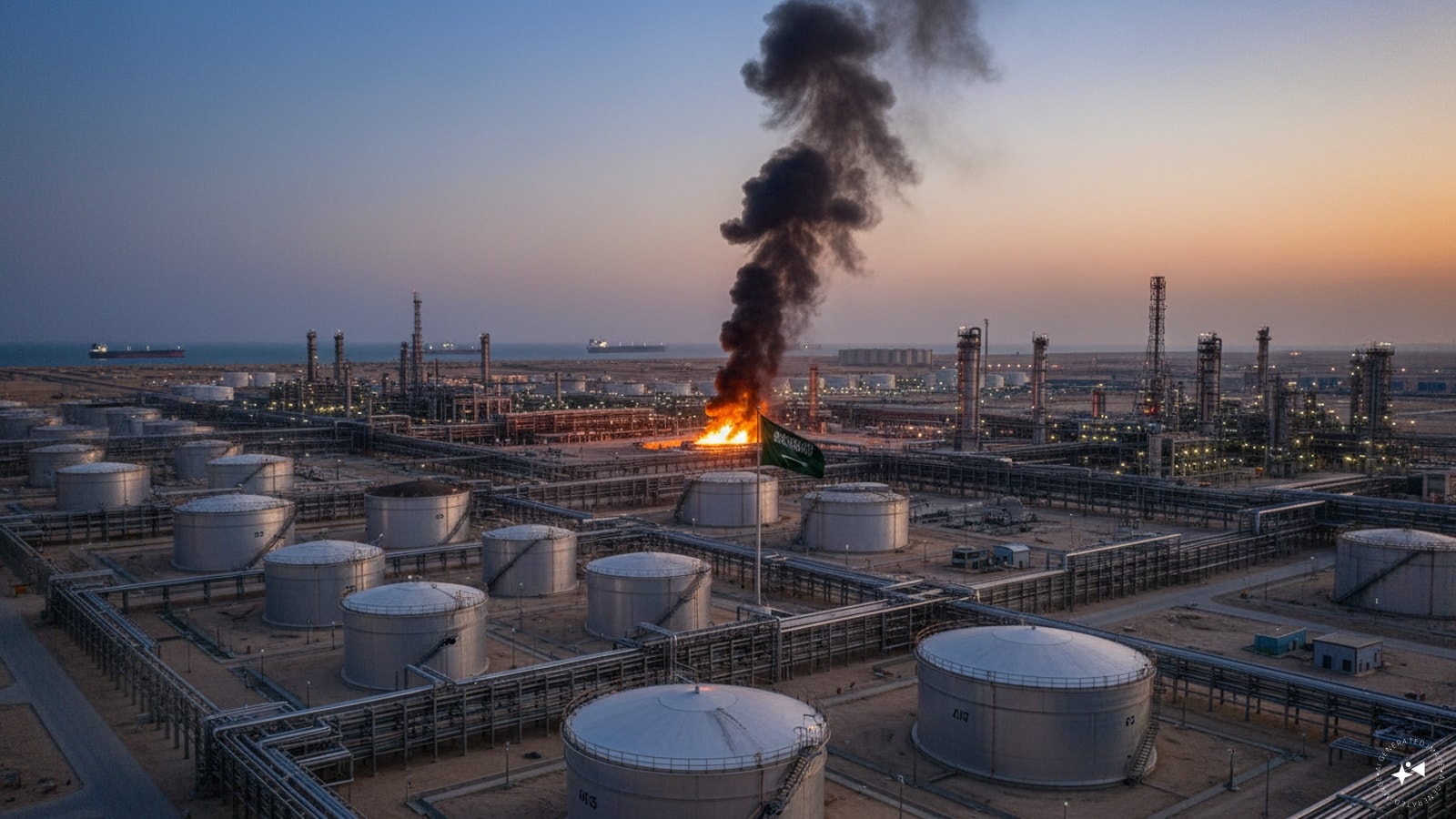
Out here, the desert morning usually arrives with a deceptive softness, painting the dunes in pale shades of amber and rose before the sun turns into a white-hot hammer. But on that morning, the light came from the wrong direction. It came from the horizon, jagged and orange, blooming into a towering column of black smoke that choked out the dawn within minutes.
Seventy-three. That was the number that would eventually cross the tickers on the terminal screens in London, New York, and Tokyo. Seventy-three people wounded. Lives torn open by shrapnel, lungs filled with the acrid grease of burning hydrocarbons, families plunged into sudden, terrifying uncertainty thousands of miles away.
Behind the dry reporting of Houthi strikes on Saudi energy facilities lies a simpler, heavier truth: the machinery of the modern world is terrifyingly fragile.
The Distance Between a Valve and a Living Room
To the average consumer thousands of miles away, petroleum is a concept. It is a green number on a digital dashboard at a corner gas station. It is a plastic wrapper, a synthetic fiber, an abstraction traded by men in expensive suits who have never smelled sulfur or felt the ground shudder beneath a heavy compressor station.
We forget that energy has a pulse.
Consider what happens when a drone, small, cheap, and guided by commercial coordinates, crosses a perimeter fence. (Note: I am using this scenario to illustrate the precise mechanics of modern asymmetrical warfare based on verified attack patterns). It is not an armada of dreadnoughts. It is a localized, surgical violation of a sprawling industrial giant.
When the metal skin of a processing unit splits, the consequences cascade outward in milliseconds. Pressure drops. Emergency flare stacks roar to life, turning night into day as millions of cubic feet of gas are burned off to prevent catastrophic explosions. Valves snap shut automatically, locking down sections of a pipeline that stretches hundreds of miles across the sand.
And in that sudden silence, the math of global commerce shifts.
The Anatomy of Vulnerability
For decades, the global economy has been built on an unspoken assumption of uninterrupted flow. We designed our supply chains like high-speed highways, optimized for maximum efficiency with zero shoulder room for error. Every refinery, every pumping station, every terminal is a node in a vast, invisible nervous system.
When a facility like Abqaiq or a regional storage depot takes a direct hit, the shockwave travels instantly through the financial markets. Traders do not panic over the loss of a few barrels; they panic because the attack exposes the illusion of invulnerability.
I remember standing near a control room years ago, listening to a senior engineer trace his finger across a blueprint of a sprawling separation plant. He tapped a small, unremarkable square on the paper.
"This is a stabilization column," he told me, his voice barely audible over the hum of the turbines. "If this goes down, the crude coming out of the ground is too volatile to ship. It has to sit, it has to breathe, it has to be treated. You cannot just reroute it down a side street."
That is the reality behind the headlines. Energy infrastructure is not infinitely flexible. It is a collection of specific, irreplaceable choke points built in remote, hostile environments where defense is an engineering nightmare.
The Cost Recorded in Flesh and Steel
Statistics sanitize violence. We hear seventy-three wounded and our brains file it away as a data point in a geopolitical conflict. But behind that number are shift workers, technicians, safety inspectors, and drivers who kissed their children goodbye in compounds across the region, expecting a normal Tuesday.
They are the ones who bear the physical toll of a war fought with remote-controlled weapons over abstract ideological borders.
When the sirens fade and the fires are finally beaten back by foam and chemical retardants, the work of rebuilding begins in the dark. Crews move in with heavy equipment to clear twisted steel and shattered glass. Engineers check welds by ultrasound, looking for micro-fractures caused by the concussive force of the blasts.
It is meticulous, dangerous, and utterly essential labor.
The markets will recover their equilibrium within days or weeks. Futures will stabilize. Tankers will adjust their headings, looping around capes or waiting patiently in holding patterns offshore. The digital tickers will move on to the next crisis, the next election, the next corporate earnings report.
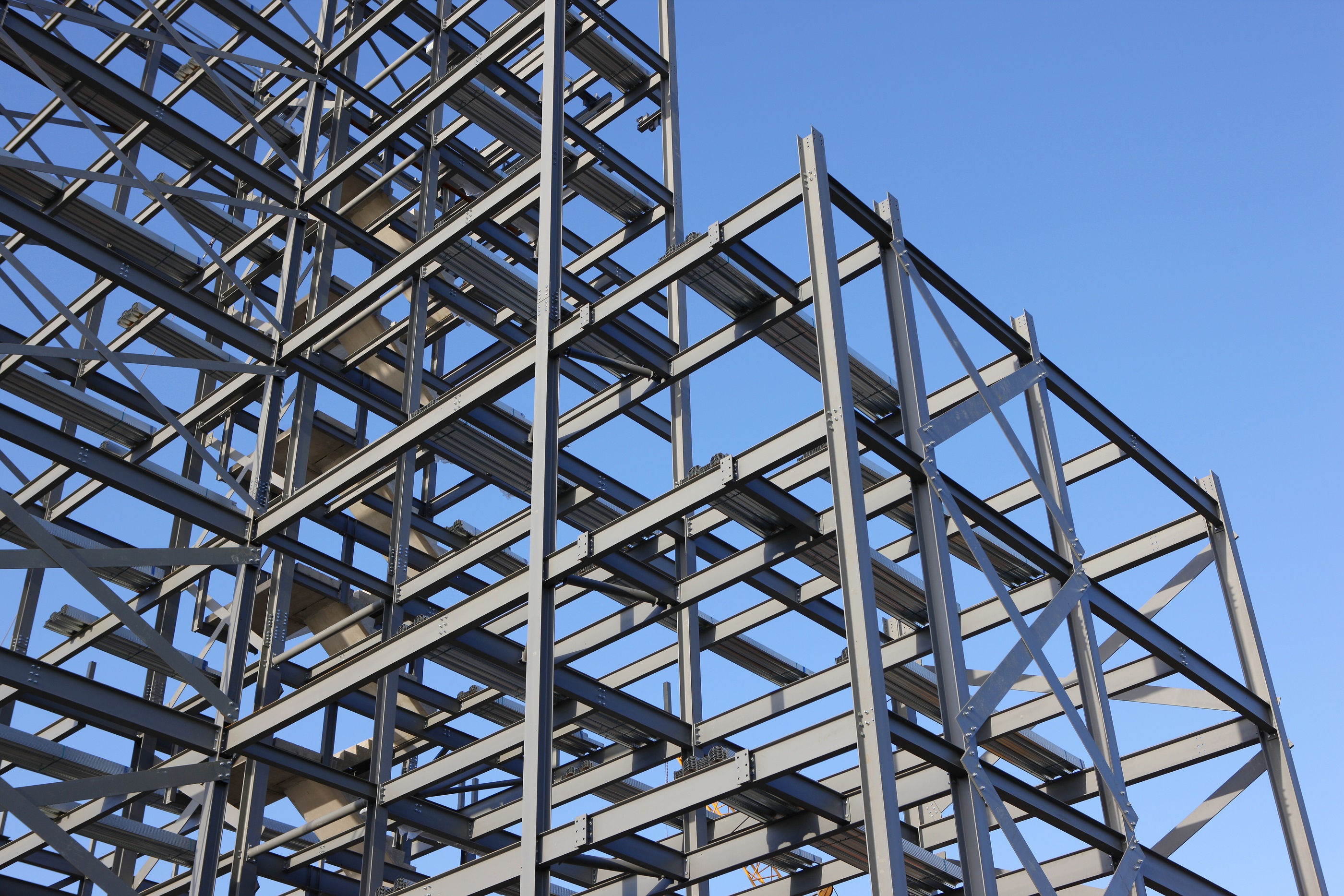
The smoke will clear from the horizon, leaving behind only a blackened stain on the steel framework of a fractionator tower.
Yet the underlying tension remains. As long as the global economy relies on centralized nodes of extraction and refinement exposed to the shifting winds of regional conflict, the quiet hum of our daily lives rests on a very thin wire. Every time that wire is tested, the world holds its breath, waiting to see if the lights stay on.

.jpg)