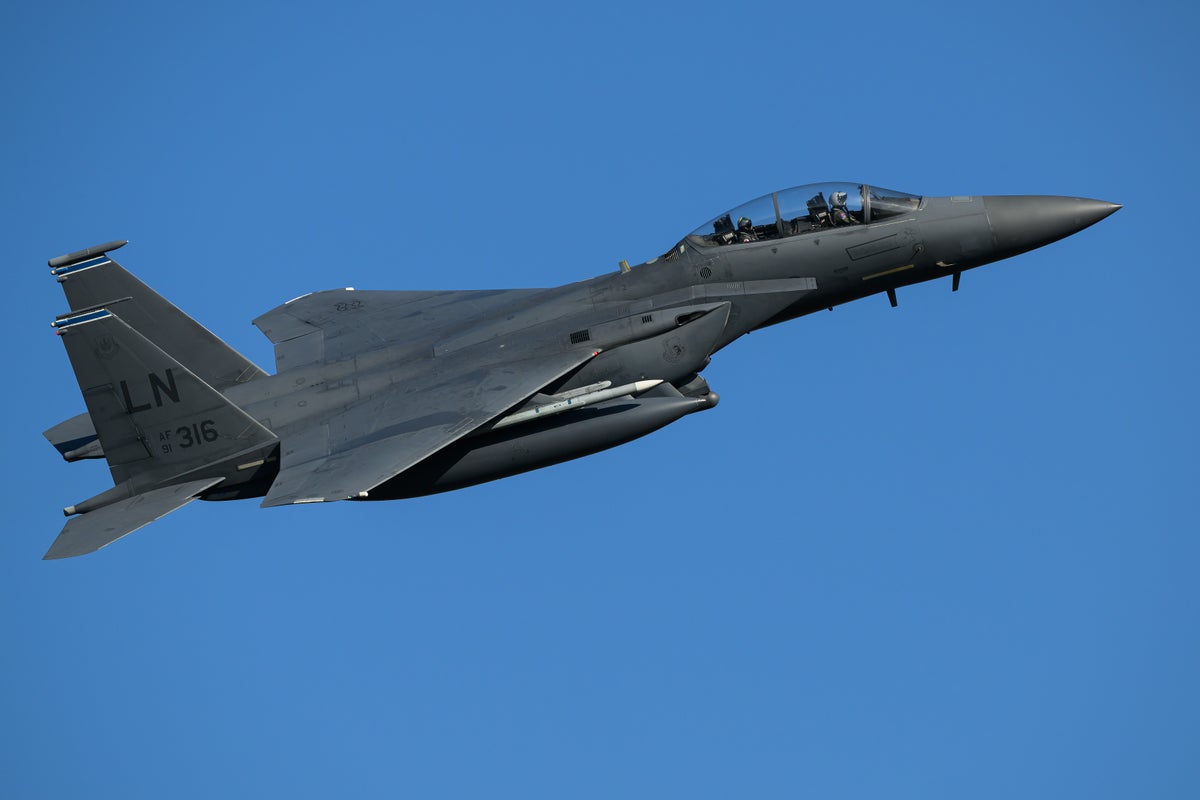
The cockpit of an F/A-18 Super Hornet at thirty thousand feet is supposed to be the most predictable place on earth. You are encased in millions of dollars of aerospace engineering. The canopy isolates you from the freezing, thin air of the upper atmosphere. Below you, the world is a dark, silent expanse. Behind you, the steady hum of twin General Electric turbofan engines provides a comforting, rhythmic vibration through your spine. You trust the glass screens. You trust the radar. Most of all, you trust your eyes.
But when the instruments go quiet and your eyes show you something that defies every hour of your training, the cockpit suddenly feels incredibly small.
It was supposed to be a routine mission over the Persian Gulf. The pilot—let’s call him Miller, a veteran aviator with hundreds of carrier landings under his belt—knew the airspace like the back of his hand. He knew the radar signatures of commercial airliners, the slow blips of maritime patrol aircraft, and the sharp, aggressive vectors of friendly fighter jets.
Then came the shapes.
They did not appear on the radar with the crisp, clean definition of a standard track. Instead, they lingered at the edge of perception, a cluster of signatures that seemed to warp and drift. When Miller tilted his helmet and looked out into the ink-black night, he didn't see the flashing strobe lights of a standard aircraft. He saw a glowing, shifting mass.
It moved with an unsettling, organic fluidity. Dozens of small, illuminated nodes drifted in unison, pulsing slightly against the backdrop of the stars. They weren't flying in a rigid military V-formation or a standard stepped-up line. They danced. They clustered. They separated and drew back together like a bioluminescent creature drifting through the deep ocean.
"Real alien shit," Miller would later mutter to his debriefing officers, trying to find words for a phenomenon that his brain, trained strictly in the physics of aviation, struggled to categorize. It looked like a jellyfish. A massive, airborne invertebrate floating silently through the airspace, completely indifferent to the multi-million-dollar fighter jet intercepting it.
What Miller was looking at wasn't a visitor from another galaxy. It was something far more terrifying because it was entirely human. He was witnessing the dawn of asymmetric autonomous warfare: an Iranian drone swarm, operating with collective intelligence, testing the boundaries of Western air defense.
To understand why this matters, we have to look past the sensational headlines of unidentified anomalous phenomena. The true threat of the "jellyfish" formation doesn't lie in the supernatural. It lies in the math.
For decades, air superiority was a game of quality over quantity. The nation with the stealthiest radar-evading skin, the fastest thrust-vectoring engines, and the most advanced targeting computers won. A single American fifth-generation fighter could dominate an entire airspace because it could see the enemy and fire long before the enemy even knew it was there.
Drone swarms change the equation entirely. They turn air defense into a problem of economic exhaustion.
Consider a hypothetical engagement. A sophisticated air defense destroyer sits in the waters below. It is equipped with the finest radar systems on earth and loaded with interceptor missiles that cost upwards of two million dollars each. Suddenly, a swarm of fifty low-cost, one-way attack drones appears on the horizon. These drones are built from commercial-grade carbon fiber, powered by simple lawnmower engines, and guided by basic GPS coordinates. Total cost per drone: perhaps twenty thousand dollars.
The destroyer faces a mathematical nightmare. If it fires its high-end missiles to eliminate the swarm, it exhausts its entire magazine within minutes, spending a hundred million dollars to destroy a million dollars' worth of plastic and cheap electronics. If it holds its fire to save its ammunition for "real" threats, the swarm overwhelms the ship, blinding its sensors and striking its superstructure through sheer volume.
But the real breakthrough isn't just the cheapness of the hardware. It is the software that allows them to move like an organism.
In traditional drone operations, one pilot sits in a trailer somewhere, manipulating a joystick to control one aircraft. If you want a hundred drones in the air, you need a hundred pilots, a massive communication network, and immense bandwidth.
A swarm operates on an entirely different architecture known as emergent behavior. Think of a flock of starlings turning on a dime over a field at dusk. There is no leader bird shouting commands. Instead, each individual bird follows a few simple, localized rules: stay a certain distance from your neighbor, match their speed, and move toward the center of the group. From those basic instructions, incredibly complex, beautiful, and terrifying patterns emerge.
When Miller looked out of his canopy and saw that jellyfish in the sky, he was looking at algorithmic flocking. The drones were communicating with each other via short-range mesh networks. They were distributed brains. If Miller had shot down the lead drone, the swarm wouldn't have scattered or crashed. The remaining drones would have simply recalibrated, filled the gap, and continued their journey. The entity lives on, even if its parts die.
This shifting architecture is what makes the phenomenon look so unnatural to the human eye. We are used to machines that move on straight axes—metal tubes that require wide, sweeping banks to turn. We are not used to a cloud of machines that can contract, expand, and drift sideways with the eerie synchronization of a deep-sea predator.
The psychological impact on the personnel fighting this new kind of war is profound. For generations, military aviators were the predators of the sky. They relied on their speed and technological dominance to control the narrative of an engagement. Now, they find themselves intercepting threats that cannot be intimidated, cannot be outmaneuvered in a traditional dogfight, and don't care if they die.
The pilot who encounters a swarm realizes that his cannon shells and heat-seeking missiles are suddenly obsolete tools. Trying to shoot down a drone swarm with an advanced fighter jet is like trying to clear a swarm of locusts with a sniper rifle. You might hit a few, but the swarm keeps moving forward, relentless and unbothered.
Military laboratories across the globe are scrambling to find an answer to the jellyfish in the sky. The solutions being tested look less like traditional weaponry and more like science fiction. Directed-energy weapons—high-powered lasers and high-power microwave systems—are being bolted to the decks of ships and the roofs of combat vehicles. These systems don't use physical ammunition; they shoot invisible beams of energy that cook the delicate circuitry inside the drones, causing them to rain down into the sea like dead insects.
But until those systems are perfected and deployed in massive numbers, the sky remains a place of profound uncertainty.
The era of clean, predictable aerial warfare is over. The sky belongs to the algorithmic collectives, to the cheap, the mass-produced, and the weird. Aviators like Miller will continue to fly their patrols through the darkness of the Persian Gulf, staring out into the blackness, knowing that at any moment, the stars themselves might start to detach, cluster together, and pulse with a cold, mechanical life.